
September 28, 2026
Skip to Main Content

- United Kingdom
- expand_more
Vegetables United Kingdom & Ireland
-
Products
View our products
-
Retail

Fresh In-Store Vision
Learn how deep consumer and shopper insights reveal opportunities to unlock growth in the fresh fruits and vegetables category. Could a partnership drive meaningful growth for your retail operation?
-
Knowledge centre

Taking action against ToBRFV
Learn more and get the latest news and information on ToBRFV from Vegetables by Bayer. -
About

At De Ruiter, we believe that by combining our customers passion with our expertise and unique technology we can grow a true piece of art together... Discover the beauty of De Ruiter tomatoes with us!
-
Innovation

Seed Quality Knowledge Center
High-quality seeds mean high performance for youStriving for excellence and high quality is central to our people and processes. Quality is in our DNA. It’s in our core. This means when you plant our seeds, you can start the season with the confidence of high quality and high performance.
Controlled inoculation trials at Bayer’s Wageningen research facility compare Grandice RES directly with susceptible tomato varieties, providing growers with a transparent view of its resistance performance.
Tomato brown rugose fruit virus, better known as ToBRFV, continues to challenge tomato growers around the world. First identified in 2014, it has since spread to glasshouse-growing regions across Europe, North America and the Middle East. Because the virus can spread mechanically through hands, tools, clothing and crop contact, hygiene remains an essential part of crop protection.
However, hygiene alone cannot eliminate every risk. Genetic resistance can provide growers with an additional layer of protection, alongside monitoring, hygiene protocols and sound crop management.
The practical question for growers is therefore straightforward: how does a resistant variety perform compared with a non-resistant variety when both are exposed to the same virus pressure?
Vegetables by Bayer’s controlled trials in Wageningen, the Netherlands, are designed to help answer that question for Grandice RES.
Testing resistance under controlled conditions
Resistance trials are conducted at Bayer’s Wageningen research facility under the supervision of Jan Barten, Strategic Project Lead at Bayer Crop Science.
The trials take place in an isolated environment where plants can be inoculated under controlled conditions. Adult plants are grown under conditions designed to be representative of high-tech commercial glasshouse production.
Since 2023, seven trials have been completed, with trials conducted during spring and autumn growing cycles. Each trial includes three replications and ten plants per variety.
At planting, the plants are vaccinated with PepMV, followed by ToBRFV inoculation one week later. Three weeks after the ToBRFV inoculation, quick-strip tests are used to confirm infection with PepMV and ToBRFV in susceptible control varieties.
Symptom evaluations begin 50 days after the ToBRFV inoculation. Leaf symptoms and, later in the crop cycle, fruit symptoms are assessed for each plant using a standardized scale:
- 1 indicates no visible symptoms
- 9 indicates heavy symptoms
The evaluations are repeated throughout the crop cycle to monitor how symptoms develop over time.
Final scores across all trials are reflected in a color scale for ease of interpretation:
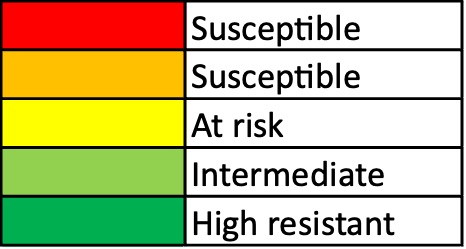 Table 1
Table 1: Consolidated evaluations of leaf and fruit symptoms across trials under controlled inoculation conditions. (N trial: number of trials, N Leaf all: number of individual leaf observations, N Fruit all: number of individual fruit observations, ToBRFV leaf: consolidated leaf symptom severity, ToBRFV Fruit: consolidated fruit symptom severity).
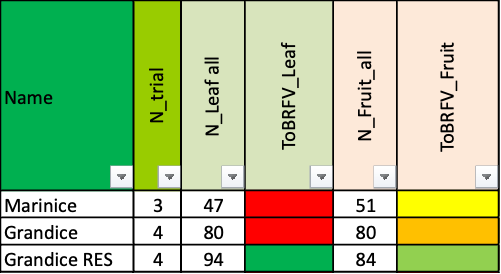 Table 2
Multi-year and multi-season data based on 4 trials and more than 80 individual observations show a significantly better behavior against leaf and fruit symptom severity for Grandice RES compared with a non-resistant comparison variety under controlled inoculation conditions.
Grandice RES compared directly with a susceptible variety
The eighth Wageningen trial includes a particularly relevant side-by-side comparison.
Grandice RES, which carries ToBRFV resistance, was grown alongside a susceptible control variety. The susceptible control was selected to provide a closely comparable genetic background, helping to focus the evaluation on differences in ToBRFV resistance rather than broader varietal characteristics. This helps to focus the comparison on the difference in ToBRFV resistance rather than on broader genetic differences between the varieties.
Both varieties were:
· inoculated with PepMV and ToBRFV;
· grown under the same environmental conditions;
· managed according to the same trial protocol; and
· placed in direct physical contact.
This created a controlled, like-for-like comparison with a high opportunity for mechanical virus transmission.
What did the quick-strip tests show?
Quick-strip lateral-flow assays were used to support the visual observations.
Each strip contains a control line that confirms whether the test has functioned correctly. A visible line at the virus-detection position indicates that the target virus was detected. If no line appears at that position, the target virus was not detected.
In the side-by-side comparison:
- ToBRFV could not be detected in Grandice RES plant. The quick strip assay showed no pink line at the virus-detection position.
- ToBRFV was clearly detected in the susceptible control variety. The virus-detection line was strongly visible.
- PepMV was detected in both Grandice RES and susceptible control variety, confirming that the PepMV inoculation (vaccination) was successful in both plants and that the resistance mechanism in Grandice RES is specific to ToBRFV.
This last point is particularly significant. The detection of PepMV in both varieties demonstrates that the plants were exposed to the same inoculation conditions and that the assay was functioning correctly across both virus targets. The absence of ToBRFV in Grandice RES is therefore a genuine reflection of the variety’s resistance performance, not an artefact of testing methodology.
These quick-strip observations support the broader results from the controlled trials, in which Grandice RES showed fewer ToBRFV symptoms than comparable susceptible varieties.
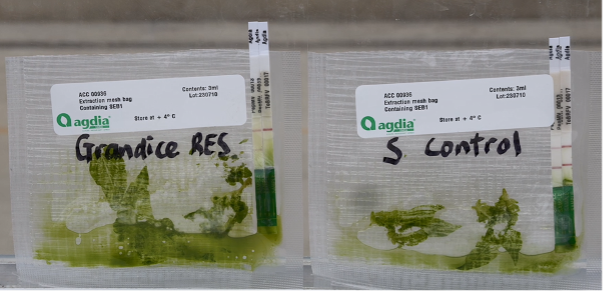 Figure 1
Figure 1. Quick-strip lateral-flow assay from the side-by-side trial. Left: Grandice RES — no ToBRFV detected (no pink line at the virus-detection position). Right: Susceptible control variety — ToBRFV clearly present (the virus-detection line was strongly visible). PepMV was detected in both varieties, confirming successful inoculation. Source: Bayer Crop Science, Wageningen research facility.
What does this mean for growers?
Grandice RES provides a demonstrable, measurable resistance advantage against ToBRFV under controlled conditions.
The side-by-side comparison makes this difference particularly visible. Grandice RES and the susceptible control received the same inoculation treatment and were grown under identical environmental conditions. Nevertheless, the two varieties showed different responses to ToBRFV.
This does not mean that resistance should be viewed as a stand-alone solution. Resistance performance may be influenced by factors including virus pressure, environmental conditions and crop management practices.
Grandice RES should therefore be considered as one component of an integrated crop management approach that also includes:
- strict hygiene;
- regular monitoring;
- appropriate crop management; and
- careful management of movements, materials and equipment within the glasshouse.
Genetic resistance adds an important layer of protection, but it does not replace these measures.
Looking beyond the resistance claim
When comparing varieties, growers need more than a resistance label. The quality of the supporting evidence is equally important.
Useful questions to ask include:
- Was the variety tested under controlled and repeatable conditions?
- Was an appropriate susceptible comparison included?
- Were the varieties exposed to the same inoculation and growing conditions?
- Were leaf and fruit symptoms assessed consistently over time?
- Were the visual observations supported by a recognized diagnostic method?
The Wageningen trials were designed around these principles. The combination of controlled inoculation, repeated symptom evaluations, susceptible comparisons and quick-strip testing gives growers a transparent basis for reviewing the resistance performance of Grandice RES.
Building confidence through transparent trial data
Vegetables by Bayer aims to support variety performance claims with clearly defined trial methodologies and controlled comparisons.
Growers, advisers and trade partners can contact Vegetables by Bayer’s breeding and development teams for more information about Grandice RES, the Wageningen trials or other varieties within the tomato portfolio.
Confidence in a variety should be based not only on the resistance designation, but also on the evidence showing how that resistance performs when challenged under controlled conditions.