
August 9, 2015
Skip to Main Content

- United Kingdom
- expand_more
Vegetables United Kingdom & Ireland
-
Products
View our products
-
Retail

Fresh In-Store Vision
Learn how deep consumer and shopper insights reveal opportunities to unlock growth in the fresh fruits and vegetables category. Could a partnership drive meaningful growth for your retail operation?
-
Knowledge centre

Taking action against ToBRFV
Learn more and get the latest news and information on ToBRFV from Vegetables by Bayer. -
About

At De Ruiter, we believe that by combining our customers passion with our expertise and unique technology we can grow a true piece of art together... Discover the beauty of De Ruiter tomatoes with us!
-
Innovation

Seed Quality Knowledge Center
High-quality seeds mean high performance for youStriving for excellence and high quality is central to our people and processes. Quality is in our DNA. It’s in our core. This means when you plant our seeds, you can start the season with the confidence of high quality and high performance.
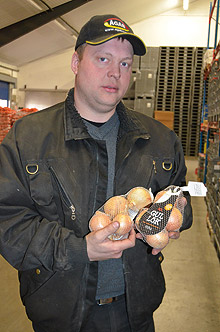
Martin Carlsson-Levin is field manager for Almhaga, a vegetable growing company in the South of Sweden. Almhaga has grown rapidly over the last 15 years: the company went from 10 hectare in 1998 to 250 hectare in 2013. Today Martin is growing the successful Seminis variety Barito on 45 hectares.
Martin: ‘I was not working for Almhaga when we decided to grow Barito in 1998, but the reasons for doing so are still evident: Barito is the earliest onion in the market. We grow other varieties as well, but Barito is always first. We sow at the end of March or the beginning of April and we harvest in August or September.’
Uniformity
Martin is very pleased with the uniformity of Barito: ‘Barito has a nice, thin neck, that goes down quickly. Within three to four days, the entire foliage will have fallen over and we can start harvesting.
This is a great benefit of this variety. We do not grow Barito for storage, so we are happy with the speed at which we can go to market. It takes Barito five days to dry in the field and then a few days in the dry room. We will then pack and sell the onions.
In the middle of November, Barito has left our company.’
Less clay
Martin prefers to grow Barito on “early soil” as he calls it: soil with less clay. ‘An early variety such as Barito needs more water and is less suitable for heavy rains and wet seasons. So soil with a limited amount of clay is the best for Barito. We irrigate Barito each year, which is quite easy on our land.
In our area it is easy to drill for water.’
Pretty in yellow
Appearances count, even for onions. Martin: ‘Barito looks really nice; it is a beautiful onion. And I am particularly fond of the nice thin neck.’
Excellent yield in 2013 As for the yield, Martin is also pleased.
‘For an early onion – two to three
weeks earlier than other yellow varieties – Barito has an acceptable yield. We have harvested approximately 64 ton per hectare. So we did really well this season!’