- United Kingdom
- expand_more

-
Products
View our products
-
Retail

Fresh In-Store Vision
Learn how deep consumer and shopper insights reveal opportunities to unlock growth in the fresh fruits and vegetables category. Could a partnership drive meaningful growth for your retail operation?
-
Knowledge centre

Taking action against ToBRFV
Learn more and get the latest news and information on ToBRFV from Vegetables by Bayer. -
About

At De Ruiter, we believe that by combining our customers passion with our expertise and unique technology we can grow a true piece of art together... Discover the beauty of De Ruiter tomatoes with us!
-
Innovation

Seed Quality Knowledge Center
High-quality seeds mean high performance for youStriving for excellence and high quality is central to our people and processes. Quality is in our DNA. It’s in our core. This means when you plant our seeds, you can start the season with the confidence of high quality and high performance.

Causal Agent
Environmental
Distribution
Worldwide
Symptoms
Catface – Typical symptoms of this disorder are misshapen fruit with scarred areas and lines that often radiate from the blossom-end of the fruit. This disorder is especially important on large-fruited tomatoes and the severity is variety dependent.
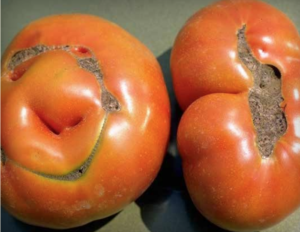 Catface: on ripe red fruit.
Cracking – Two types of cracking occur on the fruit: 1) Radial cracking is a splitting of the epidermis that radiates from the calyx-end to the blossom-end of the fruit. 2) Concentric cracking is a splitting of the epidermis in circular patterns around the calyx-end of the fruit. Cracking usually does not occur until the fruit have reached maturity.
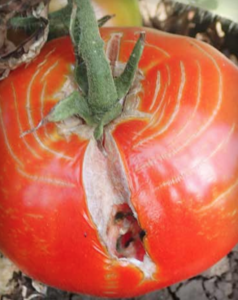 Cracking: radial and concentric cracking.
Conditions for Development
Catface – Abnormally cold weather during flowering is known to enhance this disorder. Also, high soil nitrogen levels and any disturbance to the flower parts during anthesis can increase catfacing.
Cracking – Susceptibility to cracking is related to the strength and stretching ability of the fruit’s epidermis. Periods of slow fruit growth, followed by fast growth resulting from wide differences in day and night temperatures, and a dry period followed by heavy rain or irrigation are conducive to this disorder.
Control
The best way to reduce losses from these disorders is to use tolerant varieties. Proper irrigation and nutritional management. and temperature management in greenhouses can also help reduce losses.