
June 26, 2026
Skip to Main Content

- United States
- expand_more
Vegetables United States
-
Products
Select Your Brand Below to View Full Portfolio of Offerings
-
Resources
Click Below for Specialized Tips for Your Growing Environment
-
About
Discover More About Our Commitment to Advance Health and Nutrition Globally, Together With You.
-
Innovation

Learn about our approach to innovation.
Click here to download a PDF version of this Cultivation Insights article.
» Ventilation and air circulation are used to help create optimal conditions for crop growth in the greenhouse.
» Ventilation helps remove excess heat and humidity and replenish carbon dioxide.
» Continual air circulation helps prevent the formation of pockets of hot or cold air in the house and helps maintain uniform atmospheric conditions throughout the house.
Providing adequate airflow and exchange in the greenhouse helps regulate temperature, humidity, and carbon dioxide levels in the plant canopy. The physical movement of plant foliage caused by air currents in the house also helps promote sturdy plant growth with thicker cell walls.1 Both air circulation and ventilation should be considered when establishing airflow within a greenhouse.
Ventilation is the exchange of air inside the house with outside air, which is used to remove excess heat and humidity and to replenish CO2. Circulation refers to the mixing of air within the house, which promotes uniformity of conditions throughout the house, eliminating hot and cold pockets and minimizing the areas with poor air movement.2 Proper ventilation and circulation to manage temperature helps reduce the effects of heat stress on plant growth and production.
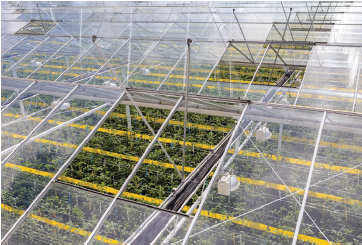 Figure 1. A greenhouse with passive roof ventilation.
VENTILATION
Ventilation during periods of warm weather is used to reduce internal temperatures, to expel excess moisture, to replenish supplies of CO2 used by the plant for photosynthesis, and to remove O2, a waste product of photosynthesis. In the winter, or during periods with cool conditions, ventilation is mostly used to help regulate humidity and replenish CO2 levels.2,3,4 Some production systems inject supplemental CO2, reducing the need to ventilate to replenish CO2 levels.
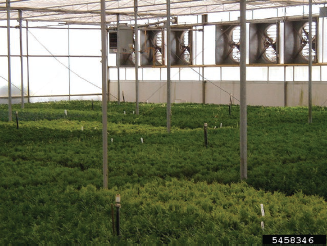 Figure 2. Exhaust fans placed in the endwall of a greenhouse pull warm, moist air out of the greenhouse. Rachel McCarthy, Cornell University, Bugwood.org.
Ventilation can be accomplished with passive systems that make use of wind and the buoyancy of warm air, or through active systems that use fans to move air. Passive systems are made up of vents in the roof and/or sidewalls that allow for air exchange (Figure 1). Passive systems are usually more energy efficient than fan-based systems and can be designed to function without access to electricity for structures such as high tunnels.1,2 Ridge vents that run the length of the greenhouse can be opened as needed to help regulate temperature. Wind passing over the roof creates a vacuum that sucks the air out of the house while cool air enters through sidewall vents or from the bottom of root vents. Wind speeds of two to three miles per hour can provide 80% or more of the ventilation needed.
The contribution of buoyancy (warm air rising) depends on the difference between the temperatures of the inside and outside air. On cool days, the large temperature difference provides more buoyancy to lift air out of the house. Narrower temperature differences on hot days lessens the contribution of buoyancy to ventilation.3,4 In passive systems, the roof vent and side vent areas should each be 15 to 20% of the total floor area. Roof/ ridge vents should open beyond horizontal (approximately 60°) to allow for good airflow. Houses should be oriented so that the prevailing summer wind direction blows over the ridge to create vacuum on the leeward ridge or roof vent. Shade systems may be needed on hot sunny days, but they should be porous to allow hot air escape through the shade material.3,4
Fan based ventilation systems use fans to pull or push air through the house. Exhaust fans pull air through the house and are usually paired with vents on the opposite walls (Figure 2). In contrast, pressure fans push air into the house and are usually placed in the end walls covered by baffles to direct airflow away from the plants. Push fans are usually covered by a hood on the outside to help prevent rain from being blown into the house.3
It is recommended to use a fan size that provides enough airflow for one house volume of air exchange per minute (45 to 60 exchanges per hour) during warm to hot conditions. Using a height of eight feet to calculate volume, a 25-foot by 96-foot greenhouse requires a total fan capacity of 19,200 cubic feet per minute (96’x25’x8’ = 19,200 ft3). In southern regions of the US, recommendations state that volume should be calculated using a height of ten feet rather than eight feet.
During cooler periods, the air exchange rate can be reduced to one quarter the volume of the house per minute. A fan and tube system can be used to mix cold outside air with warm inside air before it reaches the plants to prevent cold injury. The holes in the tubes are oriented to discharge air horizontally. Year-round greenhouses will need two-stage or variable speed fans to accommodate the different exchange rates for each season.1,3,4
The desirable flow rate depends, in part, on production system. Canopy density and height can impact airflow, with tomato and cucumber vines slowing air movement more than a pepper canopy. The difference between single and multiple level systems and the condition of the air being moved also impact airflow. It is best if the fan draw-length (length of the house) is less than 150 feet to allow for adequate airflow. It is recommended that fans (houses) be oriented with the prevailing summer wind direction, as it is more efficient to exhaust air in the direction of the wind.4
AIR CIRCULATION
Air movement within the house can occur through horizontal airflow (HAF), which circulates air through the house, or vertical airflow (VAF), which helps prevent stratification of the air mass by mixing air at different hights.1 Air speeds at plant level should be between 20 and 200 feet per minute (0.35 and 1.0 m/s) to promote transpiration that helps prevent tip burn and blossom end rot. Air speeds near the upper end of the range can be used to promote sturdy plant growth during the early vegetative stages, while speeds in the middle part of the range are often best for the flowering and fruit development stages to promote transpiration rates needed to provide adequate nutrient delivery to developing fruit.1 A well designed system can keep the air in the house moving at 50 to 100 feet per minute using a relatively small amount of energy. Moving air helps dry the plant canopy, making conditions less favorable for foliar diseases. It also helps minimize the formation of a low CO2 boundary layer of air next to the leaf surface, improving the efficiency of photosynthesis.5
For adequate horizontal airflow, fans should be set up in a “racetrack” configuration to move air in a circular pattern along the walls of the house (Figure 3). The first fan should be placed 10 to 15 ft from one end wall, and additional fans placed 40 to 50 feet apart down the length of one side of the house and back up the other to maintain desired air movement.5 Place the fans in the center of the airmass on each side, between the center
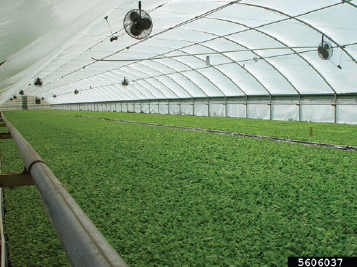 Figure 3. Circulation fans positioned to move air in opposite directions on each side of the house in a “race-track” pattern. Gerald Holmes, Strawberry Center, Cal Poly San Luis Obispo, Bugwood.org.
of the house and the wall. Vertically, place the fans just above the plant canopy so that the air mass moves through and above the canopy rather than under the benches. Vertical flow systems can be used to pull air up through the canopy to create uniform temperatures and humidity in the canopy, especially for crops with tall canopies (cucumbers, tomatoes).6
To achieve adequate circulation, provide enough airflow to turn over 15 to 30% of the volume of air in the house per minute. The total fan capacity of a circulation system should be about twice the floor area of the house. A house that is 30 by 100 feet requires a fan capacity of 6000 cfm (30 x 100 x 2). Somewhat more capacity will be needed with tall crops, such as tomatoes and cucumbers. This can be achieved by closer spacing of fans, which will require a larger number of fans. Lower horsepower fans are needed for circulation than for venting because their job is to keep the air mass constantly moving. Circulation fans should be on 24 hours a day, except during periods of ventilation.1,2,5 Fans should be cleaned and maintained regularly, as dust and cobwebs on fan blades, cages, and casings can reduce efficiency. Fan placement should be checked several times per season, as fans can occasionally be knocked out of place or alignment.5
SOURCES
1Sabeh, N. 2024. Five things to know about airflow. Dr Green House. https://www.doctorgreenhouse.com/blog/five-things-to-know-about-airflow
2Callahan, C. 2019. Ventilation in greenhouses and high tunnels. University of Vermont Extension Ag Engineering. http://go.uvm.edu/tunnelventilation
3Ferrarezi, R. and Worley, J. 2025. Greenhouses: Heating, ventilation, and cooling. University of Georgia Extension. Bulletin 792. https://fieldreport.caes.uga.edu/publications/B792/greenhouses-heating-ventilation-andcooling/
4Bartok, J. Jr. 2005. Ventilation for greenhouses. UMass Extension Greenhouse Crops and Floriculture Program. https://www.umass.edu/agriculture-food-environment/greenhouse-floriculture/fact-sheets/ventilation-for-greenhouses
5Bartok, J. Jr. and Grubinger, V. 2019. Horizontal air flow is best for greenhouse air circulation. Farm-Energy. https://farm-energy.extension.org/horizontal-air-flow-is-best-forgreenhouse-air-circulation/
6Greenhouse ventilation and air circulation methods. Vostermans Ventilation. https://www.vostermans.com/ventilation/blog/the-different-greenhouse-ventilation-andcirculation-systems
Websites verified 6/18/2026
ADDITIONAL INFORMATION
For additional agronomic information, please contact your local seed representative. Performance may vary, from location to location and from year to year, as local growing, soil and weather conditions may vary. Growers should evaluate data from multiple locations and years whenever possible and should consider the impacts of these conditions on their growing environment. The recommendations in this article are based upon information obtained from the cited sources and should be used as a quick reference for information about greenhouse cucumber production. The content of this article should not be substituted for the professional opinion of a producer, grower, agronomist, pathologist and similar professional dealing with this specific crop.
BAYER GROUP DOES NOT WARRANT THE ACCURACY OF ANY INFORMATION OR TECHNICAL ADVICE PROVIDED HEREIN AND DISCLAIMS ALL LIABILITY FOR ANY CLAIM INVOLVING SUCH INFORMATION OR ADVICE.
5010_882246 Published 06/18/2026