
November 17, 2026
Skip to Main Content

- United States
- expand_more
Vegetables United States
-
Products
Select Your Brand Below to View Full Portfolio of Offerings
-
Resources
Click Below for Specialized Tips for Your Growing Environment
-
About
Discover More About Our Commitment to Advance Health and Nutrition Globally, Together With You.
-
Innovation

Learn about our approach to innovation.
Click here to download a PDF version of this Cultivation Insights article.
» Internal tissues of pepper fruit can rot with few or no external symptoms.
» Species of Alternaria, Botrytis, Colletotrichum, Fusarium, and other pathogens can cause internal rotting of peppers.
» Fusarium lactis is an important cause of internal fruit rot in greenhouse pepper production systems.
ROTTING OF PEPPER FRUIT
Internal and external fruit rot has been an issue in pepper production for many years and can be caused by several plant pathogens. Internal rotting is more common in fruit ripening to its mature color than it is in green fruit. Rotting reduces market quality, potentially leading to rejection of lots by distributors and retail markets.1 Some rots only become apparent when the fruit is cut open and internal symptoms are revealed. Internal rots often involve infection of the seed, placenta, and internal walls of the fruit, initially with no visible external symptoms (Figure 1). External rot symptoms may develop as the condition progresses.1,2
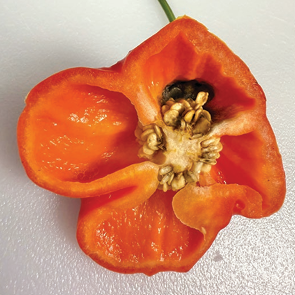 Figure 1. Internal fruit rot of pepper caused by Alternaria alternata. Cody Molnar, South Dakota State University.
CAUSAL AGENTS OF PEPPER FRUIT ROT
Several pathogens have been identified as causing internal fruit rot of peppers. Up through the early 2000s, the fungal pathogens Alternaria alternata and Botrytis cinerea were considered the most common and economically damaging causes of internal fruit rot, especially in open-field production, with other pathogens—such as species of Fusarium, Colletotrichum, and soft rot bacteria—occasionally involved.1,3,4
Fruit rot caused by Alternaria alternata usually begins with infection of the flower or young fruit, often at the stigma (female flower part) but sometimes through the gap between the calyx and fruit wall. The pathogen is widely distributed and commonly grows on plant debris. Warm, moist conditions favor its growth, and wind and splashing water can spread fungal spores. After infection, the Alternaria pathogen remains latent in fruit tissue until the fruit begins to ripen (Figure 1).1
The fungus Botrytis cinerea also grows on decaying plant debris. The pathogen produces spores that are dispersed on air currents and infect peppers through the flowers. This fungus also causes gray mold on a wide range of plant hosts.1
Several Fusarium species can cause fruit rot of peppers, including Fusarium solani and Fusarium oxysporum. Fusarium solani usually infects fruit through external wounds or damaged skin on developing fruit. The spores are spread by wind, splashing water, and insects. Seed transmission is possible for some species (Figure 2).1
An epidemic of internal fruit rot occurred in a greenhouse operation growing peppers in British Columbia, Canada in 2001, with 40% of fruit affected. The following year, the same operation experienced the disease again, with 10% of fruit affected. The pathogen was initially identified as Fusarium subglutinans. Since those initial observations, the disease has become an increasingly important problem for protected culture peppers with annual yield losses of 5% and seasonal peak losses of up to 50%.5,6,7
FUSARIUM LACTIS AND INTERNAL ROT OF GREENHOUSE PEPPERS
The fungal pathogen initially identified as F. subglutinans on greenhouse peppers in British Columbia has since been reclassified as F. lactis.7,8,9 A study published in 2012 identified isolates of Fusarium pathogens collected from symptomatic pepper fruit grown in Belgium, Canada, the Netherlands, and the United Kingdom. Of the ninety-eight isolates evaluated, thirteen were identified as F. oxysporum, nine as F. proliferatum, two as F. solani, and seventy-four as F. lactis, indicating that this species is the primary pathogen causing internal rot of greenhouse-grown peppers in these locations.5
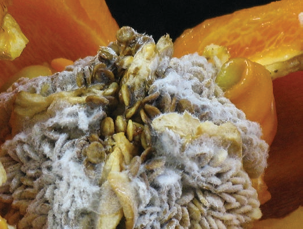 Figure 2. Fusarium lactis mycelium growing on the internal tissues of a pepper fruit. Yalong Yang & S.E. Strelkov, University of Alberta.
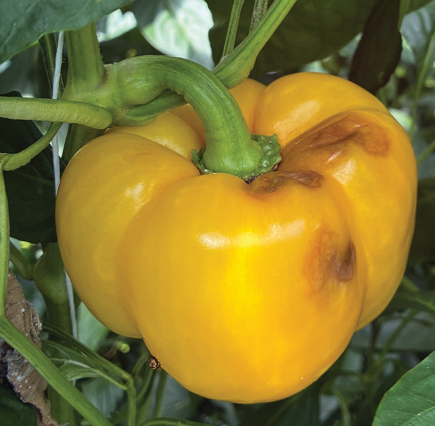 Figure 3. External, soft, sunken, brown lesions can eventually appear on pepper fruit with internal rot.
Infection by F. lactis usually takes place when spores of the fungus are deposited—by air currents, splashing water, or insects—on the stigmas of pepper flowers. The fungal spores can germinate in four to seven hours, and the fungus grows down through the style to colonize the ovary tissues. Infection of the ovary then remains latent (dormant) until the fruit starts to mature.7,11 When the fruit reaches the ripening stage, fungal growth develops on the seeds, placenta, and inner fruit surfaces. Eventually, brown, soft, sunken lesions can form on external tissues, usually near the calyx end, often during post harvest storage and distribution (Figure 3). The initial infection is favored by humid conditions and greenhouse temperatures near 77°F (25°C).7,10
MANAGING PEPPER INTERNAL ROT
Steps can be taken to help prevent infection by Fusarium species and other fruit rot pathogens. Maintaining good sanitation practices in the greenhouse can lower the level of inoculum present, thus lowering rates of infection.1,10 Remove plant debris promptly during the growing cycle and thoroughly clean greenhouse surfaces, tools, trays, and equipment between cycles to eliminate sources of inoculum. Monitor and adjust greenhouse conditions to prevent excessive humidity and wet plant surfaces. Avoid overhead irrigation to minimize periods of plant wetness.
Several studies have evaluated the effectiveness of fungicide applications for controlling pepper fruit rots, and several chemical and biological products have provided some protection against fruit rot in research trials.1,2,10 Fungicide applications starting at first flowering have been shown to help protect flowers from infection, resulting in lower levels of internal fruit rot. Both protectant and curative (systemic) fungicides have been shown to help manage fruit rots, but the most effective fungicides will depend on the pathogen involved.
In a trial evaluating products for helping to manage Fusarium lactis infections, some treatments designed to protect flowers from infection were found to lower disease levels in mature fruit later in the season.2,10 However, the availability of fungicide products registered for use against fruit rot pathogens in a greenhouse system may be limited. Always consult current product labels for application instructions and restrictions.
Research studies have found varietal differences in susceptibility to several of the internal fruit rot pathogens. When feasible, selecting less susceptible varieties may help reduce fruit rot incidence and the resulting yield losses.1
SOURCES
1 Internal rot in capsicum: Causes and control. Applied Horticultural Research. Integrated Crop Protection. https://ahr.com.au/blog/pests-and-diseases/a-new-fact-sheet-on internal-rot-in-capsicum-causes-and-control
2Utkhede, R.S. and Mathur, S. 2005. Biological and chemical control of fruit rot in greenhouse sweet peppers (Capsicum annum L.) caused by Fusarium subglutinans. Journal of Biological Sciences 5(5):610-615. https://www.researchgate.net/profile/Snehlata-Mathur-2/publication/26561363_ Biological_and_Chemical_Control_of_Fruit_Rot_in_Greenhouse_Sweet_ Peppers_Capsicum_annum_L_Caused_by_Fusarium_subglutinans/ links/561ea46808aef097132ccbc9/Biological-and-Chemical-Control-of-Fruit-Rot-in Greenhouse-Sweet-Peppers-Capsicum-annum-L-Caused-by-Fusarium-subglutinans.pdf
3Aponyi, I., Kujani, O., Balog, B., and Varga, A. 1988. The ovary moulding disease of tomato-shaped pepper and control possibilities. Acta Horticulturae 220:401-406. https://doi.org/10.17660/ActaHortic.1988.220.56
4Fletcher, J.T. 1994. Fusarium stem and fruit rot of sweet peppers in the glasshouse. Plant Pathology 43:225-227. https://doi.org/10.1111/j.1365-3059.1994.tb00576.x
5Van Poucke, K., Monbaliu, S., Munaut, F., Heungens, K., De Saeger, S., and Van Hove, F. 2012. Genetic diversity and mycotoxin production of Fusarium lactis species complex isolates from sweet pepper. International Journal of Food Microbiology 153:28–37. https://www.researchgate.net/publication/51813249_Genetic_diversity_and_mycotoxin_ production_of_Fusarium_lactis_species_complex_isolates_from_sweet_pepper
6Utkhede, R.S. and Mathur, S. 2003. Fusarium fruit rot of greenhouse peppers in Canada. Plant Dis. 87:100. https://doi.org/10.1094/PDIS.2003.87.1.100C
7Frans, M., Aerts, R., Van Laethem, S., and Ceusters, J. 2017. Environmental effects on growth and sporulation of Fusarium spp. causing internal fruit rot in bell pepper. Eur J Plant Pathol 149:875–883. https://doi.org/10.1007/s10658-017-1235-4
8Mario, F. 2017. Internal fruit rot (Fusarium spp.) in bell pepper: An integrated approach for a complex disease. Ku Leuven Research Portal. https://research.kuleuven.be/portal/en/project/3E130740
9Yang, J., Kharbanda, P.D., Howard, R.J., and Mirza, M. 2009. Identification and pathogenicity of Fusarium lactis, causal agent of internal fruit rot of greenhouse sweet pepper in Alberta. Canadian Journal of Plant Pathology 31:47–56. https://www.tandfonline.com/doi/abs/10.1080/07060660909507571
10Hofland, J. Addressing fusarium fruit rot in peppers. Hortdaily. https://www.hortidaily.com/article/6027531/addressing-fusarium-fruit-rot-in-peppers/
11Yang, Y., C., T., Yang, J., Howard, R. J., Kharbanda, P.D., and Strelkov, S. E. 2010. Histopathology of internal fruit rot of sweet pepper caused by Fusarium lactis. Canadian Journal of Plant Pathology 32:86–97. https://www.tandfonline.com/doi/full/10.1080/07060660903503681
Websites verified 11/11/2026
ADDITIONAL INFORMATION
For additional agronomic information, please contact your local seed representative.
Performance may vary, from location to location and from year to year, as local growing, soil and environmental conditions may vary. Growers should evaluate data from multiple locations and years whenever possible and should consider the impacts of these conditions on their growing environment. The recommendations in this material are based upon trial observations and feedback received from a limited number of growers and growing environments. These recommendations should be considered as one reference point and should not be substituted for the professional opinion of agronomists, entomologists or other relevant experts evaluating specific conditions.
BAYER GROUP DOES NOT WARRANT THE ACCURACY OF ANY INFORMATION OR TECHNICAL ADVICE PROVIDED HEREIN AND DISCLAIMS ALL LIABILITY FOR ANY CLAIM INVOLVING SUCH INFORMATION OR ADVICE. 6411_1016250
Published 11/11/2026