

January 29, 2026
Skip to Main Content

- United States
- expand_more
Vegetables United States
-
Products
Select Your Brand Below to View Full Portfolio of Offerings
-
Resources
Click Below for Specialized Tips for Your Growing Environment
-
About
Discover More About Our Commitment to Advance Health and Nutrition Globally, Together With You.
-
Innovation

Learn about our approach to innovation.
Click here to download a PDF version of this Cultivation Insights article.
» Banker plant systems can help provide long-term biological control of insect and mite pests of greenhouse vegetable crops.
» Banker plants are used to provide alternate food sources for insect predators and parasitoids.
» Banker plant systems can integrate well with greenhouse/protected culture production systems.
Use of integrated pest management strategies can help control insect and mite pests on greenhouse-grown vegetables. Natural enemies (beneficial organisms) can be used to help manage arthropod pests by parasitizing or preying on target pest species. Habitats can be modified to help attract natural enemies (conservation biological control), or large numbers of natural enemies can be released into a planting (augmentative biocontrol).1,2 Banker plant systems combine these two methods using alternate host plants containing natural enemies and an alternate food source, providing a self-sustaining population of pest predators or parasitoids to help manage arthropod pests.3
Augmentative biocontrol often fits well with protected culture systems because the enclosure helps prevent escape from the cropping system.2,4 However, after natural enemies are introduced into a greenhouse, their populations can decline as their food source dwindles over time. In banker plant systems, the beneficial organism is introduced along with an alternative food source and a plant host on which it can survive and reproduce as the population of the target pest species declines.1,2,3
BANKER PLANT SYSTEMS
Banker plant systems typically include a non-crop host plant that harbors a natural enemy and an alternative food source for that biocontrol agent.3,5 The food source is usually an alternate, non-pest prey or parasite-host species, or pollen that can serve as an alternate food source for some beneficial mite species. The system can also provide shelter, egg-laying sites, and other resources needed by the natural enemy.2,4 Banker plants support populations of beneficial insects after they have knocked down the pest population to the point where it cannot sustain a breeding population of predators. This allows for a quick response to pest outbreaks by helping to eliminate the lag time that can occur when introducing beneficial insects.2
Many banker plant systems have been developed and evaluated for managing insect and mite pests on a range of crops, primarily to help control aphids, spider mites, and thrips.2,5 Some of these systems are commercially available from companies that supply natural enemies. Banker plant species are selected based on their ease of cultivation, maintenance, adaptability to growing in greenhouse environments (high temperatures, day length, light intensity), and susceptibility to diseases. In particular, species that could serve as sources of inoculum for plant viruses should be avoided.5 Banker plants should support the long-term survival and reproduction of both the beneficial and alternate prey/ host species. However, it is sometimes necessary to periodically replace or replenish the banker plants in the production house.
The food source for the beneficial species is usually an alternative prey species for predators, a host species for parasitoids, or a surrogate food source such as pollen. In most cases, the alternate host/prey species are not pests on the crop being grown. Alternative foods should be sufficient to support the longevity and reproduction of the beneficial and alternative prey/host species. The use of non-indigenous host or prey species is usually avoided because of their potential to become invasive pests.5 The pollen from banker plants can also provide a food source to help support hives of bees placed in greenhouses for pollenation.
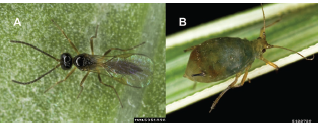 Figure 1. (A) The braconid wasp Aphidius colemani parasitizes aphid species, including (B) the bird cherry-oat aphid, which can be used as an alternate host in a banker plant system. David Capaert, Bugwood.org.
A majority (90%) of banker plant systems were developed for use in greenhouse production. Of those, 88% were developed for vegetable crops and 12% for ornamental production. Systems have been developed to help manage at least 11 pest species using 19 natural enemies. The target pest groups for banker plant systems include aphids (49%), whiteflies (31%), thrips (8%), mites (8%), and leafminers (2%).3,5 Most commercially available systems target aphid species using cereal/aphid systems.
EXAMPLE SYSTEMS
Parasitic Wasps
A common banker plant system uses a cereal plant, such as wheat, barley, or corn, to sustain a colony of bird cherry-oat aphids (Figure 1) as an alternate food source for the parasitoid wasp Aphidius colemani, for the control of green peach and cotton/melon aphids on several crops.1,2 Colonies of bird cherryoat aphids should be started on banker plants just before the beginning of the cropping season. It is recommended that initially two banker plants be placed in each house/bay and that one additional plant be added each week over the course of the season.4
Predatory Mites
Some predatory mites can use pollen from certain plants as alternate food sources. Castor bean, corn, and ornamental peppers have been used as banker plants to support populations of predatory mites.2 Unlike wasps, mites cannot fly, so they disperse from banker plants and move through crop planting more slowly. In these systems, banker plants must be placed in close proximity to crop plants, with their canopies overlapping or touching the crop canopy. Establishing mite banker plant systems often needs to be started weeks or months before the crop plants will be placed in the greenhouse. Corn pollen can be used as an alternate food source for Phytoseiulus persimilis, a biocontrol agent for two-spotted spider mites.1,2
Predatory Bugs
Some predatory bugs can also use pollen as an alternate food source. The pollen of ornamental pepper plants (‘Purple Flash’) and the common mullein plant have been used as food sources for the minute pirate bug (Orius insidiosus), a predator of western flower thrips and two-spotted spider mites. Using banker plants to supply pollen to these predatory bugs has been shown to enhance the survival and reproduction of these biocontrol agents.1,2 Colonies of minute pirate bugs should be started three to four weeks before the beginning of the cropping season. Recommendations call for placing one colonized pepper plant per 500 square feet or one mullein plant per 1,000 square feet of production space.
ASSOCIATED PRACTICE
“The primary factors affecting adoption of biological control are efficacy, predictability, and cost.”3 Banker plant systems can help with the long-term management of arthropod pests and help improve the efficacy and adoption of biocontrol strategies. The use of banker plant systems requires regular scouting to monitor the crop plants, banker plants, and populations of pests, beneficials, and alternate food sources.1,2
The application of insecticides and fungicides may still be necessary when banker plant biocontrol systems are used, particularly for managing non-target pests and diseases. However, such applications can harm the beneficial and alternative food-source organisms if not done properly. The type of pesticide and method of application can be altered to protect the beneficial species. It is best to choose narrow-spectrum pesticides that target specific pests. Banker plants should be removed from greenhouse spaces where pesticides are being applied and returned only after conditions are safe for the beneficial species.2,3
EFFICACY AND PRACTICALITY
Banker plant systems have been shown to be as effective as, or more effective than, other augmentative biocontrol systems. Banker plant systems have the potential to provide “fresher” natural enemies and support the season-long presence of these beneficial organisms, often at a lower cost.3,5 However, there are still questions about the efficacy and feasibility of integrating banker plants into commercial vegetable production systems, and more research is needed.
Efficacy can be low if the biocontrol species is more attracted to the banker plant system than it is to the target pests on the crop, because the dispersal of the beneficial organism through the crop canopy may be diminished.5 It can sometimes be difficult to find an alternate host/prey species that is not also a pest on the commercial crop, or in some cases, the biocontrol species is not able to keep pest populations below the damage threshold, and a needed application of pesticides can wipe out the entire banker plant/beneficial system.3
Banker plant systems may provide more effective beneficial organisms that persist in the greenhouse for extended periods and support long-term preventive control. Banker systems can complement other IPM strategies and may be worth considering for greenhouse vegetable production.
SOURCES
1Lindberg, H. 2015. Common banker plants in insect biological control systems. Michigan State University, MSU Extension, Floriculture & Greenhouse Production. https://www.canr.msu.edu/news/common_banker_plants_in_insect_biological_control_systems
2Schnelle, M., Miller, T., and Rebek, E. 2017. Banker plants for control of greenhouse pests. Oklahoma State University, OSU Extension. Id: EPP-7334. https://extension.okstate.edu/fact-sheets/banker-plants-for-control-of-greenhouse-pests.html
3Frank, S. D. 2010. Biological control of arthropod pests using banker plant systems: Past progress and future directions. Biological Control 52: 8-16. https://doi.org/10.1016/j.biocontrol.2009.09.011
4Liedl, B. 2018. Control pests with banker plants. West Virginia Extension. https://extension.wvu.edu/agriculture/horticulture/banker-plants
5Huang, N., A. Enkegaard, L. S. Osborne, P. M. J. Ramakers, G. J. Messelink, J. Pijnakker, and G. Murphy. 2011. The banker plant method in biological control. Critical Reviews in Plant Sciences 30: 259-278. https://doi.org/10.1080/07352689.2011.572055
Websites verified 1/28/2026
ADDITIONAL INFORMATION
For additional agronomic information, please contact your local seed representative. Performance may vary, from location to location and from year to year, as local growing, soil and environmental conditions may vary. Growers should evaluate data from multiple locations and years whenever possible and should consider the impacts of these conditions on their growing environment. The recommendations in this material are based upon trial observations and feedback received from a limited number of growers and growing environments. These recommendations should be considered as one reference point and should not be substituted for the professional opinion of agronomists, entomologists or other relevant experts evaluating specific conditions.
BAYER GROUP DOES NOT WARRANT THE ACCURACY OF ANY INFORMATION OR TECHNICAL ADVICE PROVIDED HEREIN AND DISCLAIMS ALL LIABILITY FOR ANY CLAIM INVOLVING SUCH INFORMATION OR ADVICE.
5015_745100 Published 01/28/2026