- United States
- expand_more

-
Products
Select Your Brand Below to View Full Portfolio of Offerings
-
Resources
Click Below for Specialized Tips for Your Growing Environment
-
About
Discover More About Our Commitment to Advance Health and Nutrition Globally, Together With You.
-
Innovation

Learn about our approach to innovation.

Click here to download a PDF version of this spotlight.
» Hairy galinsoga is an annual weed that can be problematic for vegetable production in many growing regions in North America.
» Hairy galinsoga seeds can remain viable in the soil for up to four years.
» An integrated management program may be needed to control hairy galinsoga.
Hairy galinsoga (Galinsoga quadriradiata) is a member of the Aster family and an annual weed that is problematic for vegetable production in North America. The species is native to Mexico and was introduced into the U.S.1,2,3 Hairy galinsoga can be found in most states in the continental U.S. and provinces in Canada. However, it is most common in areas with moist conditions, such as the Northeastern U.S. and northern regions of the Midwest. It is rarely found in dry regions, even in locations that are regularly irrigated.4,5
IDENTIFICATION
Hairy galinsoga has an erect to spreading growth habit with many branches. Plant height can range from five to thirty inches, with most plants being about twelve inches tall.2,3,5 Stems are densely hairy, hence the name, and coarse hairs are present on leaf stalks, the upper leaf surface, and along the veins on the underside of the leaves. The leaves are broad, one to three inches long by one-half to two inches wide, eggshaped to triangular, with coarsely toothed and hairy edges (Figure 1). The leaves are oppositely arranged on the stem, and the plants have shallow, fibrous root systems.2,5 The plants produce clusters of small (¼ inch dia.), composite flower heads at the ends of branches. The outer “petals” (actually ray flowers) are white, and the inner disk flowers are yellow. There are three to four ray-flowers spaced around the disc with gaps between them.2,3,5 The flowers produce small (0.1 inches long), four-sided, black, torpedo-shaped seeds. The seeds are covered with a tight, hairy coat and have a crown of brown, papery scales.2,5
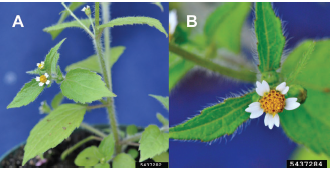 Figure 1. Mature hairy galinsoga plants, (A) leaves, stems, and flowers; (B) compound flower with white ray flowers and yellow disk flowers. Bruce Ackley, The Ohio State University, Bugwood.org.
Seedlings of hairy galinsoga have stalked cotyledons with an opposite arrangement (Figure 2). The cotyledons are hairless and square to egg-shaped with flattened, slightly indented tips. The young true leaves are triangular to egg-shaped with pointed tips and toothed edges. The stems, leaf stalks, and leaf edges are hairy.5
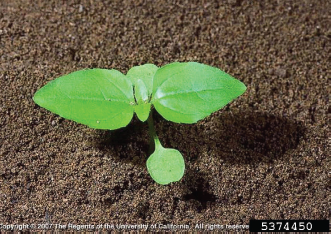 Figure 2. A young hairy galinsoga seedling with cotyledons and two pairs of true leaves. Joseph M. DiTomaso, University of California - Davis, Bugwood.org.
CYCLE AND CONDITIONS
Hairy galinsoga seeds can be spread short distances by the wind, and short and long distances in soil, manure, compost, and other material. Soil and debris containing seeds can be carried from field to field on equipment.1,2 Seeds have little to no dormancy requirements and germinate rapidly in warm conditions with exposure to light (on or near the soil surface). Soil temperatures between 54 and 97 °F are required for germination.
Plants establish quickly, and flowering starts in mid-summer, continuing through the first frost. Flowers develop 24 to 60 days after seedling emergence, and seeds are released 8 to 14 days after flowering.5 A single plant can produce up to 40,000 seeds, and several generations per growing season are common.1,2,5 Seeds can remain viable in the soil for up to four years, but most do not survive more than one year.1,5 Seedlings begin to emerge in the spring when soil temperatures reach the mid-50s °F. Emergence continues throughout the season, with peak emergence in late spring and early summer. High soil levels of nitrogen, phosphorus, and potassium enhance the growth of hairy galinsoga, with phosphorus and potassium having a greater effect than nitrogen. Plants grow best in full sun and do not grow well in shaded areas.5
MANAGEMENT
If hairy galinsoga is not already present in the field, the primary management strategy is to prevent its introduction. Any tools and equipment used in fields infested with hairy galinsoga should be thoroughly cleaned of soil and debris before entering a non-infested field. Soil amendments, such as manure, compost, and organic mulches, as well as transplants and potting soil, should undergo a germination test to check for the presence of hairy galinsoga seed.1,2,5 To detect early infestations, start scouting fields in mid-spring once soil temperatures are favorable for seed germination. Eliminating small patches of hairy galinsoga quickly can avoid the need for large-scale management efforts later.1,2
If hairy galinsoga is present, management can require the integration of several control strategies. Stale seedbeds can be used to promote an initial flush of emergence. Only seeds in the upper 0.4 inches (1 cm) of soil will likely germinate. So, repeated, shallow cultivations can help deplete hairy galinsoga seedbank levels in the upper soil layers without bringing up seeds from deeper soil levels. Flame weeding can also be used to help eliminate recently germinated seedlings.2,5 Black plastic mulch or a thick layer of organic mulch can also be used to help inhibit seedling emergence and growth.1 Tarps can be used early in the season to help raise soil temperatures high enough to allow seed germination and emergence, allowing cultivation of seedlings before planting the crop.1
Well-timed cultivations can help keep weed levels down and help prevent new seed production. However, hairy galinsoga plants should be removed from the field before they can flower and produce seeds. The cultivation of older plants may be ineffective unless soil conditions are fairly dry because hairy galinsoga can re-root from stems in contact with moist soil. At least 48 hours of dry conditions are needed to help prevent re-rooting. Physical removal of plants from the field is more effective if feasible.1,2
If seeds are produced, do not cultivate or till between the time when seeds are produced and before flowering of the weed plants the following spring. Most of the seeds released will remain on or near the soil surface and germinate the following spring. Preparing seed beds for the following spring/ summer crop will help eliminate the newly emerged seedlings. Alternatively, moldboard plowing can be used to deeply bury the seeds followed by several years of only shallow cultivation to allow time for the buried seeds to become non-viable.1,5
Because seeds only remain viable in the soil for up to four years, rotating to high-density crops, cover crops, or sod for three or four years can help reduce the seedbank levels of hairy galinsoga. Early establishing crops that vigorously compete for light, water, and nutrients will be most effective in suppressing the germination and growth of hairy galinsoga.1,3 Because many of the herbicides registered for use on most vegetable crops may not provide effective control of hairy galinsoga, rotation to an agronomic crop (corn, soybeans, etc.) with a broader range of registered herbicides that are effective against hairy galinsoga can be used to help manage this weed species.2
SOURCES
1Melendez, M. and Besancon, T. 2022. Hairy galinsoga life cycle disruptions for effective control in no- and low-spray specialty crops. Rutgers University, Cooperative Extension Fact Sheet FS1348. https://njaes.rutgers.edu/fs1348/.
2Grubinger, V. 2014. Galinsoga management. University of Vermont. https://www.uvm.edu/vtvegandberry/factsheets/galinsoga.html.
3Hartzler, B. Hairy galinsoga. Iowa State University, Integrated Crop Management. https://crops.extension.iastate.edu/encyclopedia/hairy-galinsoga.
4Galinsoga quadriradiata Cav. USDA plant database https://plants.usda.gov/home/plantProfile?symbol=GAQU.
5Galinsogas. Cornell College of Agriculture and Life Sciences, Weed Profiles. https://cals.cornell.edu/weed-science/weed-profiles/galinsogas.
Websites verified 10-22-2024
ADDITIONAL INFORMATION
For additional agronomic information, please contact your local seed representative. Performance may vary, from location to location and from year to year, as local growing, soil and environmental conditions may vary. Growers should evaluate data from multiple locations and years whenever possible and should consider the impacts of these conditions on their growing environment. The recommendations in this article are based upon information obtained from the cited sources and should be used as a quick reference for information about vegetable production. The content of this article should not be substituted for the professional opinion of a producer, grower, agronomist, pathologist and similar professional dealing with vegetable crops.
BAYER GROUP DOES NOT WARRANT THE ACCURACY OF ANY INFORMATION OR TECHNICAL ADVICE PROVIDED HEREIN AND DISCLAIMS ALL LIABILITY FOR ANY CLAIM INVOLVING SUCH INFORMATION OR ADVICE.
5023_462250 Published 10/21/2024