- United States
- expand_more

-
Products
Select Your Brand Below to View Full Portfolio of Offerings
-
Resources
Click Below for Specialized Tips for Your Growing Environment
-
About
Discover More About Our Commitment to Advance Health and Nutrition Globally, Together With You.
-
Innovation

Learn about our approach to innovation.


Click here to download a PDF version of this spotlight.
» Maize dwarf mosaic of sweet corn can be caused by several strains of viruses in the maize dwarf mosaic virus/sugarcane mosaic virus complex.
» Maize dwarf mosaic infections of sweet corn can result in the production of fewer, smaller ears and reduced kernel development, resulting in potential yield losses and reductions in product quality.
» Planting maize dwarf mosaic resistant sweet corn hybrids is the primary method used to help manage this disease.
Maize dwarf mosaic (MDM) is a viral disease of corn (maize) first reported in Ohio in 1965. The disease now occurs worldwide, wherever corn is grown. MDM is a disease complex that can be caused by any of several closely related viruses, including maize dwarf mosaic virus (MDMV) and sugarcane mosaic virus (SCMV). Both of these viruses are present in North America and Europe. MDMV is the most common cause of MDM in North America, while SCMV tends to be more prevalent in Asia and South America.1,2,3 MDM has resulted in economic losses in several crops, including field (dent) corn, broom corn, sweet corn, and sorghum, resulting from reduced rates of photosynthesis and elevated rates of respiration. Yield losses of up to 70% have been documented in dent corn, and near-total losses have occurred in late-planted fields of sweet corn.2,3,4,5
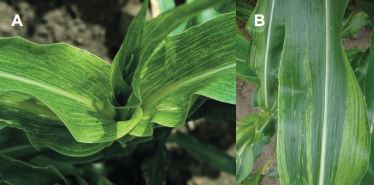 Figure 1. (A) Foliar mosaic and (B) sectoring symptoms on sweet corn plants infected with maize dwarf mosaic. J K Pataky, University of Illinois.
SYMPTOMS
The symptoms resulting from infection of corn plants by MDMV and SCMV are very similar and vary with the developmental stage of the host at the time of infection, the host genotype, and the strain of the virus. Initial symptoms typically include the development of chlorotic spots on leaves followed by the formation of mottling and mosaic patterns of light and dark green (Figure 1A). Chlorotic streaks can form on young leaves, leaf sheaths, and husks. Mosaic symptoms often first appear at the base of the youngest unfolding leaf. Symptoms form on tissues that develop after infection but not on those produced before the time of infection.1,4,6,7
If plants are infected when young, they may become stunted due to shortened internodes, resulting in the formation of bunchy plants with profuse tillering (Figure 2A). Stunting and leaf chlorosis (mosaic symptoms) reduce photosynthetic leaf area, which can lower yield potential.1,4,6 Ears can stop developing on infected plants. Smaller ears result from sterility due to delayed silking and tasseling and lower pollen viability, which can lead to ears that are barren or have missing kernels, most often at the base of the ear (butt blanking) (Figure 2B).1,4 Loss of kernels, fewer ears, and reductions in ear weight, length, and diameter have resulted in yield reductions of 75% or more in affected sweet corn fields.4,5 Symptoms are often most severe on young plants that were infected as seedlings, and foliar symptoms may disappear as the plant ages and temperatures increase. Symptoms may not develop on plants infected at or after pollination.6
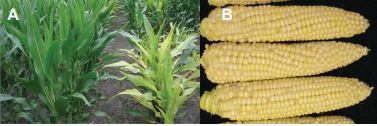 Figure 2. (A) MDM resistant and susceptible sweet corn lines with a susceptible line (right) showing stunted and chlorotic plants. (B) Aborted kernel development on ears from MDM infected sweet corn plants. J K Pataky, University of Illinois.
THE VIRUSES
As mentioned, several viruses in the sugarcane mosaic virus complex can produce the characteristic symptoms of MDM on corn. Initially, all of these viruses were classified as maize dwarf mosaic virus, but they have since been separated into at least six virus species: maize dwarf mosaic virus (MDMV), sugarcane mosaic virus (SCMV), Johnsongrass mosaic virus (JGMV), sorghum mosaic virus (SrMV), Zea mosaic virus (ZeMV), and Pennisetum mosaic virus (PenMV). Of these, MDMV and SCMV are the most common and most widely distributed. The ability to infect Johnsongrass was once used to distinguish species, but strain variation in pathogenicity on Johnsongrass occurs in both MDMV and SCMV. For example, MDMV-A can infect Johnsongrass while MDMV-B cannot.1,3
CYCLE AND CONDITIONS
MDMV and SCMV can overwinter in Johnsongrass and/or other wild perennial grass species. The viruses can also overwinter in sugarcane, corn, sorghum, and other members of the Poaceae (grass family) in the southern U.S. and Central America. The viruses have been isolated from at least 40 plant species under field conditions. Outbreaks of MDM are often associated with the nearby presence of infected Johnsongrass. Annual grasses, including corn and sorghum, can be virus reservoirs for spreading MDM to other host crops during the growing season. A low number of infected plants in a field can result in up to 100% of plants becoming infected.4,6,8,9,10
Plant-to-plant spread of MDM occurs primarily through transmission by aphids. The MDM viruses are transmitted by more than fifteen aphid species, including the corn leaf aphid and green peach aphid. The viruses are transmitted in a nonpersistent manner, meaning that aphids can quickly (in minutes) acquire the virus when feeding on infected plants and quickly transmit the virus when feeding on healthy plants. However, the aphids are only able to transmit the virus for a short time, in this case for up to six hours after acquiring the virus.1,2,6,7 The MDM viruses can be carried northward from Mexico and southern Texas by aphids in air currents. The occurrence of MDM progresses northward during the growing season as temperatures increase and Johnsongrass starts to grow.6,10 The MDM viruses also can mechanically spread from plant to plant through leaf rubbing.1
MDMV has been detected at low levels in corn seed, and low levels of seed transmission (up to 5%) have been observed. When present, the virus is usually detected in the seed pericarp but rarely in the embryo or endosperm. The presence of the virus in the seed often declines as the seeds mature.1,3,4
MANAGEMENT
Planting disease-resistant hybrids is the primary method for managing MDM of sweet corn. Several genes that provide some level of resistance to MDM have been identified in corn. Mdm1 is the gene that has been used most to confer resistance to MDM in both field corn and sweet corn, but other genetic factors can modify the level of resistance. Additional resistance genes for the MDMV/SCMV complex include Scmv1, Scmv2, Wsm1, Wsm2, and Wsm3. 1 Resistance does not always mean a complete absence of symptoms in a variety/hybrid. Symptoms can develop on resistant varieties, but those symptoms may be less severe and/or qualitatively different than those that form on fully susceptible varieties (Figure 2).5 Symptom expression can also be affected by environmental conditions, virus inoculum concentrations, and the developmental stage of the host. Plants are often more susceptible to MDM infection in younger stages and become more resistant as they mature. The presence of Mdm1 is believed to affect the movement of the viruses within the host tissues. The restriction of virus movement can result in sectoring, with the development of patches or streaks of mosaic symptoms on a leaf (Figure 1B). Tissues in symptomatic sectors contain high virus concentrations, while the virus may not be present in the non-symptomatic areas of the same leaf.3
Other strategies that can can be used to help manage MDM include the management of grass weed hosts, especially Johnsongrass, in and around the field. Herbicides can be applied to help manage Johnsongrass and other weed hosts. However, this can be difficult in fields regularly planted to corn. Rotation to non-grass crops can allow the application of herbicides to help control weed hosts of MDM in the rotational years.1,3,6 While rates of seed transmission of MDM in sweet corn are relatively low and not thought to greatly impact the development of MDM in the field, the use of disease-free seed is often listed as a strategy to help manage the disease.1
While the MDM viruses are transmitted by aphids, using insecticides to control aphids is not an effective way to manage MDM. Aphids transmit the viruses so quickly that transmission occurs before the insecticide can work. However, planting sweet corn early, before aphid populations can build up, or waiting to plant until after aphid flights are over can help prevent sweet corn plants from being infected in the most susceptible seedling stage of development.3,5,6,7
SOURCES
1 Stewart, L., Louie, R., and Redinbaugh, M. 2016. Maize dwarf mosaic. In Munkvold, G. and White, D. (Eds.), Compendium of Corn Diseases, Fourth Edition. American Phytopathological Society. St. Paul.
2 Signoret, P. 2008. Cereal viruses: Maize/corn. Encyclopedia of Virology (Third Edition), Academic Press, pp 475-482.
3 Kannan, M., Ismail, I., and Bunawan, H. 2018. Maize dwarf mosaic virus: From genome to disease management. Viruses 10(9):492.
4 Scheck, H. 2020. California pest rating proposal for maize dwarf mosaic virus. California Department of Food & Agriculture
5 Kerns, M. and Pataky, J. 1997. Reactions of sweet corn hybrids with resistance to maize dwarf mosaic. Plant Disease 81:460-464.
6 Wise, K., Mueller, D., Sisson, A., Smith, D., Bradley, C., and Robertson, A. 2016. Maize dwarf mosaic. In A Farmer’s Guide to Corn Diseases. American Phytopathological Society. St. Paul.
7 Davis, R. 2006. Maize dwarf mosaic. Agriculture: Corn Pest Management Guidelines. UC IPM. https://ipm.ucanr.edu/agriculture/corn/maize-dwarf-mosaic/#:~:text=Symptoms%20of%20maize%20dwarf%20mosaic,young%20leaves%20become%20more%20yellow.
8 Alabi, O. 2019. Sugarcane mosaic virus (sugarcane mosaic). CABI Compendium. https://doi. org/10.1079/cabicompendium.49801.
9 CABI. 2021. Maize dwarf mosaic virus (dwarf mosaic of maize). CABI Compendium. https:// doi.org/10.1079/cabicompendium.8157.
10 Tolor, R. 1985. Maize dwarf mosaic, the most important virus disease of sorghum. Plant Disease 69:1011-1015.
Websites verified 1/11/2024
ADDITIONAL INFORMATION
For additional agronomic information, please contact your local seed representative. Performance may vary, from location to location and from year to year, as local growing, soil and environmental conditions may vary. Growers should evaluate data from multiple locations and years whenever possible and should consider the impacts of these conditions on their growing environment. The recommendations in this article are based upon information obtained from the cited sources and should be used as a quick reference for informationabout vegetable production. The content of this article should not be substituted for the professional opinion of a producer, grower, agronomist, pathologist and similar professional dealing with vegetable crops.
BAYER GROUP DOES NOT WARRANT THE ACCURACY OF ANY INFORMATION OR TECHNICAL ADVICE PROVIDED HEREIN AND DISCLAIMS ALL LIABILITY FOR ANY CLAIM INVOLVING SUCH INFORMATION OR ADVICE.
5911_279851 Published 11/09/2023