- United States
- expand_more

-
Products
Select Your Brand Below to View Full Portfolio of Offerings
-
Resources
Click Below for Specialized Tips for Your Growing Environment
-
About
Discover More About Our Commitment to Advance Health and Nutrition Globally, Together With You.
-
Innovation

Learn about our approach to innovation.


Click here to download a PDF version of this spotlight.
» High Plains disease can affect sweet corn and result in reduced yields and smaller ear size.
» High Plains disease of corn is caused by the High Plains wheat mosaic virus (HPWMoV), which also can infect winter wheat.
» The most effective management strategy for High Plains disease of sweet corn is to avoid late planting.
In 1993, symptoms characteristic of viral infections were observed on corn and winter wheat in several of the High Plains states in the central and western United States. The disease on wheat was named wheat mosaic, and the disease on corn was named High Plains disease. It was determined that the diseases were caused by what at the time were thought to be two viruses, subsequently named wheat mosaic virus (WMoV) and High Plains virus (HPV), respectively.1,2 Since that time, the diseases have been documented on corn and wheat in areas from eastern Nebraska to western Idaho and from the Texas panhandle up to central South Dakota. Winter-grown sweet corn in southern Florida also has been shown to be infected. In one case, a 50% yield loss was documented in a commercial sweet corn field.3
It was later determined that the diseases on corn and wheat are caused by the same virus, which is now called High Plains wheat mosaic virus (HPWMoV). Evidence suggests that the diseases have been present on corn and wheat in the High Plains region since at least the 1950s.4
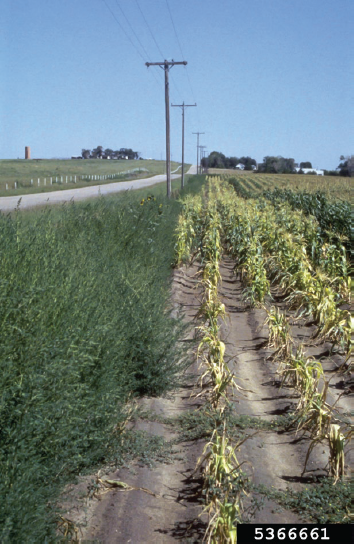 Figure 1. Sweet corn plants severely affected by High Plains disease showing stunting and chlorosis symptoms. William M. Brown Jr., Bugwood.org.
SYMPTOMS
Symptoms of High Plains disease on corn are variable, depending on the corn variety (genotype), the environment, the developmental stage of the plant at the time of infection, and the possible co-infection with other viruses, including wheat streak mosaic virus (WSMV).2 Infected plants are typically stunted and chlorotic (Figure 1). Mosaic patterns and ¼ to ½ inch-wide chlorotic streaks often develop on corn leaves (Figure 2). The streaks, leaf tips, and margins may be red to purple on varieties containing anthocyanin pigments.1,2,4,5
The streaks can start as chlorotic spots that tend to form along and run parallel to the veins in midsized to fully developed leaves.1,2 The streaks turn tan with age as the tissues senesce. The spots and streaks are never sunken or water-soaked. Foliar symptoms are usually more severe on the older/lower leaves, but symptoms develop more slowly on older plants. Corn plants infected early in the season often die. Seedlings may die in as little as two weeks after infection, depending on the age of the plant and environmental conditions.5,6 The root systems of infected plants may be weakened and stunted, and ears can be stunted.1,2
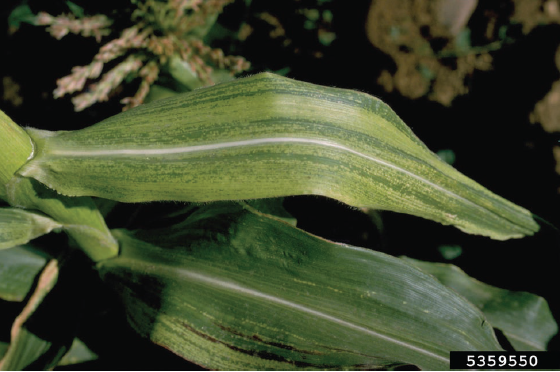 Figure 2. Mosaic and banding symptoms of High Plains disease on sweet corn. Howard F. Schwartz, Colorado State University, Bugwood.org.
DISEASE CYCLE
HPWMoV is transmitted (vectored) by the wheat curl mite (Aceria tosichella). This mite also transmits the wheat streak mosaic virus (WSMV). HPWMoV is not mechanically transmitted, meaning that it cannot be easily spread in plant sap from an infected to a healthy plant through mechanical means (rubbing/wounding).1,2,4 The virus cycles between winter wheat and corn plants over the course of the year. In the early summer, as the wheat crop starts to senesce, wheat on young corn plants. If the wheat plants they were feeding on were infected with HPWMoV, the mites carry the virus from the wheat plants and infect the corn plants. The virus survives in infected corn plants over the summer and into the fall. When the corn plants start to senesce, the mites move to the newly emerged winter wheat seedlings and infect the wheat plants with HPWMoV, continuing the cycle. This explains why the diseases (of corn and wheat) are most prevalent in the High Plains region, a region where corn and winter wheat crops are abundant. The virus can also infect other grass species, including barley, rye, rye brome, oat, green foxtail, yellow foxtail, and witch grass (Figure 3). The infection of these species may serve as an added source of inoculum and a means for the survival of the virus during the cycle.1,2,4
HPWMoV may also be present in infected corn seeds, including sweet corn seeds.2,4 Initially, it was thought that seed transmission of HPWMoV in sweet corn occurred at a very low level. A study published in 2001 evaluated seed transmission in sweet corn seed collected from symptomatic plants. The study found that of 38,473 emerged seedlings, only three showed symptoms of High Plains disease and tested positive for the presence of the virus.7 The conclusion of the study was that seed transmission of HPWMoV in sweet corn seed was possible but at a very low level that would not substantially contribute to the development of disease in sweet corn plantings. However, a later study showed that transmission in sweet corn seed could be much more consequential.5 That article described a situation in which sweet corn plants with High Plains disease were found in commercial sweet corn fields in 2016 and 2017. The patterns of distribution of the infected plants were consistent with transmission by infected seed rather than by the wheat curl mite. Testing of remnant seed showed that 70% of the seed from the 2016 planting tested positive for the presence of HPWMoV, and 20% of the seed from the 2017 planting tested positive for the virus. Infected seed resulted in seedling death and lower levels of stand establishment. It was estimated that the disease resulted in a 40% reduction in yield from the 2016 planting.
The presence of the viral pathogen usually depends on the presence of growing plant hosts throughout the year. Even though most commercial dent corn grown in the region is resistant to High Plains disease, and the plants do not develop symptoms or suffer yield reductions from the disease, the plants can be infected by the virus and serve as a source of inoculum for the wheat crops that emerge in the fall.4 The virus can also infect volunteer wheat and other host crops during the summer months.
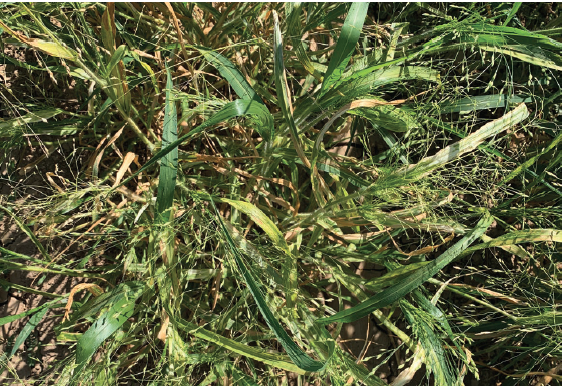 Figure 3. Weedy grass plants infected with HPWMoV can serve as sources of inoculum for infection of sweet corn and wheat.
MANAGEMENT
Most commercial dent corn hybrids are resistant to High Plains disease, and resistance genes have been identified in the inbred lines B73 and B14.6 In the past, most sweet corn varieties were highly susceptible, but many new sweet corn varieties are thought to be resistant to HPWMoV. However, it is difficult to evaluate resistance under field conditions. Resistance to maize dwarf mosaic virus (MDMV) may also provide some resistance to HPWMoV.
Avoid late seeding of sweet corn. Earlier planting allows the corn plants to grow out of the extremely susceptible seedling phase before the mites migrate from wheat to corn.1 The application of miticides to protect the corn plants has not been shown to be effective. Controlling grassy weeds and volunteer grain plants (wheat and barley) may help by eliminating additional sources of mites and inoculum.
SOURCES
1 Corn (Zea mays)-high plains disease. 2023. Pacific Northwest Pest Management Handbook.
https://pnwhandbooks.org/plantdisease/host-disease/corn-zea-mays-high-plains-disease.
2 Jensen, S. The high plains virus: A newly emerging problem of maize and wheat with world wide implications. https://nematode.unl.edu/ppathper/hpv.htm.
3 Revilla, P., Anibas, C.M. & Tracy, W.F. 2021. Sweet corn research around
the world 2015–2020. Agronomy, 11, 534.
4 Tatineni, S. and Hein, G. 2021. High Plains wheat mosaic virus: An enigmatic disease of wheat and corn causing the high plains disease. Mol. Plant Pathol. 22:1167-1179.
5 Nischwitz, C. 2020. Seed-transmitted wheat mosaic virus in Utah. Plant Health Progress, 21, 212–213.
6 Marçon, A., Kaeppler, S.M., and Jensen, S.G. 1997. Genetic variability among maize inbred lines for resistance to the High Plains virus-wheat streak mosaic virus complex. Plant Disease 81:195-198.
7 Forster, R., Seifers, D., Strausbaugh, C., Jensen, S., Ball, E., and Harvey, T. 2001. Seed transmission of the High Plains virus in sweet corn. Plant Disease 85:696–699.
Websites verified 9/27/2023
ADDITIONAL INFORMATION
For additional agronomic information, please contact your local seed representative.
Performance may vary from location to location and from year to year, as local growing, soil, and environmental conditions may vary. Growers should evaluate data from multiple locations and years whenever possible and should consider the impacts of these conditions on their growing environment. The recommendations in this material are based upon trial observations and feedback received from a limited number of growers and growing environments. These recommendations should be considered as one reference point and should not be substituted for the professional opinion of agronomists, entomologists or other relevant experts evaluating specific conditions.
BAYER GROUP DOES NOT WARRANT THE ACCURACY OF ANY INFORMATION OR TECHNICAL ADVICE PROVIDED HEREIN AND DISCLAIMS ALL LIABILITY FOR ANY CLAIM INVOLVING SUCH INFORMATION OR ADVICE.
6711_303911 Published 10/19/2023