- United States
- expand_more

-
Products
Select Your Brand Below to View Full Portfolio of Offerings
-
Resources
Click Below for Specialized Tips for Your Growing Environment
-
About
Discover More About Our Commitment to Advance Health and Nutrition Globally, Together With You.
-
Innovation

Learn about our approach to innovation.


» Seedless watermelons result from the crossing of seeded diploid and tetraploid parental lines using traditional breeding techniques.
» Tetraploid female flowers are pollinated with pollen from diploid plants to create seedless triploid watermelon varieties.
» Some triploid varieties may have other desired characteristics, such as a potential for increased plant vigor and higher fruit production.
Watermelons (Citrullus lanatus – dessert watermelons) are native to Africa and have been cultivated for thousands of years. Unlike other cucurbit fruits, which contain soft seeds that are eaten along with the flesh (cucumbers and zucchini) or which produce hard seeds in a central cavity (pumpkins and winter squash), the seeds of watermelons are distributed throughout the edible flesh of the fruit. Until the mid-20th century, only seeded varieties of watermelon were grown.
Research on the development of seedless watermelon varieties began in Japan in the early 20th century with the first report of the creation of a seedless triploid in 1951.1,2,3 An additional twenty years went by before seedless watermelon varieties became commercially available.
US growers were somewhat slow to adopt seedless varieties because of the higher seed cost and the special conditions required for germination. In the 1990s, seedless watermelons comprised only 5% of the US market. Seedless varieties now account for over 90% of all watermelons sold in the US.1,2,3
Traditional, seeded watermelon plants are diploid (2n), having two copies of each chromosome, one set from each parent plant (Figure 1A). Seedless varieties lack the ability to produce normal, viable seeds because these plants are triploids (3n), meaning their cells contain three copies of each chromosome. Triploid plants are created by crossing diploid (2n) and tetraploid (4n) plants (Figure 1B).3 The breakthrough in the development of production levels of seedless watermelons came with the discovery of a technique for creating tetraploid watermelon plants at production scale to use for the creation of triploid hybrids from the diploid:tetraploid cross.
CREATING TETRAPLOID PLANTS
The primary method used to commercially create tetraploid plants is to apply an antimitotic chemical to seeds or growing points of young seedlings. These chemicals interfere with the process of cell division. Normal cell division starts with the copying of each chromosome, followed by the separation of the chromosome pairs into two new cells. If doubling occurs but separation does not, the end result is a cell with twice the normal number of chromosomes.4 The Japanese researchers found that they could create tetraploid watermelon plants by treating seedlings with colchicine, a chemical extracted from autumn crocus plants. Colchicine is still used today along with other chemicals, including dinitroaniline compounds, such as ethalfluralin and oryzalin.3 The chemicals is be applied to growing tips of seedlings or seeds are soaked in a solution of the chemicals before planting. Tetraploid plants that form are identified and used to produce tetraploid seeds.3,5,6
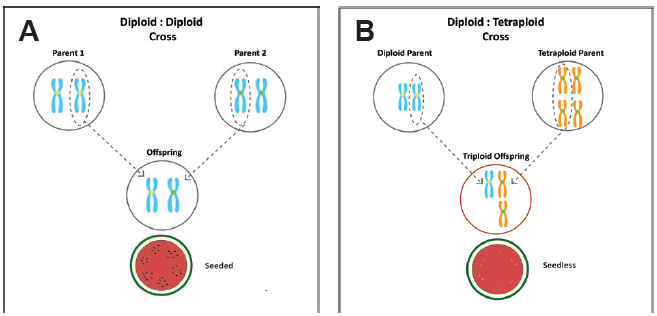 Figure 1. The process of parental lines contributing chromosomes during fertilization. (A) In a diploid:diploid cross each parent contributes one copy of each chromosome. (B) In a diploid:tetraploid cross, the diploid parent contributes one copy, and the tetraploid parent contributes two copies of each chromosome.
TRIPLOID VARIETIES
To create triploid varieties, pollen from a diploid parent (22 chromosomes) is used to fertilize the female flower of a tetraploid parent (44 chromosomes). The pollen and ovum cells (gametes) each have half the number of chromosomes as their parent cells (11 and 22, respectively). When the pollen and ovum cells fuse, they form a cell with 33 chromosomes.2,7 Having 33 sets of chromosomes (an odd number) interferes with the process of creating new gametes (pollen and ovum cells) during the sexual cell division process (meiosis).1,5 Crosses are always made using tetraploid female flowers and diploid pollen because the seeds resulting from crosses between diploid female flowers and tetraploid pollen are usually not viable.3
Most watermelon varieties are monoecious, able to produce female and male flowers on the same plant. Preventing self-pollination to ensure the creation of hybrids requires hand pollination, manually removing all male flowers from the female parent plants, or using a male-sterile variety as the female parent.5,8 Seeds harvested from the resulting fruit will develop into triploid plants that produce seedless fruit.
SEEDLESS FRUIT PRODUCTION
With the higher cost of triploid seeds and the specific conditions needed to optimize germination and emergence, almost all seedless watermelon fields are planted with greenhouse grown transplants.1,6,8 An added benefit of transplanting is that seedlings can survive at temperatures lower than the minimum needed for germination of direct-planted seeds. Therefore, transplanted fields can be established earlier, potentially resulting in an earlier harvest.6
Seedlings are often started in germination chambers with high humidity and temperatures between 84° and 90°F (29° and 32°C) for 24 to 72 hours. Seeds should be sown in moist, but not wet, soilless planting mix.3,8 There can be problems with seed coats sticking to emerging cotyledons, resulting in damage and deformation of the cotyledons. Some operations scarify seed coats before planting and/or manually remove persistent seed coats after emergence to avoid damage and slow growth of seedlings. One method of scarification involves tumbling seeds with ceramic stones or steel balls before plantings. Seeds can also be planted, with the radicle (pointed) end of the seed pointing upward at a 45 to 90° angle.5,8 The initial growth of triploid seedlings is often slower than that of diploids. However, once past the cotyledon stage, the growth rate of triploid seedling is comparable to that of most diploid varieties. After 24 to 72 hours, the seedlings can be moved to the greenhouse set to a temperature of 77°F (25°C).5,6
The growth of the flesh of watermelon fruits of standard diploid plants is stimulated by hormones produced by the developing seeds.8 In triploid varieties, the hormones needed to enhance fruit development are provided by germinating pollen grains in the female flower. Therefore, diploid pollenizer plants are needed to provide the pollen that promotes fruit set and development in triploid plants.1,8 One method used is to plant one row of a pollenizer variety for every three rows of triploid plants. Alternatively, the pollenizers can be planted in the same row with the triploids, with one diploid for every four triploid plants in the row.1 The pollenizers can be seeded varieties that can be harvested for market or specialized varieties that produce many male flowers and have small fruit that are not harvested. The chosen pollenizer variety should at least produce fruit that is easily distinguished from the fruit of the seedless variety to allow for easy separation at harvest.1
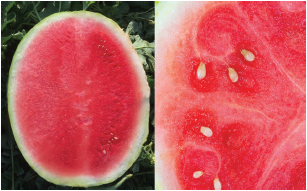 Figure 2. Triploid watermelon fruit can contain the white, soft, edible seed coats (pips) of non-viable seed.
Although characterized as “seedless”, fruit produced by triploid watermelon plants can contain small, soft, white to cream colored empty seed coats of seeds that failed to mature, known as pips (Figure 2). The pips are edible, similar to the seeds in a young cucumber or zucchini.1 Because of the random segregation of chromosomes during the process of ovum production in the triploid female flowers, occasionally a viable embryo can form and develop into a typical dark, hard seed, similar to those found in seeded fruit. However, the occurrence of such seeds is rare.5
In addition to producing “seedless” fruit, triploid watermelon varieties can also have other beneficial characteristics. Triploid plants tend to be somewhat stronger than diploid plants, have longer harvest periods, and produce more fruit per plant. The fruit tend to be smaller, have tougher rinds, increased levels of soluble solids (sugars), and a longer shelf life. Some triploid hybrids have increased resistance to Fusarium wilt and watermelon fruit blotch (Acidovorax avenae). These characteristics can help to offset the higher costs of seed and transplant production, compared to the costs associated with direct seeding of traditional diploid varieties.3,6
SOURCES
1Wehner, T., Naegele, R., Myers, J., Dhillon, N., and Crosby, K. 2020. Cucurbits, 2nd Edition. CABI.
2Where does seedless watermelon come from? Watermelon.org https://www.watermelon.org/the-slice/where-does-seedless-watermelon-come-from/
3Ermolaev, A., Fomicheva, M., and Domblides, E. 2026. Advances in polyploid breeding of Cucurbitaceae crops: From polyploidy research to triploid seedless hybrid breeding. Crops 6, 5. https://doi.org/10.3390/crops6010005
4Yu, C. and Liang, N. 1998. The discovery of the breeding of seedless watermelon. Discoveries in Plant Biology. https://doi.org/10.1142/9789812813046_0019
5Rhodes, B. and Zhang, X. 2000. Hybrid seed production in watermelon. In Basra, A. ed. Hybrid seed production in vegetables: Rationale and methods in selected crops. CRC Press.
6Kapiel, T., Rhodes, B., Dane, F., and Zhang, X. 2004. Advances in watermelon breeding. Journal of New Seeds 6:(4) 289-319. DOI: 10.1300/J153v06n04_01.
7Barlow, S. 2017. Where does seedless watermelon come from? American Farm Bureau Foundation for Agriculture. https://www.agfoundation.org/news/where-does-seedless-watermelon-come-from?gad_ source=1&gad_campaignid=20006637599&gbraid=0AAAAApH2yeYM3JHShV6IH2MECg TC-Drib&gclid=EAIaIQobChMIuI-LwoPzkgMVpj0IBR0Cjxv7EAMYASAAEgJFNfD_BwE
8Maynard, D. N. and Elmstrom, G. W. 1992. Triploid watermelon production practices and varieties. In: Acta Horticulturae. pp. 169–178. https://doi.org/10.17660/ActaHortic.1992.318.21
Websites verified 3/27/2026
ADDITIONAL INFORMATION
For additional agronomic information, please contact your local seed representative. Performance may vary, from location to location and from year to year, as local growing, soil and environmental conditions may vary. Growers should evaluate data from multiple locations and years whenever possible and should consider the impacts of these conditions on their growing environment. The recommendations in this article are based upon information obtained from the cited sources and should be used as a quick reference for information about vegetable production. The content of this article should not be substituted for the professional opinion of a producer, grower, agronomist, pathologist and similar professional dealing with vegetable crops.
BAYER GROUP DOES NOT WARRANT THE ACCURACY OF ANY INFORMATION OR TECHNICAL ADVICE PROVIDED HEREIN AND DISCLAIMS ALL LIABILITY FOR ANY CLAIM INVOLVING SUCH INFORMATION OR ADVICE.
7020_797200 Published 03/30/2026