- United States
- expand_more

-
Products
Select Your Brand Below to View Full Portfolio of Offerings
-
Resources
Click Below for Specialized Tips for Your Growing Environment
-
About
Discover More About Our Commitment to Advance Health and Nutrition Globally, Together With You.
-
Innovation

Learn about our approach to innovation.


Click here to download a PDF version of this spotlight.
» Several vegetable pathogens in the bacterial genus Xanthomonas have developed strains that are resistant to copper-based bactericides.
» Management of diseases such as bacterial spot of pepper and tomato, and black rot of brassicas may be more difficult to achieve when copper-resistant pathogens are present.
» Alternatives to copper-based products are being evaluated for their efficacy in managing bacterial plant pathogens.
Bacteria in the genus Xanthomonas include several important pathogens of vegetable crops, including the causal agents of bacterial spot of pepper and tomato, and the cause of black rot on brassica crops such as broccoli and cabbage. Bacterial spot of tomato and pepper is caused by four species of Xanthomonas: X. vesicatoria, X. euvesicatoria, X. gardneri, and X. perforans (Figure 1).1,2 While black rot of brassicas is caused by X. campestris pathovar campestris (Figure 2).3 These diseases are usually managed with a combination of cultural, genetic, and chemical strategies, including crop rotation, diseasefree seed, resistant varieties, and the use of copper-based bactericides. The presence of pathogen strains with resistance to copper bactericides reduces the effectiveness of copper applications resulting in increased disease levels and lower yields and product quality.
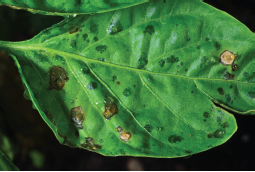 Figure 1. Bacterial spot of pepper caused by Xanthomonas sp.
Copper is an element that is required for the growth and proper functioning of the cells of living organisms, but if the concentrations of copper get too high, copper can become toxic to these same cells. To help prevent this, cells have mechanisms that help them regulate the amount of copper in the cell and detoxify copper ions near the cell.3,4 The regular use of copper-based bactericides to help manage vegetable diseases has resulted in the development of pathogen strains that are no longer susceptible to the effects of copper at the levels indicated on the product labels. This includes the development of copper-resistant strains of Xanthomonas species.4
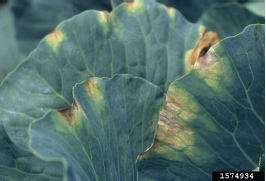 Figure 2. Black rot of cabbaged caused by Xanthomonas campestris pv. campestris. Gerald Holmes, Strawberry Center, Cal Poly San Luis Obispo, Bugwood.org.
COPPER RESISTANCE IN PLANT PATHOEGENIC BACTERIA
Copper resistance genes appear to be present in many bacteria, and they can be induced (turned on) in the presence of high levels of copper. The bacterial genes studied so far appear to work by converting the copper into less toxic forms outside of the cell or by altering the bacterial cell membrane to prevent the movement of excess copper into the bacterial cell and to increase the transport of copper out of the bacterial cell.5,6 The first copper resistance genes were identified in Pseudomonas syringae pv. tomato, the cause of bacterial speck in tomato, in 1986, and several copper resistance genes have now been characterized in that bacterium. Some of the genes are involved with the regulation of the movement of copper across cell membranes, and others facilitate the oxidation of copper ions to less toxic forms. The reduced effect of copper bactericides and the identification of copper-resistant strains has since been reported for other species of plant pathogenic bacteria, including species of Xanthomonas that attack vegetable crops. There is good evidence to suggest that these resistance genes can be passed between different bacterial species and genera.3,5,6
COPPER RESISTANCE IN XANTHOMONAS
Copper resistance was first documented in Florida in 1982 in the pathogen that causes bacterial spot of pepper and tomato, then named Xanthomonas campestris pv. vesicatoria.7,8 It has since been determined that at least four different species of Xanthomonas are able to cause this disease. Although copper resistance was first recognized in the early 1980s, resistance was found in strains of the bacterial spot pathogen originally isolated as early as 1968, indicating that copper-resistant strains had existed but were not recognized for many years.6
Copper resistance in the bacterial spot pathogen was found on tomato plants in Mexico in 1984 and since then in many other locations in the U.S., as well as Canada and Brazil.1,9 A study of bacterial spot strains from tomatoes in Illinois found that 59% of the X. perforans isolates and 38% of the X. gardneri isolates had some level of copper resistance.1 Similar results were seen with strains from tomatoes in Indiana, with 78% of X. perforans and 20% of X. gardneri isolates showing copper resistance. Very high levels of resistance were also seen in bacterial spot strains from Florida and Michigan. 10 Copper resistance has also been documented in Xanthomonas campestris pv. campestris (Xcc), the bacterium causing black rot of brassicas. A 2013 study found high levels of copper resistance in 61% of Xcc strains collected from brassica crops in Trinidad from 2001 to 2003. Higher incidence levels of black rot started to occur in the early 1990s after many years of routine use of copper-based bactericides on brassica crops. Sixty-one percent of the isolates tested showed copper resistance, and there was a strong association between the proportion of strains from an area showing resistance and the length of time that copper bactericides were continuously used in that area.5,11 Copper resistance was also found in strains of Xcc isolated from brassica crops in Mauritius from 2019 to 2021.3 Genetic analysis of the strains from Trinidad and Mauritius found genetic sequences that were similar to those of copper resistance genes in other bacterial species.
Adding the fungicide mancozeb to the copper bactericide treatment may result in better control of bacterial disease. The addition of a copper-chelating carbamate fungicide, such as mancozeb, has been shown to increase the effectiveness of copper bactericides, helping to overcome copper resistance in some situations. It is believed that the presence of the fungicide results in higher levels of copper ions available to inhibit the bacteria.6
Even though the occurrence of copper resistance in Xcc has only been documented in a few locations, the concern over the development of copper-resistant strains of the black rot bacterium has prompted studies on alternative methods for managing black rot on brassica crops in other areas. A 2024 Florida study evaluated the use of plant defense activator products for their ability to help manage black rot. The study included products such as acibenzolar-S-methyl (Actigard®
50WG Plant Activator) and laminarin (Vacciplant® Stimulant of Plant Defense Reactions), as well as a number of biological products including Pseudomonas chlororaphis, and strains of Bacillus subtilis, B. amyloliquefaciens, and B. mycoides. Some of these products provided partial control of black rot, but the level of control was modest. The average level of control was an eight percent reduction in disease severity compared to the non-treated control. The highest level of control was just over eighteen percent, and increased yield levels in treated plots compared to the non-treated controls were seen in some trials.12 Some of the vegetable diseases caused by Xanthomonas species can be managed with the help of disease resistant varieties, such as using pepper varieties with resistance to bacterial spot.
SOURCES
1Khanal, S., Hind, S., and Babadoost, M. 2020. Occurrence of copper-resistant Xanthomonas perforans and X. gardneri in Illinois tomato fields. Plant Health Progress 21:338-344.
2Jones, J., Lacy, G., Bouzar, H., Stall, R., and Schaad, N. 2004. Reclassification of the Xanthomonads associated with bacterial spot disease of tomato and pepper. Syst. Appl. Microbiol. 27(6):755-762.
3Boyer, C., Lefeuvre, P., Richard, D., Lobin, K. K., and Pruvost, O. 2024. Complete genome sequence of a copper-resistant Xanthomonas campestris pv. campestris strain isolated from broccoli in Mauritius suggests adaptive gene gain through horizontal gene transfer. Phytopathology 114:328-333.
4Voloudakis, A., Reignier, T., and Cooksey, D. 2005. Regulation of resistance to copper in Xanthomonas axonopodis pv. vesicatoria. Applied and Environmental Microbiology 71:782- 789.
5Behlau, F., Gochez, A. M., Lugo, A. J., Elibox, W., Minsavage, G. V., Potnis, N., White, F. F., Ebrahim, M., Jones, J. B., and Ramsubhag, A. 2017.Characterization of a unique copper resistance gene cluster in Xanthomonas campestris pv. campestris isolated in Trinidad, West Indies. Eur. J. Plant Pathol. 147:671-681.
6Cooksey, D. A. 1990. Genetics of bactericide resistance in plant pathogenic bacteria. Annu. Rev. Phytopathol. 28:201-219.
7Marco, G. and Stall, R. 1982. Resistance to copper in Xanthomonas campestris pv. vesicatoria. Phytopathology 72:359-359.
8Marco, G. and Stall, R. 1983. Control of bacterial spot of pepper initiated by strains of Xanthomonas campestris pv. vesicatoria that differ in sensitivity to copper. Plant Dis. 67:779-781.
9Adaskaveg, J., and Hine, R. 1984. Resistance of field strains of Xanthomonas campestris pv. vesicatoria to copper bacteriocides. Phytopathology 74:858-858.
10Egel, D., Jones, J., Minsavage, G., Creswell, T., Ruhl, G., Maynard, E., and Marchino, C. 2018. Distribution and characterization of Xanthomonas strains causing bacterial spot of tomato in Indiana. Plant Health Progress 19:319-321.
11Lugo, A. J., Elibox, W., Jones, J. B., and Ramsubhag, A. 2013. Copper resistance in Xanthomonas campestris pv. campestris affecting crucifers in Trinidad. European Journal of Plant Pathology 136:1–10.
12Ramirez, R. Dufault, N., Paret, M., and Vallad, G. 2024. Field evaluations of plant defense activators and sulfur as alternatives to copper bactericides for the management of cabbage black rot in Florida. Plant Health Progress. https://doi.org/10.1094/PHP-03-24-0023-RS.
Websites verified 12/05/2024
ADDITIONAL INFORMATION
For additional agronomic information, please contact your local seed representative. Performance may vary, from location to location and from year to year, as local growing, soil and environmental conditions may vary. Growers should evaluate data from multiple locations and years whenever possible and should consider the impacts of these conditions on their growing environment. The recommendations in this article are based upon information obtained from the cited sources and should be used as a quick reference for information about vegetable production. The content of this article should not be substituted for the professional opinion of a producer, grower, agronomist, pathologist and similar professional dealing with vegetable crops.
BAYER GROUP DOES NOT WARRANT THE ACCURACY OF ANY INFORMATION OR TECHNICAL ADVICE PROVIDED HEREIN AND DISCLAIMS ALL LIABILITY FOR ANY CLAIM INVOLVING SUCH INFORMATION OR ADVICE.
5011_477900 Published 12/05/2024