- United States
- expand_more

-
Products
Select Your Brand Below to View Full Portfolio of Offerings
-
Resources
Click Below for Specialized Tips for Your Growing Environment
-
About
Discover More About Our Commitment to Advance Health and Nutrition Globally, Together With You.
-
Innovation

Learn about our approach to innovation.
Causal Agent
Stemphylium botryosum (teleomorph: Pleospora tarda)
Distribution
Worldwide
Symptoms
Early symptoms of black stalk rot and purple blotch may be confused because they are similar in appearance. However, black stalk rot will eventually cover the infection site with a dense carpet of black spores. The affected areas generally progress along the length of leaves and flower stalks. Initially yellow then tan, these lesions later darken when spore production is at its highest. Seed stalks may become girdled and break before the seed matures. Surface infection of bulbs results in a black sooty appearance.
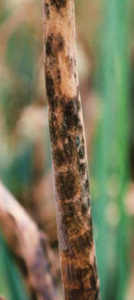 Black spore production on a scape.
Conditions for Development
This fungus can infect and survive over a wide range of environmental conditions, causing the most severe damage in warm, humid climates. It generally attacks old, diseased, weakened host tissue and will often follow downy mildew.
Control
The crop should be kept free from downy mildew, leaf blight and other diseases. Although chemical sprays can be effective, cultural control may also be achieved with proper plant spacing, fertilizer applications and irrigation to ensure the healthiest plant possible. Controlling insects such as thrips, which may injure the plant and provide access for the fungus, can be beneficial. Also, bulbs should not be bruised when harvested and should be properly dried before storage.