Skip to Main Content

- United States
- expand_more
Vegetables United States
-
Products
Select Your Brand Below to View Full Portfolio of Offerings
-
Resources
Click Below for Specialized Tips for Your Growing Environment
-
About
Discover More About Our Commitment to Advance Health and Nutrition Globally, Together With You.
-
Innovation

Learn about our approach to innovation.



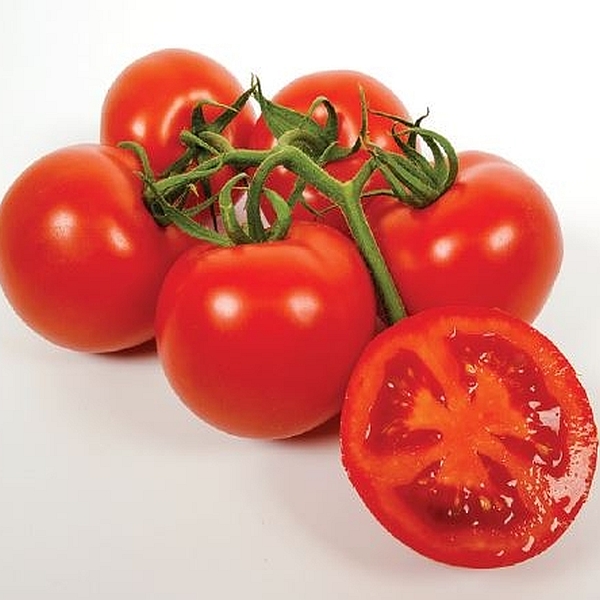
Bountice, a FULLRED large truss tomato with high yield potential, good average degrees brix and suitable for conventional and lit crops.
- FULLRED variety – Deep internal and external red color
Features
- Average fruit weight 165 - 170 grams
- High yield potential
- Rounded fruits
- Open plant type with strong vigor
- Suitable for conventional and lit crops
- Suitable for non-grafting
Advantages
- Strong disease package
- Consistently good average degrees brix
Agronomic Tips
- Environment: Heated glasshouses Season: suitable to the same crop cycles where Merlice is well adapted. Can be grown year-round where summer conditions are not extreme (i.e. BC, Quebec). Suitable for Artificial light crops. Head density: it varies according to latitude, greenhouse type and crop cycle. Commonly head density seen in commercial crops varies from 2.5 to 3.6 heads/m2. No blind heads present in 2 crop cycles of development Grafting on a generative rootstock such as DR0138TX is suitable for short crop cycles. Grafting on a more vigorous rootstock is recommended for long crop cycles. It needs generative steer for its vegetative behavior, especially when starting a crop cycle under high light levels. It tends to hold one extra truss vs Merlice. Truss support is a must for its large fruit size.
Disease Resistance
Disease Resistance (HR)
Fol:1,2/For/Pf:A-E/ToMV:0-2/ToTV/Va:1/Vd:1
Disease Resistance (IR)
Ma/Mi/Mj/On/TSWV:0
Characteristics
AVERAGE WEIGHT
165-170 grams
BRIX POTENTIAL
5.4
EXTERNAL COLOR
Red
HARVEST METHOD
Truss
HARVEST UNIFORMITY
High Uniformity
HARVESTING SEASON
All Year, Lit Crop
JOINTLESS
Yes
MATURITY (DAYS)
Earlier than competition.
PLANT TYPE
Indeterminate
RELATIVE MATURITY
Medium
SEGMENT
L
SHAPE
Round
SIZE
Large
SOWING SEASON
All Year, Lit Crop
TRANSPLANTING SEASON
All Year, Lit Crop
VIGOR
Very Strong