Confidence on every level

Druck

New tomato varieties from Vegetables by Bayer offer protection against ToBRFV mutation

By: Jan Barten, Strategic Project Lead, Bayer Crop Science

ToBRFV remains a serious threat to tomato production, especially with the emergence of resistance-breaking strains. Vegetable by Bayer trials show Seminis® and De Ruiter® multi-gene resistant tomato varieties offer durable protection for growers.

Global impact of ToBRFV

Tomato Brown Rugose Fruit Virus (ToBRFV) continues to be one of the most disruptive viruses in tomato production worldwide. Its high mutation rate and ability to exist as a complex mix of viral isolates in infected plants (Harrison, 2002) make it difficult to maintain long-term resistance.

RB-ToBRFV: The resistance-breaking strain

Recently, a new threat has emerged: a single nucleotide mutation in ToBRFV – referred to as resistance breaking (RB)-ToBRFV – has been shown to overcome single-gene resistance in some tomato cultivars (Zisi et al., 2024). This raises concerns for the durability of current resistant varieties on the market.

Multi-gene resistant tomato varieties

But there’s good news. Vegetables by Bayer, driven by its world-class seed brands, Seminis and De Ruiter, has tested four tomato varieties containing multi-gene resistant technology, and the results show protection – even against the new RB-ToBRFV isolate.

"Viruses can have particular difficulty in overcoming strong resistance controlled either by multiple recessive genes or by coat-protein transgenes."
(Harrison, 2002)
"Viruses can have particular difficulty in overcoming strong resistance controlled either by multiple recessive genes or by coat-protein transgenes."
Harrison, 2002
"Viruses can have particular difficulty in overcoming strong resistance controlled either by multiple recessive genes or by coat-protein transgenes."
Harrison, 2002

What the trials showed

Two internal Bayer trials were conducted using 20 seedlings of two current varieties and two pre-commercial varieties with resistance to ToBRFV, plus a susceptible check. The seedlings were planted in a randomized complete block design with four replications of five plants each.

Fifteen days after sowing:

  • One trial was inoculated with the standard ToBRFV isolate (St-ToBRFV)
  • The other was inoculated with the resistance-breaking mutant (RB-ToBRFV)
  • Trials were kept in separate glasshouse compartments

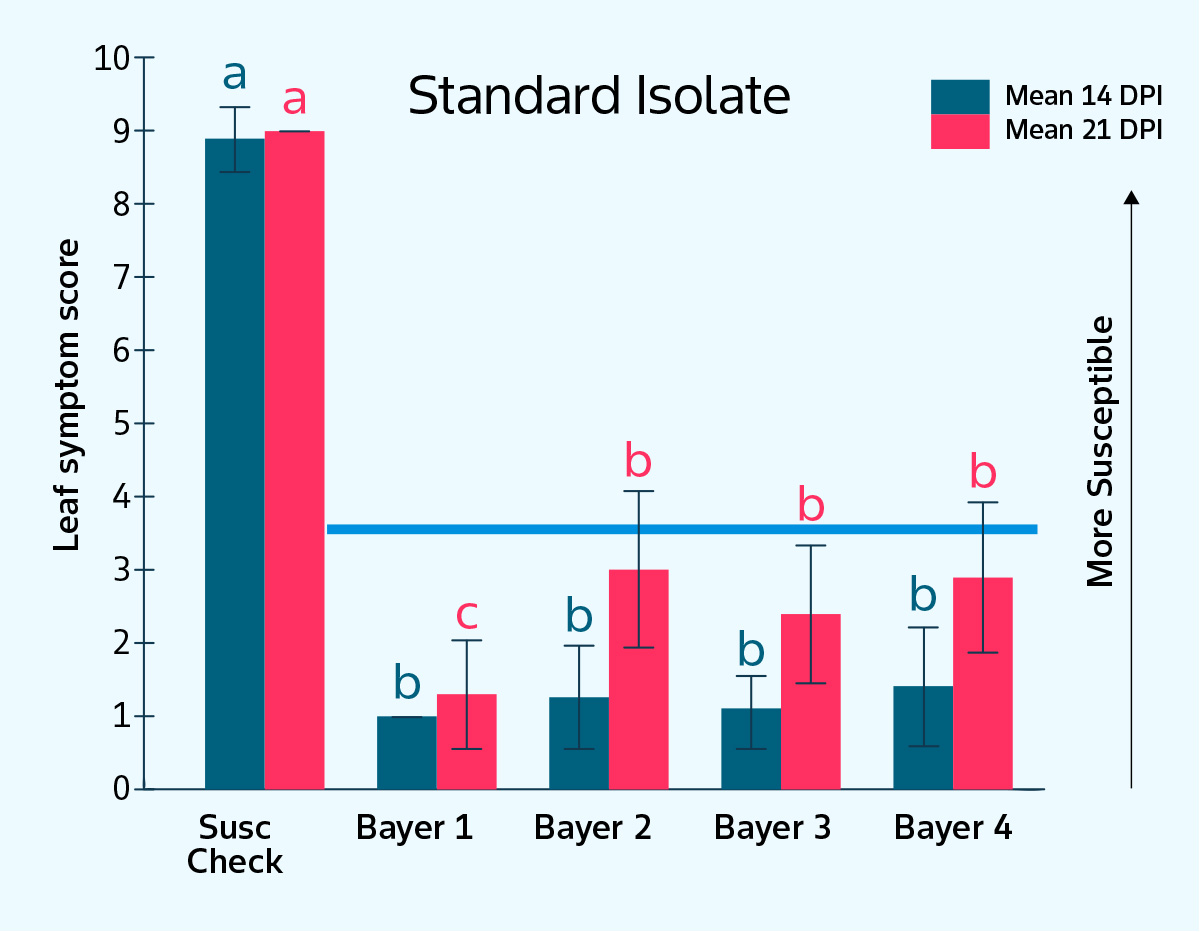
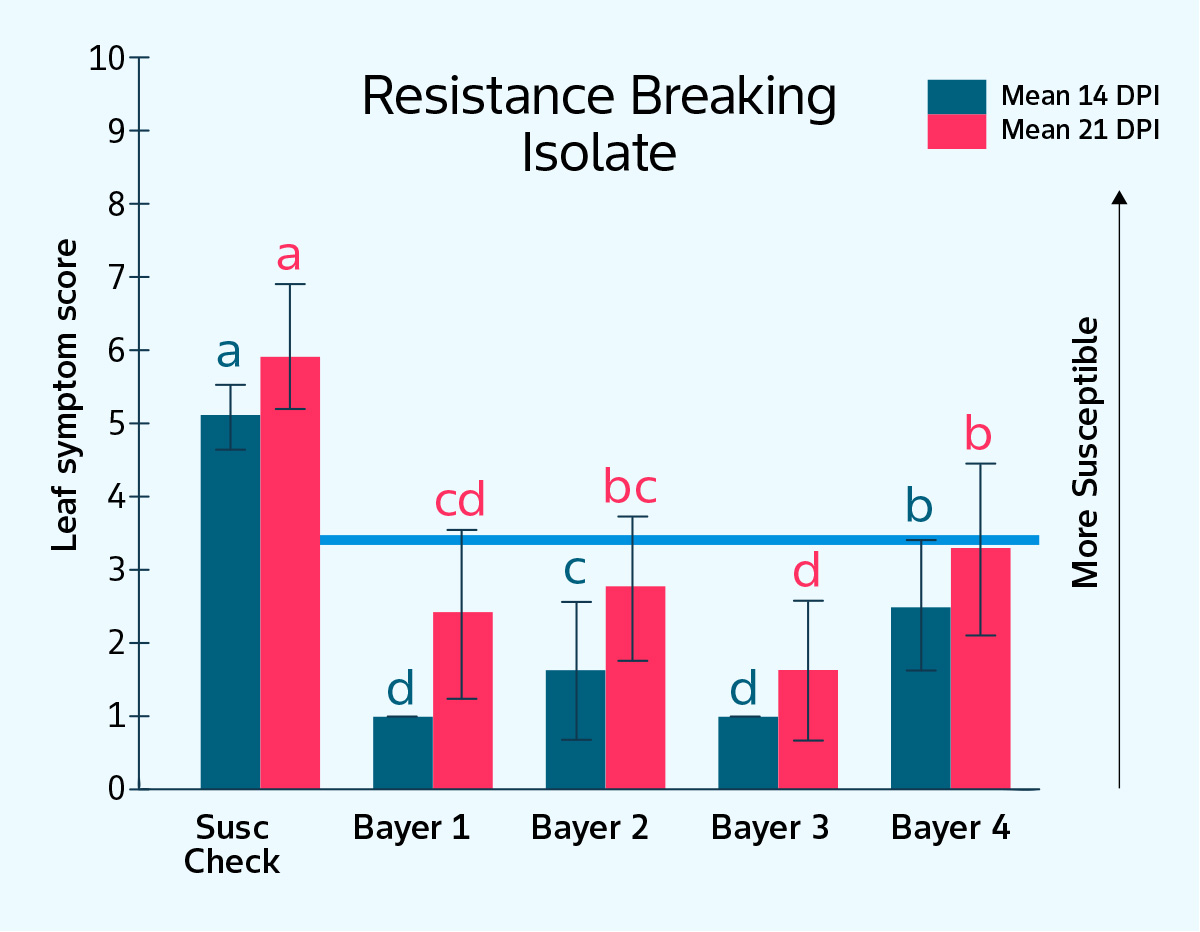
Virus symptoms were evaluated at 14 and 21 days after inoculation using the scale from Gonzáles-Concha (2023), where 1 = no visible symptoms and 9 = severe symptoms.

The susceptible check (left bar on each plot of Figure 1) showed ToBRFV symptoms in both trials, confirming successful inoculation. Symptoms from St-ToBRFV were more severe than those from RB-ToBRFV (score 9 vs. 5), aligning with observations reported by Zisi et al. (2024).

The four varieties scored between 1 and 3 in both trials. These initial results indicate resistance to both the original and the mutated virus strains. 

Trial timing
Sowing: 8 Aug 2024
Inoculation: 23 Aug 2024
Evaluation 1: 6 Sept 2024
Evaluation 2: 13 Sept 2024

What this means to you

With the risk of resistance-breaking mutations on the rise, the multi-gene resistance provides an added layer of protection.

While we’re confirming these results in real-world field evaluations, Seminis and De Ruiter are well-positioned to deliver durable protection against ToBRFV – helping keep your yield potential and peace of mind intact.

Figure 1: Leaf Symptoms 14- and 21-Days Post Inoculation

Figure 1: Each variety is represented by 20 data points in each trial. We tested the statistical significance of the symptom difference between each variety within each evaluation date with a Tukey test: varieties sharing the same letter cannot be differentiated in terms of symptom severity, while varieties under different letters display distinct symptom severity levels. All Bayer varieties were significantly more resistant than the susceptible check in the St-ToBRFV trial as well as the RB-ToBRFV trial at 14- and 21-days post-inoculation.

News for you

Frequently asked questions about ToBRFV

Tomato Brown Rugose Fruit Virus (ToBRFV) is a highly contagious virus that disrupts tomato production worldwide. Its ability to mutate and exist as multiple viral isolates makes it especially difficult to manage long-term.

RB-ToBRFV stands for “resistance-breaking ToBRFV.” It is a newly identified strain caused by a single-nucleotide mutation. This strain has been shown to overcome single-gene resistance in some tomato varieties, raising concerns about the durability of current resistant cultivars.

Unlike single-gene resistance, which provides only one layer of protection, multi-gene resistance combines multiple resistance factors. This creates a durable barrier against both the standard ToBRFV isolate and the RB-ToBRFV strain.

Two glasshouse trials tested four tomato varieties (two current, two pre-commercial) with multi-gene resistance. All four showed strong protection, scoring between 1–3 on a 1–9 symptom severity scale. In contrast, the susceptible check scored 9 with St-ToBRFV and 5 with RB-ToBRFV.

Initial results are highly promising. Vegetables by Bayer is confirming performance through ongoing field evaluations to help ensure protection holds up under diverse growing environments.

Growers can have greater peace of mind knowing that Seminis® and De Ruiter® varieties with multi-gene resistance offer an added layer of protection, helping reduce the risk of yield loss from evolving ToBRFV strains.

Literature cited:

Harrison, B. D. (2002). Virus variation in relation to resistance-breaking in plants.  Euphytica 124, 181-192.  doi: 10.1023/A:1015630516425.

Zisi Z, Ghijselings L, Vogel E, Vos C and Matthijnssens J (2024).  Single amino acid change in tomato brown rugose fruit virus breaks virus-specific resistance in new resistant tomato cultivar.  Front. Plant Sci. 15:1382862.  doi: 10.3389/fpls.2024.1382862

González-Concha, L.F., Ramírez-Gil, J.G., Mora-Romero, G.A., García-Estrada, R.S., Carrillo-Fasio, J.A., Tovar-Pedraza, J.M. (2023).  Development of a scale for assessment of disease severity and impact of tomato brown rugose fruit virus on tomato yield.  Eur. J. Plant Pathology, 165, 579-592.


HR = High Resistance. IR = Intermediate Resistance. To find out more about disease resistance and the applicable levels of disease resistance, visit www.worldseed.org, and view the “Definition of the Terms Describing the Reaction of Plants to Pests for the Vegetable Industry” paper in the Vegetable Resources section.


Performance may vary, from location to location and from year to year, as local growing, soil and environmental conditions may vary. Growers should evaluate data from multiple locations and years whenever possible and should consider the impacts of these conditions on their growing environment.

The recommendations in this material are based upon trial observations and feedback received from a limited number of growers and growing environments. These recommendations should be considered as one reference point and should not be substituted for the professional opinion of agronomists, entomologists or other relevant experts evaluating specific conditions.

Stay up to date about ToBRFV

Need more information?

This browser is no longer supported. Please switch to a supported browser: Chrome, Edge, Firefox, Safari.