
October 14, 2026
Skip to Main Content

- Canada
- expand_more
Vegetables Canada
-
Products
Select Your Brand Below to View Full Portfolio of Offerings
-
Resources
Click below for Specialized Tips for Your Growing Environment
-
About
Discover More About Our Commitment to Advance Health and Nutrition Globally, Together With You.
-
Innovation

Learn about our approach to innovation.
Click here to download a PDF version of this Cultivation Insights article.
» Tomato brown rugose fruit virus (ToBRFV) is an important pathogen on protected culture tomatoes in some regions around the world including Europe, the Mediterranean, China, Canada, and Mexico.
» ToBRFV virus particles (virions) are highly stable and can be transmitted mechanically in plant sap, on tools, clothing, and in seed.
» Strict sanitation practices can help prevent the introduction of ToBRFV, and resistant tomato varieties have recently become commercially available.
ToBRFV BACKGROUND AND IMPACT
Virus-like symptoms were observed on tomato plants in Israel in 2014, and a new virus was isolated from similarly affected plants in Jordan in 2015. The new virus was given the name tomato brown rugose fruit virus (ToBRFV) and determined to be related to tobacco mosaic virus (TMV) and tomato mosaic virus (ToMV) in the Tobamovirus group.1,2 The disease was then detected in other countries around the Mediterranean, in Europe, and eventually in other tomato growing countries around the world.1,3
ToBRFV is known to be present in Canada, Mexico, and several countries in South America. The virus was detected in several states in the US, but all of the infected plants were destroyed, and the disease is currently considered eradicated in the US.4 The disease has occurred most frequently and caused the most damage in greenhouse and high-tunnel production systems.5,6 Infection by ToBRFV can result in substantial reductions in fruit yield and market quality. Yield losses of 30 to 70% have been reported, and complete crop failure can occur when severely infected plantings are terminated.5,7
Tomato and peppers (Capsicum spp.) are considered the natural hosts of ToBRFV.1,4 In artificial inoculation studies, ToBRFV has been shown to infect species in four plant families (Amaranthaceae, Apocynaceae, Asteraceae, and Solanaceae). These host species may be able to serve as reservoir hosts of the virus.1,4
SYMPTOMS OF ToBRFV INFECTION
Symptoms can vary depending on tomato variety, plant age at the time of infection, temperature, photoperiod, and cultural conditions.1,8 Initial symptoms appear on young shoots and leaves in the upper canopy. These symptoms include mild to severe mosaic patterns with dark green bulges on leaves, interveinal yellowing, upward curling of leaf edges, and growth distortion resulting in narrow, elongated leaves (Figure 1).1,4,6 In some cases, necrotic lesions
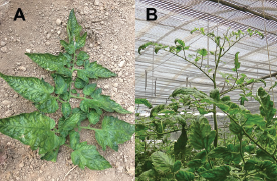 Figure 1. Foliar symptoms of ToBRFV on tomato: (A) mosaic discoloration of leaves, (B) leaf narrowing and distortion.
can develop on stems, peduncles, and calyces. In severe cases, plants can collapse and die.
The fruit of infected plants can ripen irregularly, developing red, yellow, orange, or green blotches, with the discoloration potentially extending into the flesh (Figure 2). Raised, rough (rugose), brown patches can develop on the skin, resulting in reduced fruit quality. Some fruit deformation may also occur. Fruit size can be reduced, and there can be fewer fruit produced per cluster.1,4,6
Mixed infections with other plant viruses (PepMV and TSWV) are not uncommon, potentially resulting in more severe symptoms.8 Symptoms of ToBRFV are similar to symptoms caused by other viruses, including TMV and ToMV, and laboratory testing is usually needed to verify the causal agent.6
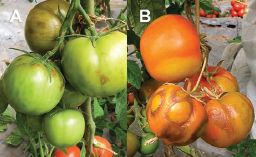 Figure 2. Fruit symptoms: (A) brown necrotic lesions, (B) rugose fruit surface, necrosis of stem and calyx.
HOW IS ToBRFV SPREAD?
ToBRFV is spread as virus particles (virions) in plant sap, on infested surfaces, and in seed. ToBRFV particles are highly stable and can remain infective for long periods on greenhouse surfaces, tools, and in infested soil and plant debris.1,4,6 The virus can easily be spread through cultural practices, such as transplanting, thinning, trellising, and pruning. ToBRFV has been shown to remain infective on workers’ hands for at least two hours after touching an infected plant, and for at least three to six months on greenhouse surfaces including metal benches, concrete, glass, plastic pots, and trays. The virus can survive in soil and crop debris for years and has been detected in irrigation water.
ToBRFV can be seed-transmitted. Studies have found ToBRFV in the pulp and on the seed coats of seed from infected fruit. Long distance spread of ToBRFV most likely occurs with contaminated seeds. However, observed rates of infection from contaminated seed have been fairly low, 2.8% transmission to cotyledons and 1.8% to third-true leaves.1
ToBRFV transmission within a planting occurs through virus particles present on tools and the hands or clothing of work-ers. No arthropod vectors have been identified for ToBRFV, in the traditional sense, where an insect acquires the virus when feeding on an infected plant and then transmits that virus to a healthy plant. However, it has been verified that bumblebees can transmit ToBRFV during pollination through contaminated crude sap from pollen grains on their mandibles. However, the disease is not transmitted on airborne pollen.1,4
DETECTION OF ToBRFV INFECTION
Definitive verification of ToBRFV infection requires testing of plant material. ELISA tests, which rely on antigen/antibody responses, are available for in-lab or onsite testing. In the past, ELISA tests could detect the presence of tobamovirus pathogens in general but not distinguish infections by TMV, ToMV, and To- BRFV. Newer kits and immunostrips are more specific for ToBRFV with lower cross-reactivity to other tobamoviruses. Detections with these kits should be verified through molecular tests.1,4
Molecular tests can detect the presence of viral ribonucleic acid (RNA) in plant samples. Molecular tests, such as PCR, are often more sensitive than ELISA tests and able to detect lower levels of infection. They can also better distinguish specific viruses, such as ToBRFV. One RT-PCR procedure can detect a 0.1% infection level from 3,000 seeds with a 95% confidence level.1,4
MANAGING ToBRFV IN TOMATOES
The main strategy for managing ToBRFV on tomatoes in locations with no history of the pathogen is to avoid the introduction of the virus on infected seeds or other propagation materials including transplants and rootstocks. Use only certified, disease- free seed that has been tested for ToBRFV purchased from reputable sources.1,4,6 Chemical seed treatments with disinfectants, including Virocid®, lactoferrin, sodium hypochlorite (bleach), Virex®, and hydrochloric acid have shown some ability to reduce levels of seed infection. Heat treatment of seeds has not been shown to be effective.1,8
Strict sanitation practices should be followed to help prevent the introduction of ToBRFV into production and transplant operations.1,4,6
• Restrict greenhouse access to trained personnel.
• Wash clothing daily, discarding disposable suits after each use.
• Use disposable gloves and discard after each use.
• Disinfect hands when entering and leaving greenhouses.
• Clean shoes in disinfectant footbaths before entering houses.
Tools that come into contact with tomato plants should regularly be disinfected with products such as fifth generation quaternary ammonium compounds (5°QAS), glutaraldehyde, or bleach. Clean tools before treatment, as organic and inorganic debris can reduce the effectiveness of disinfectants. The most effective application methods (spray vs. immersion) vary with the disinfectant product and material being treated.9
Inspect plants regularly for ToBRFV symptoms. Avoid touching any symptomatic plants. If a symptomatic seedling is found in a seedling tray, isolate the entire tray. Thoroughly clean and disinfect greenhouse surfaces, tools, and materials (pots, trays) between cropping seasons. Avoid planting in houses with a history of ToBRFV infection for at least two years.6
ToBRFV RESISTANCE IN TOMATOES
Disease resistance is likely to be the most effective tool for managing ToBRFV going forward. “R-gene” resistance (Tm-1, Tm-2, and Tm-22) has been used for many years to help protect tomatoes from TMV and ToMV. ToBRFV was first identified because it is able overcome those resistance genes.1,2 For the past several years, tomato breeders and plant pathologists have been working to develop commercial tomato varieties with acceptable levels of resistance to ToBRFV. Some wild tomato relatives have been identified as highly resistant or tolerant of ToBRFV, and these are being used to help improve resistance in commercial tomato breeding lines.1,2,8 Seed companies have started releasing varieties labeled as having intermediate (IR) or high (HR)* levels of resistance to ToBRFV. Some of these resistant varieties result from combining (stacking) multiple genes that provide partial resistance to the virus. However, the virus is highly adaptable, and resistance breaking strains have already been documented on some of the new varieties.10
SOURCES OF INFORMATION ON ToBRFV
1Caruso, A. G., Bertacca, S., Parrella, G., Rizzo, R., Davino, S., and Panno, S. 2022. Tomato brown rugose fruit virus: A pathogen that is changing tomato production worldwide. Annals of Applied Biology. 181:258–274. https://doi.org/10.1111/aab.12788
2Topcu, Y., Yildiz, K., Kayikci, H. C., Aydin, S., Feng, Q., and Sapkota, M. 2025. Deciphering resistance to tomato brown rugose fruit virus (ToBRFV) using genome-wide association studies. Scientia Horticulturae. 341 113968. https://doi.org/10.1016/j.scienta.2025.113968
3EPPO. 2023. Global Database. https://gd.eppo.int/taxon/TOBRFV/distribution
4Turina, M. and Salem, N. 2020. Tomato brown rugose fruit virus. CABI Compendium 88757522. https://doi.org/10.1079/cabicompendium.88757522
5Salem, N. M., Jewehan, A., Aranda, M. A., and Fox, A. 2023. Tomato brown rugose fruit virus pandemic. Annu. Rev. Phytopathol. 61:137–164. https://www.annualreviews.org/content/journals/10.1146/annurev-phyto-021622-120703
6Minnesota Department of Agriculture. 2025. Tomato brown rugose fruit virus (ToBRFV). https://www.mda.state.mn.us/plants/plantdiseases/ToBRFV
7Zhang, S., Bernards, M. A., and Wang, A. 2026. The durable resistance gene Tm-22 remains partially resistant to tomato brown rugose fruit virus. PLOS Pathogens. 22:e1014380. https://journals.plos.org/plospathogens/article?id=10.1371/journal.ppat.1014380
8Zhang, S., Griffiths, J. S., Marchand, G., Bernards, M. A., and Wang, A. 2022. Tomato brown rugose fruit virus: An emerging and rapidly spreading plant RNA virus that threatens tomato production worldwide. Mol. Plant Pathol. 23:1262–1277. https://bsppjournals.onlinelibrary.wiley.com/doi/10.1111/mpp.13229
9Zamora-Macorra, E. J., Merino-Domínguez, C. L., Ramos-Villanueva, C., Mendoza-Espinoza, I. M., Cadenas-Castrejón, E., and Aviña-Padilla, K. 2026. Analysis of disinfectant efficacy against tomato brown rugose fruit virus: Surface and method effects in greenhouse production. Agronomy. 16:15. https://www.mdpi.com/2073-4395/16/1/15
10Zisi, Z., Ghijselings, L., Vogel, E., Vos, C., and Matthijnssens, J. 2024. Single amino acid change in tomato brown rugose fruit virus breaks virus-specific resistance in new resistant tomato cultivar. Front. Plant Sci. 15:1382862. https://www.frontiersin.org/journals/plantscience/articles/10.3389/fpls.2024.1382862/full
Websites verified 10/7/2026
ADDITIONAL INFORMATION
For additional agronomic information, please contact your local seed representative. Performance may vary, from location to location and from year to year, as local growing, soil and weather conditions may vary. Growers should evaluate data from multiple locations and years whenever possible and should consider the impacts of these conditions on their growing environment. The recommendations in this article are based upon information obtained from the cited sources and should be used as a quick reference for information about greenhouse cucumber production. The content of this article should not be substituted for the professional opinion of a producer, grower, agronomist, pathologist and similar professional dealing with this specific crop.
BAYER GROUP DOES NOT WARRANT THE ACCURACY OF ANY INFORMATION OR TECHNICAL ADVICE PROVIDED HEREIN AND DISCLAIMS ALL LIABILITY FOR ANY CLAIM INVOLVING SUCH INFORMATION OR ADVICE.
5010_882246 Published 06/18/2026