- United States
- expand_more

-
Products
Select Your Brand Below to View Full Portfolio of Offerings
-
Resources
Click Below for Specialized Tips for Your Growing Environment
-
About
Discover More About Our Commitment to Advance Health and Nutrition Globally, Together With You.
-
Innovation

Learn about our approach to innovation.


» Verticillium wilt is a vascular disease that can cause substantial reductions in watermelon yields.
» Verticillium wilt tends to be more common on watermelons grown in cooler climates or during cooler seasons.
» Watermelon seedlings grafted onto Verticillium-resistant rootstocks may help in managing the disease.
Verticillium wilt of watermelon is usually caused by the soilborne fungi Verticillium dahliae and, less commonly, V. alboatrum.1,2,3 The disease occurs worldwide and can substantially impact the yield of affected watermelon crops.2,4 Affected plants can be stunted, distorted, chlorotic, wilted, and may die prematurely.4 The disease tends to be most problematic in regions with cooler climates, like the Pacific Northwest, or on crops grown during periods of cooler temperatures, such as fall-harvested crops.1,3
SYMPTOMS
Watermelon plants can be infected early in the season, during periods of lower soil temperatures, but do not develop symptoms until plants become stressed by higher temperatures and/or fruit set.1,2,3,4 The initial symptoms include the crown leaves losing their luster and becoming a faded green. The leaves then become chlorotic and start to wilt during the heat of the day (Figure 1). V-shaped lesions develop on older leaves, starting at the leaf margins and progressing inward (Figure 2). Eventually, the leaves become necrotic, collapse, and dry up (Figure 1C). The development of foliar symptoms will progress along the vines, often, initially, only on one side of the plant or set of vines. When the leaves collapse, fruit can become exposed and develop sunburn symptoms. Eventually, the whole plant can decline and die. Plants that are not killed are severely stunted and fruit production is substantially reduced.
The vascular tissue of the crown and root system of infected plants develops a tan to light-brown discoloration. Vascular
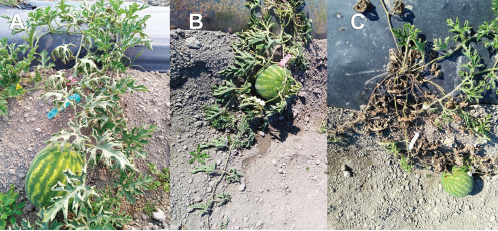 Figure 1. Verticillium wilt symptoms: (A) partial foliar wilt, (B) complete foliar wilt, (C) death of watermelon plant. Carol Miles, Washington State University
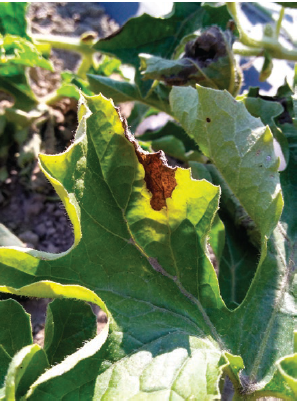 Figure 2. V-shaped chlorotic/necrotic lesion on the margin of a watermelon leaf infected with Verticillium wilt. Carol Miles, Washington State University
discoloration can also occur in above-ground parts of the plant, most notably at the nodes of secondary vines, and in internodal vascular tissues.1,3,4 While the above-ground symptoms of Verticillium wilt are similar to those of other root and vascular diseases, such as Fusarium wilt, the color and pattern of discoloration of the vascular tissues can help distinguish the diseases. In the later stages of the disease, tiny, black microsclerotia develop in the root epidermis of Verticillium infected plants.1
CYCLE AND CONDITIONS
Verticillium dahliae has a wide host range of over 400 crops. The microsclerotia produced by the fungus can survive in the soil for up to 14 years. Exudates from the roots of susceptible host plants can stimulate microsclerotia to germinate and infect root-hair cells and small, secondary roots. The fungus can also infect through root wound sites.1,2,4 Studies have found that inoculum densities of five to twelve microsclerotia per gram of soil are enough to initiate the disease in a watermelon crop.5 The pathogen first colonizes the cortex and root tips of lateral roots, then grows into the xylem (vascular tissue), and finally spreads systemically within the plant. The spores and hyphae produced by the pathogen can plug the xylem elements resulting in a disruption of the movement of water and nutrients from the soil up into the plant.4
Infection and disease development are favored by cool and moist soil conditions. Optimal soil temperatures for germination are between 70° and 75 °F, and the disease develops best between 70° and 81°F. In particular, soil temperatures after flowering can have a substantial impact on disease development, with temperatures less than 50 °F at a depth of 4 inches being most favorable. As soil temperatures rise, the pathogen usually becomes quiescent. However, wilting symptoms are often first observed during warm, dry periods after fruit set when the plants become stressed because the vascular tissue has already been colonized. Microsclerotia form on the infected root tissue late in the season and are released into the soil as the tissue decomposes. Verticillium wilt is not know to be a seedborne disease.1,2,3,4
MANAGEMENT
There are no rescue treatments for Verticillium wilt once plants are infected.4 Initial management efforts focus on avoiding planting of watermelons in fields where the pathogen is established and in which inoculum levels are above the threshold. Avoid planting watermelons in fields previously planted to Verticillium susceptible crops including cotton, potato, and tomato.1,2 Use good field sanitation practices to help prevent the spread of the pathogen into non-infested fields. In infested fields, dispose of crop debris or deep plow to bury inoculum below the root zone. Clean tools and equipment that have been used in infested fields before bringing them into non-infested locations.2,4
Because of the wide host range of Verticillium dahliae and its ability to remain viable in the soil for many years, crop rotation is usually not an effective strategy for managing Verticillium wilt of watermelon. Some pest management guides recommend a three-year rotation to non-host crops, such as corn or other grasses, to help prevent inoculum buildup.1,2 Fumigating soils with chloropicrin and metam sodium can be used to lower Verticillium levels, but regular applications may not be economically feasible for many watermelon production systems. 2,4 In fields known to be infested with the Verticillium pathogen, growers are advised to consider delaying planting until soil temperatures warm to a level that inhibits the development of Verticillium wilt.1,2
Currently, there are no commercially available watermelon varieties that are classified as resistant to or tolerant of Verticillium wilt. However, varietal differences in susceptibility have been observed.3,4 Watermelon seedlings can be grafted onto Verticillium-resistant cucurbit rootstocks to help manage the disease.2,4 No cucurbit rootstocks are completely resistance to Verticillium wilt, but grafting onto some rootstock varieties can result in decreased disease incidence and severity.5 Studies on the effectiveness of grafted watermelons for protection against Verticillium have identified several rootstocks that can help reduce disease levels. Some rootstock varieties resulting from the crossing of Cucurbita moschata with Cucurbita maxima, such as the hybrid variety ‘Tetsukabuto’, have been shown to reduce severity levels of Verticillium wilt of watermelon when used to create grafted seedlings. However, grafted watermelons have not shown acceptable levels of resistance to Verticillium wilt in all studies and trials.5
SOURCES
1Gubler, W. and Bruton, B. 2017. Verticillium wilt. In Keinath, A., Wintermantel, W., and Zitter, T., Eds. Compendium of cucurbit diseases and pests, Second edition. American Phytopathological Society.
2Kurowski, C., Conn, K., Lutton, J., and Rosenberger, S. 2015. Cucurbit disease field guide. Seminis De Ruiter. https://www.vegetables.bayer.com/us/en-us/resources/disease-guides.html
3Pscheidt, J. and Ocamba, C. (Eds.) 2026. Watermelon (Citrullus sp.) – Verticillium wilt. Pacific Northwest Pest Management Handbooks. https://pnwhandbooks.org/plantdisease/host-disease/watermelon-citrullus-sp-verticillium-wilt
4Devi, P. and Miles, C. 2018. Verticillium wilt on watermelon. Washington State University Extension. https://wpcdn.web.wsu.edu/extension/uploads/sites/25/VerticilliumWatermelon9-21-18.pdf
5Devi, P., Tymon, L., Keinath, A., and Miles, C. 2021. Progress in grafting watermelon to manage Verticillium wilt. Plant Pathology 70:767–777. https://doi.org/10.1111/ppa.13344.
Websites verified 7/21/2026
ADDITIONAL INFORMATION
For additional agronomic information, please contact your local seed representative.
Performance may vary, from location to location and from year to year, as local growing, soil and environmental conditions may vary. Growers should evaluate data from multiple locations and years whenever possible and should consider the impacts of these conditions on their growing environment. The recommendations in this article are based upon information obtained from the cited sources and should be used as a quick reference for information about vegetable production. The content of this article should not be substituted for the professional opinion of a producer, grower, agronomist, pathologist and similar professional dealing with vegetable crops.
BAYER GROUP DOES NOT WARRANT THE ACCURACY OF ANY INFORMATION OR TECHNICAL ADVICE PROVIDED HEREIN AND DISCLAIMS ALL LIABILITY FOR ANY CLAIM INVOLVING SUCH INFORMATION OR ADVICE.
7011_909600 Published 07/27/2026