- United States
- expand_more

-
Products
Select Your Brand Below to View Full Portfolio of Offerings
-
Resources
Click Below for Specialized Tips for Your Growing Environment
-
About
Discover More About Our Commitment to Advance Health and Nutrition Globally, Together With You.
-
Innovation

Learn about our approach to innovation.




Click here to download a PDF version of this spotlight.
» Infection of tomato plants by the tomato spotted wilt virus (TSWV) can result in substantial yield losses.
» The use of tomato spotted wilt virus–resistant tomato varieties has been a primary management tool for many years.
» Resistance-breaking strains of the tomato spotted wilt virus are now present in North America.
Tomato spotted wilt (TSW) affects several crop species and is especially damaging to both fresh market and processing tomatoes.1,2 Yield losses of 75 to 100% have been reported on tomatoes in Hawaii.3 In the US, the disease has been observed on tomatoes in Alabama, Arkansas, California, Florida, Georgia, Hawaii, Louisiana, Mississippi, North Carolina, South Carolina, Tennessee, and the Pacific Northwest.3,4,5
A primary method for helping to manage TSW is to use tomato varieties with the Sw-5 gene that conveys resistance to the tomato spotted wilt virus (TSWV). However, new strains of TSWV that break Sw-5 resistance were detected on tomatoes in California in 2017 and North Carolina in 2022. Resistant strains have since been detected in several additional states.2,6 The presence of resistance-breaking TSWV strains poses a threat to tomato production in North America.
SYMPTOMS
Symptoms of TSW on tomatoes can be highly variable, affected by variety, the age of the plant at infection, and environmental conditions.1,5 When infected as seedlings, plants can become severely stunted, show yellowing and bronzing of foliage, may develop necrotic spots or rings on leaves, and can produce irregularly shaped leaves. Infected plants may not produce any fruit, and severe infections can result in seedling death.1,5 Infection in later stages can result in some stunting. Leaves may show a bronze discoloration, and small, dark brown-to-chlorotic spots can develop on the leaves (Figure 1A). Spots can coalesce and become necrotic. Leaf wilt and tip dieback can occur. Developing leaves may cup downward, and purple streaks can develop on stems (Figure 1B).1,3,4,5
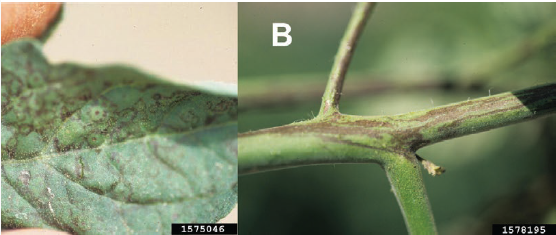 Figure 1. (A) Foliar symptoms of TSW showing ring spots. (B) Purple streak symptoms on the stem. Gerald Holmes, Strawberry Center, Cal Poly San Luis Obispo, Bugwood.org.
Chlorotic to necrotic rings may appear on the fruit (Figure2A).4,5,7 Pale green to chlorotic blotches, concentric rings, and
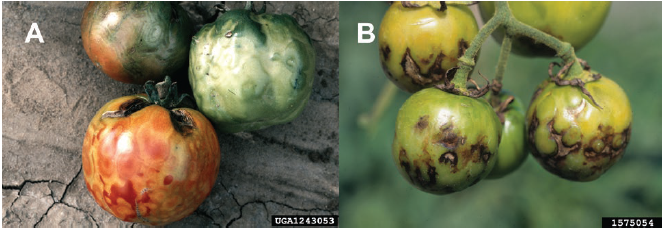 Figure 2. (A) Ring spot symptoms on ripe and green fruit. (B) Necrotic blotches on green fruit. Whitney Cranshaw, Gerald Holmes, Strawberry Center, Cal Poly San Luis Obispo Colorado State University, Bugwood.org.
bumps can form on green fruit (Figure 2B). On maturing fruit, the blotches are often yellow, orange, or green, with concentric rings and black spots. TSW-infected plants often produce small, unmarketable fruit or may not produce any fruit.1,5,8
Plants infected during flowering and fruit set may only show symptoms on one or two shoots. Leaves formed after infection may show green-to-yellow or purple discoloration, with some leaf curling. Bumps may develop on fruit, and fruit may be deformed with ring spots, blotches, and some necrosis.1
Other viral diseases can cause similar symptoms. Rapid diagnostic tests or sending samples to a plant clinic can be used to verify the presence of TSWV.1,6
CYCLE AND CONDITIONS
TSW is caused by the tomato spotted wilt virus (TSWV). This virus has a very wide host range, infecting over 1000 plant species. Many vegetable crops, including pepper, potato, eggplant, celery, and lettuce, are hosts of TSWV. Landscape plants and native plant species, including amaranth, burdock, shepherd’s purse, jimson weed, blue morning-glory, purslane, cheese-weed, chickweed, cocklebur, sowthistle, prickly lettuce, and nasturtium, are also hosts of TSWV.1,4,6,7
TSWV is transmitted by at least ten different species of thrips, with the western flower thrips being the most important vector in many areas. Onion thrips, tobacco thrips, and chili thrips are also common vectors of TSWV. Thrips acquire the virus when they are in the nymph (larval) stage, while feeding on infected plants. The nymphs take the virus into their bodies, where the virus replicates. After reaching the adult stage, infected thrips can transmit the virus to other plants they feed upon, and they can do so for their entire life (30 to 45 days). TSWV is not passed on to the thrips’ offspring.1,3,4,6,7,8
The disease is dispersed over long distances in windblown thrips and on infected plant material, such as transplants, but the virus is not easily transmitted mechanically on contaminated tools or clothing.2,7
DISEASE MANAGEMENT
TSW on tomato can be difficult to manage. The primary method used to help manage TSW on tomato is to plant varieties with the Sw-5 resistance gene, available in many commercial tomato varieties. Some strains of TSWV can overcome this form of resistance; however, they do not commonly occur in many areas.1,2,6 Presence of the gene helps prevent the movement of the viruses within the plant, limiting the virus’s ability to cause disease.9,10
Resistance-breaking strains of TSWV with the ability to infect tomatoes with the Sw-5 gene were detected in Hawaii, Australia, South Africa, and Italy in the late 1990s and early 2000s. More recently, resistance-breaking strains have been documented in California and North Carolina. Where resistance-breaking strains are present, other management strategies will be needed to help minimize TSW epidemics.9,10
Several cultural practices can help limit infection and minimize disease spread. Start by planting virus-free and thrips-free transplants.1 Tomato transplants should not be grown in the same greenhouse with ornamental planting stock. Quarantine any new plants before bringing them into the greenhouse until they are shown to be insect and disease free. Place screens on greenhouse vents and other openings to prevent the entry of thrips. Monitor greenhouses for thrips using yellow sticky cards and check plants regularly for TSW symptoms. If necessary, apply insecticides or use biologicals to help manage thrips in the greenhouse. Remove and destroy any infected plants and plant debris. Manage weeds in and around greenhouses to eliminate potential reservoirs of the virus.1,5,6
Inspect seedlings for insects and disease symptoms before transplanting. If possible, plant at times that do not coincide with major thrips migration periods. Avoid planting tomatoes near fields of established susceptible crops infected with TSWV or near greenhouses where ornamentals are grown.1,4,5,8
Planting on reflective mulches can help reduce populations of thrips in field plantings before plants have covered the mulch area. Reflective mulches can disorient thrips and help to prevent them from landing on young tomato plants. However, using these mulches can result in cooler soils in early season plantings.6 Covering plants with fine-mesh nets to act as a physical barrier to thrips is a strategy used in some areas.
Monitor the crop for thrips using yellow sticky cards, and scout plants regularly for symptoms of TSW.1 If feasible, rogue out and destroy any symptomatic tomato plants.1,4 Insecticide applications can help to manage thrips on young plants early in the season if thrips are present and symptoms of TSW are observed, but the effectiveness of applications has been inconsistent. The use of contact insecticides alone is usually not effective because they often do not reach the areas where thrips are feeding. The addition of a surfactant has been shown to increase the effectiveness of some insecticides and slow the spread of the disease. Rotate insecticides with different modes of action to help minimize the development of insecticide resistance in thrips populations.4,6,7
Managing weed and volunteer hosts in and around the field can also help remove refuge plants for thrips, sites for thrips reproduction, and reservoirs for the TSW pathogen. Managing dandelion, sow thistle, chickweed, buttercup, and plantain can be especially helpful.1,6 After tomato harvest, promptly remove and/or destroy (till-in) crop debris, preferably on a regional level. Continue to control weeds and volunteer host plants during periods of fallow and on non-cropped land near next year’s tomato fields.1,8
SOURCES
1Gilbertson, R., Batuman, O., LeStrange, M., Turini, T., Stoddard, S., Miyao, G., Ullman, D. Tomato spotted wilt disease: Detection, epidemiology, and integrated pest management (IPM). UC IPM. https://ipm.ucanr.edu/PDF/PMG/Tomato_Spotted_Wilt_Print.pdf
2Batuman, O., Turini, T., Oliveira, P., Rojas, M., Macedo, M., Mellinger, H., Adkins, S., and Gilbertson, R. 2017. First report of a resistance-breaking strain of tomato spotted wilt virus infecting tomatoes with the Sw-5 Tospovirus-resistance gene in California. Plant Disease 101:637. https://doi.org/10.1094/PDIS-09-16-1371-PDN
3Melzer, M., Tripathi, S., Matsumoto, T., Keith, L., Sugano, J., Borth, W., Wieczorek, A., Gonsalves, D., and Hu, J. 2012. Tomato spotted wilt. College of Tropical Agriculture and Human Resources, University of Hawaii at Manoa. PD-81. https://www.ctahr.hawaii.edu/oc/freepubs/pdf/PD-81.pdf
4Jones, J., Zitter, T., Momol, T., and Miller, S. 2014. Compendium of tomato diseases and pests: Second edition. American Phytopathological Society, St. Paul, MN. 52026 Tomato (Solanum lycopersicum) – tomato spotted wilt. Pacific Northwest pest management handbook. https://pnwhandbooks.org/plantdisease/host-disease/tomato-solanum-lycopersicum-tomatospotted-wilt
6Cooper, A. and Meadows, I. 2024. Tomato spotted wilt virus on tomato and pepper. Vegetable pathology factsheets. NC State Extension. https://content.ces.ncsu.edu/tomato-spotted-wilt-virus-on-tomato-and-pepper
7Sherwood, J., German, T., Moyer, J., and Ullman, D. 2009. Tomato spotted wilt. The Plant Health Instructor. DOI:10.1094/PHI-I-2003-0613-02.
8Davis, R., Miyao, G., Subbaro, K., Stapleton, J., Aegerter, B., 2013. Tomato spotted wilt. UC IPM pest management guidelines: Tomato. UC ANR Publication 3470. https://ipm.ucanr.edu/agriculture/tomato/tomato-spotted-wilt/#gsc.tab=0
9Lahre, K., Shekasteband, R., Meadows, I., Whitfield, A., and Rotenberg, D. 2023. First report of resistance-breaking variants of tomato spotted wilt virus (TSWV) infecting tomatoes with the Sw-5 resistance gene in North Carolina. Plant Disease vol. 107(7):2271.
10López, C., Aramburu, J., Galipienso, L., Soler, S., Nuez, F., Rubio, L. 2011. Evolutionary analysis of tomato Sw-5 resistance-breaking isolates of tomato spotted wilt virus. Journal of General Virology 92:210-215. https://doi.org/10.1094/PDIS-11-22-2637-PDN
Websites verified 4/17/2026.
ADDITIONAL INFORMATION
For additional agronomic information, please contact your local seed representative. Performance may vary, Performance may vary, from location to location and from year to year, as local growing, soil and environmental conditions may vary. Growers should evaluate data from multiple locations and years whenever possible and should consider the impacts of these conditions on their growing environment. The recommendations in this material are based upon trial observations and feedback received from a limited number of growers and growing environments. These recommendations should be considered as one reference point and should not be substituted for the professional opinion of agronomists, entomologists or other relevant experts evaluating specific conditions.
BAYER GROUP DOES NOT WARRANT THE ACCURACY OF ANY INFORMATION OR TECHNICAL ADVICE PROVIDED HEREIN AND DISCLAIMS ALL LIABILITY FOR ANY CLAIM INVOLVING SUCH INFORMATION OR ADVICE.
6811_827850 Published 04/17/2026.