- United States
- expand_more

-
Products
Select Your Brand Below to View Full Portfolio of Offerings
-
Resources
Click Below for Specialized Tips for Your Growing Environment
-
About
Discover More About Our Commitment to Advance Health and Nutrition Globally, Together With You.
-
Innovation

Learn about our approach to innovation.



» Several species of stink bug can feed on pepper fruit, resulting in damage that reduces fruit quality and marketability.
» The brown marmorated stink bug has become the dominant species affecting crops in many parts of the US.
» Cultural practices and the application of insecticides can help manage stink bugs on peppers.
Several species of stink bugs can feed on peppers and damage the fruit. Brown, green, and brown marmorated stink bugs can be found on peppers in many regions of the US. The brown marmorated stink bug (BMSB) is native to Asia and was first detected in the US in the 1990s. Since that time, it has become the dominant stink bug species affecting vegetable crops in many areas.1,2,3,4
The BMSB can feed on a wide range of plants, including tomatoes, corn, beans, cucumbers, and peppers.2 Both adult and nymph stages feed primarily on reproductive parts of plants (fruits, seeds, seed pods) using piercing-sucking mouthparts (stylets) that inject digestive juices into plant tissues when they feed.1,2 Stink bugs are highly mobile and readily move from crop to crop with the ability to fly long distances.
STINK BUG DAMAGE TO PEPPER FRUIT
When feeding on pepper fruit, stink bugs probe several sites with their stylets, causing damage to the skin and underlying fruit tissue. As the fruit develops, callus tissue forms, and the affected areas become cloudy, with hard, corky, white-to-yellow patches beneath (Figure 1). It may take one to two weeks after feeding for the damage to become apparent.1,4,5 Stink bug damage can substantially reduce the market value of the fruit, and injured areas are susceptible to secondary infections that cause decay. If feeding occurs while the fruits are still developing, the fruits can become distorted, catfaced, or fail to develop.2,5 Damage can be more severe during warm, dry periods, and colored (mature) peppers may be more attractive to stink bugs than green fruit.3,6
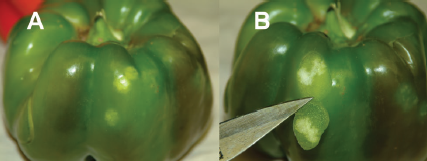 Figure 1. Symptoms of Pseudomonas leaf spot on pepper. (A) Pseudomonas leaf spots often lack the yellow halo commonly seen with bacterial spot. (B) Yellowing of the leaf can occur as lesions coalesce.
IDENTIFICATION OF STINK BUGS ON PEPPERS
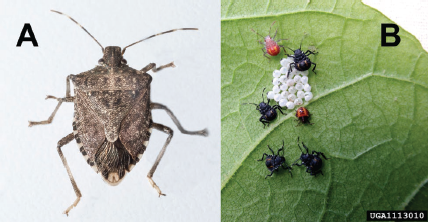 Figure 1. Symptoms of Pseudomonas leaf spot on pepper. (A) Pseudomonas leaf spots often lack the yellow halo commonly seen with bacterial spot. (B) Yellowing of the leaf can occur as lesions coalesce.
Adult stink bugs are shield-shaped, usually 0.5 to 0.63 (13 to 16 mm) long, brown or green, and have an inverted triangle on their backs. The eggs are usually laid on the undersides of leaves and are barrel-shaped, initially white but darkening with age. The nymphs that emerge from the eggs look similar to the adults but are smaller and rounded, often brightly patterned (black, red, white, green).5
The brown marmorated stink bug (Halyomorpha halys) adults are about one half-inch (17 mm) long with rounded shoulders. They have mottled light and dark brown upper bodies with cream colored abdomens, and have alternating light and dark bands on their legs, antennae and the outer edge of their bodies (Figure 2). BMSB nymphs vary in color with age, initially yellow-red with black stripes but turning a darker color as they mature.2,4,6
Green stink bug (Chinavia hilaris) adults are 0.5 to 0.75 inches (13 to 19 mm) long. They have uniform green colored bodies (upper and lower surfaces) with yellow and black bands on the edge of the lower part of their bodies (Figure 3).7
STINK BUG LIFE CYCLE
Stink bugs overwinter as adults in protected areas, such as under plant debris, in weedy areas, wood piles, and in buildings (barns, sheds, houses). The adults become active and move into agricultural crops in the spring and early summer.
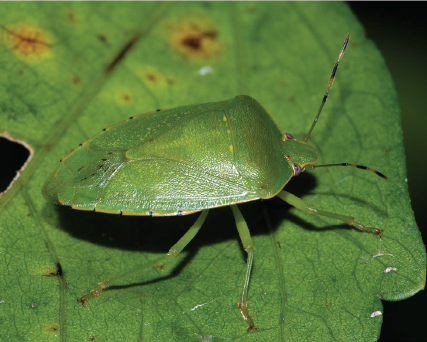 Figure 1. Symptoms of Pseudomonas leaf spot on pepper. (A) Pseudomonas leaf spots often lack the yellow halo commonly seen with bacterial spot. (B) Yellowing of the leaf can occur as lesions coalesce.
Adult stink bugs are strong fliers and can travel up to 70 miles a day to find suitable host plants. They start feeding on a wide range of hosts, including fruit and vegetable crops, such as peppers and tomatoes, as they become available. They feed using their stylet, usually on the plant’s reproductive structures. Adult females lay eggs in groups of 20 or 30 on the undersides of leaves. Newly emerged nymphs feed in groups but scatter and feed individually as they mature.2,4,5
There can be one to several generations per year, depending on the region and temperatures, and populations can decline following periods of heavy rainfall.2,6
SCOUTING AND MONITORING FOR STINK BUGS
Once fruits start to develop, pepper plants should be scouted at least weekly to monitor for stink bug adults and nymphs. Scouting should focus on field edges near wooded areas or other overwintering sites. Plant parts can be shaken over a tray or other light-colored surface so that the adults and nymphs can be counted. The action threshold is usually one stink bug for every three plants. Continue scouting through harvest.1,4,5,6
MANANGING STINK BUGS IN PEPPERS
Managing stink bug damage in peppers can be difficult because the insects are strong fliers that migrate readily, and symptoms may appear after the insects have moved on. Overwintering populations may be reduced by managing weeds and crop debris in fields and along field edges. Covering plants with floating row covers can provide a physical barrier to keep adults off of plants, but the timing can be tricky. The row covers need to be in place before the stink bugs are present, but after the fruits have been pollinated, which may not be feasible.1,2,5
Insecticide applications can help protect fruit from stink bug feeding, but the relief can be short-lived. Knocking down the first population on peppers is needed to protect fruit from damage, and fruits need to be protected from initial fruit set through harvest. 2,4 Because infestations often start on field edges, border sprays can help manage stink bugs without needing to treat the entire field. Insecticides are most effective against young nymphs are usually not recommended for use against adults. To help protect pollinators, apply insecticides in the evening, when bees are less active, and choose products that are less harmful to non-target insects. Check regional pest management guides for recommendations on registered products. Always consult current pesticide labels for application instructions and restrictions.2,4,6
SOURCES
1Bessin, R. 2026. ENTFACT-301: Common insects attacking peppers. University of Kentucky, Department of Entomology. https://entomology.mgcafe.uky.edu/ef301
22025. Pepper, eggplant: Brown marmorated stink bug. Hortsence, Washington StateUniversity. https://hortsense.cahnrs.wsu.edu/fact-sheet/pepper-eggplant-brown-marmorated-stink-bug/
3Lopez, L., and Kuhar, T. 2021. Diagnosing stink bug injury to vegetables. Virginia Tech. ENTO-173NP (ENTO-449NP) https://www.pubs.ext.vt.edu/ENTO/ENTO-173/ENTO-173.html
4Spears, L., Alston, D., Murray, M. 2018. Brown marmorated stink bug management for fruits and vegetables in Utah. All Current Publications. Paper 1888. https://digitalcommons.usu. edu/extension_curall/1888
52026. Stink bugs. Utah vegetable production guide. Utah State University. https://extension.usu.edu/vegetableguide/tomato-pepper-eggplant/stink-bugs
62025. Stink bug, primarily the brown marmorated stink bug (BMSB), Halyomorpha halys. In, Reiners, S., Bihn, E., Curtis, P., Helms, M., Heck, D., Pethybridge, S., Smart, C., Nault, B., Seaman, A., and Sosnoskie, L. (Eds.) 2025 Cornell Integrated Crop and Pest Management Guidelines for Commercial Vegetable Production. Cornell Cooperative Extension.
7Holthouse, M., Schumm, Z., Alston, D., and Spears, L. 2019. Common stink bugs of Utah. Utah State University Extension. All Current Publications. Paper 1996. https://digitalcommons.usu.edu/extension_curall/1996
Websites verified 8/27/2026
ADDITIONAL INFORMATION
For additional agronomic information, please contact your local seedrepresentative. Performance may vary, Performance may vary, from location to location and from year to year, as local growing, soil and environmental conditions may vary. Growers should evaluate data from multiple locations and years whenever possible and should consider the impacts of these conditions on their growing environment. The recommendations in this material are based upon trial observations and feedback received from a limited number of growers and growing environments. These recommendations should be considered as one reference point and should not be substituted for the professional opinion of agronomists, entomologists or other relevant experts evaluating specific conditions.
BAYER GROUP DOES NOT WARRANT THE ACCURACY OF ANY INFORMATION OR TECHNICAL ADVICE PROVIDED HEREIN AND DISCLAIMS ALL LIABILITY FOR ANY CLAIM INVOLVING SUCH INFORMATION OR ADVICE.
6415_969250 Published 09/18/2026