- United States
- expand_more

-
Products
Select Your Brand Below to View Full Portfolio of Offerings
-
Resources
Click Below for Specialized Tips for Your Growing Environment
-
About
Discover More About Our Commitment to Advance Health and Nutrition Globally, Together With You.
-
Innovation

Learn about our approach to innovation.


» Several species in the fungal genus Stemphylium can cause leaf spots on spinach.
» Several inoculum sources can initiate disease epidemics in spinach fields.
» Cultural practices, seed treatments, disease resistance, and fungicide applications can be used to help manage Stemphylium leaf spot of spinach.
Stemphylium leaf spot of spinach was first observed in 1997 in the Salinas Valley of California. Since then, the disease has been observed in Arizona, Delaware, Florida, Maryland, New York, Oregon, Texas, and Washington.1,2,3 Initially, the disease was not considered to be of major importance, and the damage from infection was considered minor. However, Stemphylium leaf spot is now recognized as a problem for fresh market, processing, and seed-crop spinach production systems, possibly due to the appearance of new species of Stemphylium and the development of fungicide resistance in pathogen populations.2,4
The fungal pathogen was originally named Stemphylium botryosum f. sp. spinacea. However, further research has shown that three species of Stemphylium (S. beticola, S. vesicarium, and S. drummondii) are the causal agents of Stemphylium leaf spot, and the original name (S. botryosum f. sp. spinacea) is no longer considered valid. Stemphylium vesicarium and S. beticola are the most commonly occurring species on spinach in the US. Stemphylium drummondii has only been detected on spinach a few times in the US and at a low incidence level.2 Both S. beticola and S. vesicarium can infect crop species other than spinach. Stemphylium beticola can also cause leaf spot diseases on sugar beet, lentil, and lupin, while S. vesicarium has been isolated from a wide range of hosts, including onion, asparagus, and pear.
SYMPTOMS
Foliar symptoms on spinach start as pinpoint-sized, circular, sunken spots, becoming circular to oval, gray-green spots 0.13 to 0.25 inches in diameter. Over time, the spots continue to enlarge and become tan colored. Later, spots can coalesce with the affected tissue becoming brown and dry with a papery texture.1,4 Symptoms develop most rapidly on older leaves, and defoliation can occur when the disease is severe. The lack of fungal growth appearing on Stemphylium leaf spot-affected tissues can help distinguish these symptoms from those of other foliar diseases, such as downy mildew, anthracnose, and Cladosporium leaf spot. Stemphylium leaf spot symptoms can be similar to contact herbicide injury or fertilizer burn.4
There are subtle differences in symptoms caused by S. beticola and S. vesicarium. Symptoms caused by S. vesicarium can form fairly quickly, sometimes within 24 hours after infection. The resulting spots are tan with dark brown margins. Symptoms from S. beticola infection may take 7 to 14 days to appear, and these spots are somewhat larger, white to brown, and with diffuse margins.2
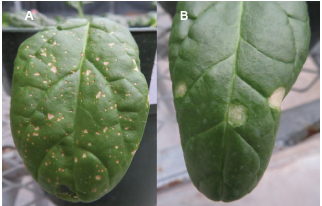 Figure 1. Symptoms of Septoria leaf spot on spinach. (A) Spots caused by S. vesicarium usually are tan with dark brown, well defined margins. (B) Spots caused by S. beticola are usually white to light brown with diffuse margins. Lindsey du Toit, Washington State University.
CYCLE AND CONDITIONS
Stemphylium leaf spot is usually most severe when conditions are humid and moderately warm. The most damage typically occurs at temperatures between 65° and 74°F when relative humidity levels are above 80%.1,2,3 Inoculum of the pathogen(s) can come from several sources. The fungus can survive in colonized spinach residues, on infected volunteer spinach plants, on infected spinach seeds, and possibly on alternate host species.3 On spinach residue sitting on the soil surface, the pathogen can overwinter and form a spore-producing structure called a pseudothecium that produces sexual spores called ascospores. Pseudothecia do not form on buried residue. Cool, wet conditions in the spring promote the development of these structures and ascospores. Ascospores may be released from the pseudothecia, beginning when air temperatures warm in the spring. They may then be dispersed by air currents and splashing water.1,2 Both S. beticola and S. vesicarium have been shown to be transmitted externally on the seed coat and internally in the embryo of infested spinach seed.2,3 Levels of detection on and in seeds can vary greatly, but seed detection levels do not always correlate well with the number of seedlings that become infected in grow-out tests.1,2
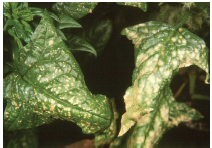 Figure 2. Symptoms of Cladosporium leaf spot (left, caused by Cladosporium variabile) vs. Stemphylium leaf spot (right, caused by Stemphylium beticola). Mike Derie, Washington State University.
MANAGEMENT
Strategies for management of Stemphylium leaf spot include cultural practices, disease resistant varieties, and the application of fungicides. Some of the cultural practices focus on limiting the periods of leaf wetness which can favor infection by the pathogen, as longer periods of leaf wetness are associated with higher disease incidence and severity. When possible, avoid the use of overhead irrigation, reduce the frequency of irrigation, irrigate early in the day to allow plants to dry before sunset, and orient rows into the direction of prevailing winds to promote better air circulation in the canopy. Many baby spinach crops are irrigated with overhead sprinklers, so irrigation frequency and time of application are especially important for these crops.2,3
Incorporate spinach residues promptly after harvest. Burying infested crop debris helps to minimize the production of ascospores the following season. Discing in volunteer plants and crop residues helps reduce the survival of the pathogen in the off-season. It is recommended that growers avoid sequential plantings of spinach and increase the duration of rotations away from spinach.1,2,3
Spinach varieties with resistance to Stemphylium leaf spot are available for fresh market and processing production. However, many of the studies evaluating resistance focused primarily on resistance to S. beticola, which may or may not also provide resistance to S. vesicarium.2,3 One study evaluated resistance to Stemphylium leaf spot over a three year period and found that 11% to 27% of the tested varieties (depending on the year) were rated as resistant to S. vesicarium, and 29% to 48% were rated as moderately resistant. The authors of this study also noted that there may be different resistance factors for the two Stemphylium species present on spinach in the US. 3 It is recommended that growers avoid using varieties highly susceptible to Stemphylium leaf spot unless alternative management strategies, such as fungicide applications, will be used.
Seed treatments, using either chlorine or hot water, may help reduce the amount of seedborne inoculum and disease levels in the field. Hot water treatment of seeds at 104° to 122°F for 10 to 20 minutes has been shown to be partially effective in the management of Stemphylium leaf spot. However, species of Stemphylium have been shown to tolerate fairly high temperatures. Therefore, hot treatments will probably be most effective on seed lots with low infection levels and where the inoculum is mostly located externally on the seed coat. Chlorine treatments will also be more effective for inoculum on the seed coat rather than in the embryo.1,2,3 Fungicide seed treatments may help reduce both external and internal inoculum. However, fungicide resistance has been documented in some Stemphylium populations.3
Foliar fungicide applications can be used to help lower infection rates and disease development. The Stemphylium pathogens can use pollen on the leaves as a source of nutrition to increase rates of infection. Therefore, it is recommended that fungicides be applied just before the initiation of pollen shed.1 Fungicide resistance has been observed to FRAC group 11 fungicides, including azoxystrobin and pyraclostrobin, reducing the effectiveness of these fungicides. One study found that 100% of the S. vesicarium isolates tested showed resistance to FRAC 11 fungicides, but none of the S. beticola isolates showed resistance.5 This may help explain the increase in prevalence of S. vesicarium over S. beticola in spinach producing areas in the US. The use of fungicides for managing Stemphylium leaf spot is limited because some fungicides are only registered for use on spinach grown for seed. In addition, more than 60% of fresh market spinach production in the US is certified organic, which limits the number of fungicides available for use.1,2,3,5
SOURCES
1 du Toit, L. and Ocamb, C. 2025. Spinach (Spinacia oleracea) – Stemphylium leaf spot. Pacific Northwest Pest Management Handbook. https://pnwhandbooks.org/plantdisease/host-disease/spinach-spinacia-oleraceastemphylium-leaf-spot
2Spawton, K. and du Toit, L. 2024. Characterization of Stemphylium species associated with Stemphylium leaf spot of spinach (Spinacia oleracea). Plant Disease 108(12):3578-3667. https://apsjournals.apsnet.org/doi/10.1094/PDIS-10-23-2223-RE
3Spawton, K. A., Stein, L. A., and du Toit, L. J. 2023. Evaluation of spinach cultivars for resistance to Stemphylium leaf spot (Stemphylium vesicarium) and white rust (Albugo occidentalis). HortScience, 59(1), 51–63. https://doi.org/10.21273/HORTSCI17373-23
4Koike, S. and LeStrange, M. 2009. Stemphylium leaf spot. UC IPM Pest Management guidelines: Spinach, UC ANR Publication 3467. https://ipm.ucanr.edu/agriculture/spinach/stemphylium-leaf-spot/#gsc.tab=0
5Spawton, K.A., and du Toit, L.J. 2024. Prevalence of FRAC group 11 fungicide resistance in Stemphylium vesicarium isolates, but not S. beticola isolates, causing Stemphylium leaf spot of spinach (Spinacia oleracea). Plant Disease 108:2122-2135.
https://doi.org/10.1094/PDIS-11-23-2328-RE
Websites verified 3/10/2026
ADDITIONAL INFORMATION
For additional agronomic information, please contact your local seed representative. Performance may vary, from location to location and from year to year, as local growing, soil and environmental conditions may vary. Growers should evaluate data from multiple locations and years whenever possible and should consider the impacts of these conditions on their growing environment. The recommendations in this article are based upon information obtained from the cited sources and should be used as a quick reference for information about vegetable production. The content of this article should not be substituted for the professional opinion of a producer, grower, agronomist, pathologist and similar professional dealing with vegetable crops.
BAYER GROUP DOES NOT WARRANT THE ACCURACY OF ANY INFORMATION OR TECHNICAL ADVICE PROVIDED HEREIN AND DISCLAIMS ALL LIABILITY FOR ANY CLAIM INVOLVING SUCH INFORMATION OR ADVICE.
6511_764700 Published 03/10/2026