- United States
- expand_more

-
Products
Select Your Brand Below to View Full Portfolio of Offerings
-
Resources
Click Below for Specialized Tips for Your Growing Environment
-
About
Discover More About Our Commitment to Advance Health and Nutrition Globally, Together With You.
-
Innovation

Learn about our approach to innovation.

» Squash vein yellowing virus (SqVYV) infection of watermelon causes the disease watermelon vine decline.
» SqVYV is transmitted by the sweetpotato whitefly.
» Planting disease free transplants, eliminating weed hosts, and managing whiteflies may help control watermelon vine decline.
SqVYV History and Impact on Watermelon Yellowing viruses have become increasingly important and impactful pathogens on cucurbit crops, including watermelon, in the US over the past 20 years.1 In 2003, watermelon plants were observed with symptoms resulting from an infection by a new viral pathogen. This virus was later determined to be the same as one detected on squash plants growing in Florida in 2005. The newly identified virus was named squash vein yellowing virus (SqVYV).2,3 The virus is now considered to be endemic in Florida and has been detected on cucurbit crops in Arizona, California, Georgia, and South Carolina. The disease on watermelon was given the name watermelon vine decline because the disease causes a sudden decline and collapse of vines just before harvest.2,3,4,5 SqVYV epidemics have occured in Florida consistently since 2003 with losses reaching 50 to 100%.5 Currently, all commercial watermelon varieties are susceptible to SqVYV and watermelon vine decline.3
SYMTOMPS OF WATERLMELON VINE DECLINE
Watermelon plants are susceptible to infection by SqVYV at any age, but symptoms typically appear at or just before the harvest period. In inoculation trials, symptoms usually developed 12 to 16 days after inoculation, regardless of plant age.3,6 The initial symptoms are a wilting of young leaves near the tips of vines and the yellowing of veins of infected leaves.1,3,6 Within a few days of the initial appearance of symptoms, petioles become necrotic, the leaf blades collapse, and the stems of infected vines become necrotic resulting in the rapid wilt and death of affected vines (Figure 1). Usually, vine decline does not develop on plants that have not set fruit.1,3,5,6 The vine decline symptoms are most severe in watermelon, but they occur in a few other cucurbit species, such as Cucurbita maxima.5
The fruit on infected plants usually develop necrosis of the internal rind and a degradation of the flesh (Figure 2). Changes
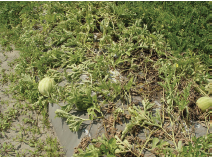 Figure 1. Symptoms of Pseudomonas leaf spot on pepper. (A) Pseudomonas leaf spots often lack the yellow halo commonly seen with bacterial spot. (B) Yellowing of the leaf can occur as lesions coalesce.
in acid and sugar content of the flesh results in offflavors, and infected fruit are usually not marketable.1,3,5 Fruit symptoms tend to be less severe on plants that are infected at later stages. Flesh color is more likely to be affected on plants infected at younger stages, and smaller fruit may develop necrotic areas at the blossom end.6 Externally, fruit can appear normal, but fruit quality can deteriorate even if fruit are harvested before the vines have fully collapsed. 2,6
Mixed infections of SqVYV with other viral pathogens, such as papaya ringspot virus, cucurbit leaf crumple virus, or cucurbit yellow stunting disorder virus, are common. Symptoms on plants infected by multiple viruses can vary and identification based on symptoms becomes difficult. Co-infections can also delay the onset of symptoms for two to four days, but yield losses can be more severe.1,3,6
Many cucurbit species can be infected by SqVYV, but only a few show the necrotic symptoms seen on watermelon, and some show only mild symptoms or do not develop symptoms even though the virus is systemically present in the plants.5
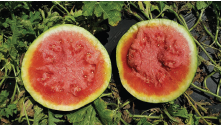 Figure 1. Symptoms of Pseudomonas leaf spot on pepper. (A) Pseudomonas leaf spots often lack the yellow halo commonly seen with bacterial spot. (B) Yellowing of the leaf can occur as lesions coalesce.
SPREAD OF SqVYV IN WATERMELONS
Currently, all known hosts of SqVYV are in the Cucurbitaceae (the cucumber family).3 Long distance (region to region) spread of this pathogen most likely occurs by the movement of infected plant material, such as transplants. Whiteflies are responsible for localized plant-to-plant spread of SqVYV within and between fields within a region.1,3 Specifically, the sweetpotato whitefly type B transmits SqVYV in a semipersistent manner, meaning that the insects can retain and transmit the virus for a short time (usually less than a day). It takes about thirty minutes of feeding on an infected plant for a whitefly to acquire the virus and at least another thirty minutes of feeding to transmit the virus to a new host plant. On average, it takes about three hours to complete the process of acquisition, movement to a new host, and transmission.1,3
Acquisition is best with a four-hour feeding time, and a four- to eight-hour transmission time is most effective. Transmission efficiency is relatively low, with at least thirty whiteflies per plant needed for consistent transmission.7
Disease incidence on watermelon increases as whitefly numbers increase, with the most disease occurring following mild winters. Epidemics are most common where both the whitefly vector and susceptible hosts (cucurbit crops, volunteers, and weed species) can overwinter and oversummer.3 SqVYV was reported on watermelons growing in Indiana in 2006. However, the whitefly vector is not common in Indiana, and the freezing winter temperatures usually prevent the overwintering of the whitefly and any susceptible host crops or weed species. So, SqVYV is not likely to be a common problem on watermelons in Indiana.8
In addition to cucurbit crop species (cucumber, melon, squash, watermelon), SqVYV can infect cucurbit weed species, including balsam apple, balsam pear, and smellmelon.1,2,3 Many host species remain symptomless or show only mild vein yellowing after being infected, despite the virus spreading systemically through the plants. These plants can serve as a source of inoculum for nearby squash and watermelon crops.9
MANAGEMENT OF SqVYV ON WATERMELON
Watermelon growers are advised to plant only diseasefree transplants produced in whitefly-free areas or under conditions that exclude or manage whiteflies in transplant greenhouses. Use of insect screens on houses and the application of approved insecticides can help prevent the infection of seedlings during transplant production.1,2,3 Growers are advised to inspect seedlings for virus-like symptoms prior to transplanting. Seed transmission of SqVYV has not been observed on watermelons. Therefore, infection of direct seeded watermelons is not likely to come from infected seeds.3
Managing whitefly populations in watermelon fields can help lower the incidence and spread of SqVYV in the planting. Insecticide applications starting shortly after transplanting and continuing periodically throughout the season can help slow the plant-to-plant spread of the virus. Alternate applications of insecticide products with different modes of action to help prevent the development of insecticide resistance in the whitefly population. Growers are encouraged to consult regional pest management guides for recommendations on products to use for managing whiteflies in their area.2,3
Using UV-reflective mulches may help reduce whitefly feeding and transmission of SqVYV, but research trials with reflective mulches for managing watermelon vine decline have shown inconsistent results.2,3,10
The elimination of weed hosts and volunteers may help to slow the spread of SqVYV by lowering inoculum levels and whitefly populations in areas where such practices are feasible.1,3 Roguing out infected watermelon plants can slow the spread of the disease in the field. The prompt post-harvest destruction (burn down and incorporation) of cucurbit crops can also help lower inoculum and whitefly levels to protect later plantings. Where feasible, a regional two-month cucurbit-free period, can help reduce the levels of SqVYV and other pests and pathogens of these crops.1,2,3
So far, all commercial watermelons that have been evaluated are susceptible to infection by SqVYV. However, some variation in susceptibility has been documented. Sources of resistance have been found in some watermelon lines and in other cucurbit species.2,3 One greenhouse study evaluated 218 watermelon lines for resistance to SqVYV and found that none of the lines tested were immune to the virus but some showed various levels of resistance that slowed disease development. These may be useful in efforts to develop commercial watermelon varieties with resistance to SqVYV infection.4 Grafting watermelons onto SqVYV resistant rootstocks has not shown to be effective for managing watermelon vine decline.2,3
SOURCES
1Melanson, R. A., Wintermantel, W. M., Sikora, E. J., and Singh, R. 2024. Whiteflytransmitted and yellowing viruses in watermelon and other cucurbit crops. Mississippi State University Extension. Publication 3439. https://extension.msstate.edu/publications/whitefly-transmitted-and-yellowing-viruseswatermelon-and-other-cucurbit-crops
2Kousik, C. S., Adkins, S., Turechek, W. W., Webster, C. G., Webb, S. E., Baker, C. A., and Roberts, P. D. 2012. Progress and challenges in managing watermelon vine decline caused by whitefly-transmitted Squash Vein Yellowing Virus (SqVYV). Israel Journal of Plant Sciences 60(4):435-445. https://www.tandfonline.com/doi/abs/10.1560/IJPS.60.4.435
3Adkins, S., Turechek, W., Roberts, P., Webb, S., Baker, C., and Kousik, C. 2017. Squash vein yellowing. In Keinath, A. P., Wintermantel, W. M., and Zitter, T. A., Eds. Compendium of Cucurbit Diseases and Pests, Second Edition. American Phytopathological Society. https://doi.org/10.1094/9780890545744
4Kousik, C., Adkins, S., and Roberts, P. 2009. Sources of Resistance in U.S. Plant Introductions to Watermelon Vine Decline Caused by Squash Vein Yellowing Virus. HortScience 44:256-262. https://doi.org/10.21273/HORTSCI.44.2.256
5Webster, C. G., Kousik, C. S., Turechek, W. W., Webb, S. E., Roberts, P. D., and Adkins, S. 2013. Squash vein yellowing virus Infection of vining cucurbits and the vine decline response. Plant Disease 97(9):1149-1157. https://apsjournals.apsnet.org/doi/abs/10.1094/PDIS-01-13-0076-RE
6Adkins, S., McCollum, T. G., Albano, J. P., Kousik, C. S., Baker, C. A., Webster, C. G., Turechek, W. W. 2013. Physiological effects of squash vein yellowing virus infection on watermelon. Plant Disease 97:1137-1148. https://doi.org/10.1094/PDIS-01-13-0075-RE
7Webb, S. E., Adkins, S., and Reitz, S. R. 2012. Semipersistent whitefly transmission of squash vein yellowing virus, causal agent of viral watermelon vine decline. Plant disease 96(6):839-844. https://doi.org/10.1094/PDIS-09-11-0761
8Egel, D. S. and Adkins, S. 2007. Squash vein yellowing virus Identified in Watermelon (Citrullus lanatus) in Indiana. Plant Disease 91(8):1056-1056. https://doi.org/10.1094/PDIS-91-8-1056B
9Webster, C. G., Kousik, C. S., Turechek, W. W., Webb, S. E., Roberts, P. D., and Adkins, S. 2013. Squash vein yellowing virus Infection of vining cucurbits and the vine decline response. Plant Disease 97(9):1149-1157. https://doi.org/10.1094/PDIS-01-13-0076-RE
10Kousik, C. S., Adkins, S., Webster, C. G., Turechek, W. W., Stansly, P., and Roberts, P. D. 2015. Influence of insecticides and reflective mulch on watermelon vine decline caused by squash vein yellowing virus (SqVYV). Plant Health Progress 16(1):43-49. https://doi.org/10.1094/PHP-RS-14-0040
Websites verified 9/30/2026
ADDITIONAL INFORMATION
For additional agronomic information, please contact your local seed representative. Performance may vary, from location to location and from year to year, as local growing, soil and environmental conditions may vary. Growers should evaluate data from multiple locations and years whenever possible and should consider the impacts of these conditions on their growing environment. The recommendations in this article are based upon information obtained from the cited sources and should be used as a quick reference for information about vegetable production. The content of this article should not be substituted for the professional opinion of a producer, grower, agronomist, pathologist and similar professional dealing with vegetable crops.
BAYER GROUP DOES NOT WARRANT THE ACCURACY OF ANY INFORMATION OR TECHNICAL ADVICE PROVIDED HEREIN AND DISCLAIMS ALL LIABILITY FOR ANY CLAIM INVOLVING SUCH INFORMATION OR ADVICE.
7011_971700 Published 10/01/2026