- United States
- expand_more

-
Products
Select Your Brand Below to View Full Portfolio of Offerings
-
Resources
Click Below for Specialized Tips for Your Growing Environment
-
About
Discover More About Our Commitment to Advance Health and Nutrition Globally, Together With You.
-
Innovation

Learn about our approach to innovation.


Click here to download a PDF version of this spotlight.
» Pyrethroid insecticides have been the primary means of managing insect pests of sweet corn for many years.
» Sweet corn insect pests have developed resistance to some insecticides.
» Changes in available insecticides, host resistance traits, and insect traits necessitate changes in management practices.
Corn earworm, European corn borer, and fall armyworm are economically important insect pests of sweet corn that have been managed primarily through the use of insecticides. Repeated insecticide applications for controlling these pests, not only on sweet corn but on other host species, such as field corn, cotton, and soybean, has resulted in populations of insects that are resistant to some classes of insecticides.
PYRETHROID INSECTICIDES
The pyrethroids are a group of synthetic insecticides with a mode of action similar to the pesticide pyrethrum, which is produced naturally in chrysanthemum flowers. The pyrethroid insecticides have been widely adopted for crop insect management because they have low toxicity levels to humans and other mammals, and they readily break down in the environment. These products can be harmful to beneficial insects, such as bees, and aquatic organisms, so they should be used with care, following the labeled directions.
Pyrethroids began to be used to manage insect pests of sweet corn in the 1980s, and they continue to be widely used on sweet corn today. However, insecticide resistant populations of some sweet corn pests began to be reported in the 1990s, and the trend for increased levels of resistance continues (Figure 1).1,2
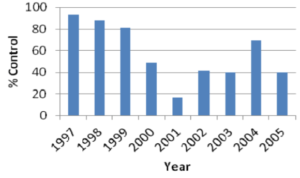 Figure 1. Declining efficacy of pyrethroid applications for corn earworm control.2
CORN EARWORM
Corn earworm (CEW) is one of the most economically damaging insect pests of sweet corn. The insect overwinters in southern areas of the U.S., below the 40° latitude. The insect is a pest of corn (field and sweet), soybean, cotton, and sorghum. Adult CEW moths migrate north in the spring, laying eggs on crops. The widespread use of insecticides to manage CEW on crops in the southern regions has resulted in the development of populations that are resistant to some insecticides. The use of insecticides on crops in the northern areas has had minimal impact on the development of resistance, because the insects that develop in the north do not survive the cold winters; thus any resistant individuals are not able to pass on their traits to later generations. Some reverse migration, moths moving southward, may occur in the fall, but this probably does not have a significant impact on the development of resistance.3
Pyrethroids are the primary class of insecticides used to manage CEW on sweet corn, and many products in this class are available, including Asana® XL (esfenvalerate), TombstoneTM (cyfluthrin), Baythroid® XL (beta-cyfluthrin), Warrior II with Zeon Technology® (lambda-cyhalothrin), Mustang® Maxx® (zeta cypermethrin), and Hero® Insecticide (zeta cypermethrin and bifenthrin).4 The use of these products in the southern areas of the U.S. has resulted in the development of insecticide resistant CEW populations that migrate northward in the spring.3,4
While the pyrethroid insecticides remain mostly effective in areas such as the Midwest, there have been sporadic failures of control and decreased efficacy of applications in some locations and years4,5, and low to moderate levels of resistance have been documented in the Midwest. Increased rates of application may be needed to provide adequate control.5,6 In some areas, such as Texas, up to ten-fold increases in resistance of CEW to pyrethroid insecticides have been observed.7
EUROPEAN CORN BORER
The widespread use of Bt field corn hybrids has significantly reduced populations of some insect pests of sweet corn. In particular, the populations of European corn borer (ECB) throughout the U.S. are much lower than they were prior to the adoption of Bt field corn hybrids. This has reduced the impact of this pest on sweet corn production and the need to apply insecticides to manage them.6 However, resistance to the Bt toxin has been documented in ECB.8
Unlike CEW, which only overwinters in southern areas, ECB overwinters throughout the sweet corn growing regions of the country. Widespread overwintering of ECB means that selection for insecticide resistant individuals in all areas could contribute to the development of resistant populations of ECB.
FALL ARMYWORM
As with CEW, fall armyworm (FAW) does not overwinter in northern locations. Overwintering occurs in the southern U.S., and adults migrate northward during the growing season. Therefore, the use of insecticides in the southern growing regions and the development of insecticide resistant populations there determine the levels of resistance seen in northern locations. FAW populations showing resistance to several classes of insecticides, including pyrethroids, organophosphates, and carbamates, were documented in the 1990s1, and efforts to manage and slow the development of these resistant populations are underway.
CORN ROOTWORM
The introduction of sweet corn varieties with the Bt Cry3Bb1 trait provided a new tool for managing corn rootworm (CRW). However, the widespread use of this trait in field corn has resulted in the development of populations of western CRW that are resistant to the effects of the Cry3Bb1 protein. Performance problems of field corn with the Cry3Bb1 trait were first reported in southern Minnesota and eastern Iowa in 2009 and additional states in following years.9
In 2016, the Environmental Protection Agency (EPA) revised requirements for using Bt traits in field corn to control CRW in order to delay further development of resistant CRW.10 In areas where Bt resistant CRW have been documented, field corn seed companies are required to work with farmers to implement integrated pest management (IPM) practices, including rotations with non-CRW host crops, the use of field corn varieties with multiple (pyramided) Bt traits, and the planting of non-Bt CRW protected field corn with a soil-applied insecticide at planting.
The EPA has documented Bt resistant CRW populations in parts of Iowa, Nebraska, and Illinois, and it has designated a resistant CRW “red zone” for areas of the field corn belt that use cultural and planting practices that favor the development of resistant CRW populations (Figure 2). The situation with resistance in field corn will also impact efforts to control CRW problems in Performance Series® sweet corn with the Cry3Bb1 trait.
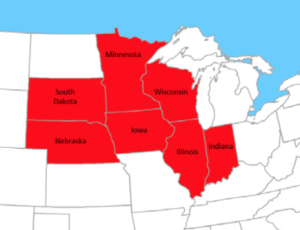 Figure 2. US EPA designated “red zone” states at risk for developing Bt resistant populations of corn rootworm. 8
NEW INSECTICIDES
Although sweet corn growers have relied on pyrethroid insecticides for many years, new types of insecticides with different modes of action have become available, and trials have shown that these products can be used to effectively control pests such as CEW, ECB, and FAW.6,11 These insecticides include the bacterial based products Spinosad (Blackhawk®) and Spinetoram (Radiant®), and the diamide insecticides Flubendiamide (Belt® and Vetica®), chlorantraniliprole (Coragen®), and chlorantraniliprole+lambda cyhalothrin (Besiege®).
Non-pyrethroid products, such as Coragen®, Radiant® , and Blackhawk®, have been shown to provide good control of CEW in sweet corn. The rotation of applications of pyrethroid insecticides with insecticides in different mode-of-action classes can help delay the development of resistant populations of CEW, especially in the southern, overwintering regions of the country.5
SOURCES
1 Yu, S. 1991. Insecticide resistance in the fall armyworm, Spodoptera frugiperda (J. E. Smith). Pesticide Biochemistry and Physiology 39:84-91.
2 Foster, R. 2007. Corn earworm: Is it resistant to pyrethroids? Purdue University Extension. https://ag.purdue.edu/hla/fruitveg/Presentations/Forms/Web%20View.aspx.
3 Flood, B. and Rabaey, T. 2007. Potential impact of pyrethroid resistance in Helicoverpa zea to the Midwest processing industry: sweet corn and snap beans. Plant Health Progress doi:10.1094/PHP-2007-0719-06-RV.
4 Jacobson, A., Foster, R., Krupke, C., Hutchison, W., Pittendrigh, B., and Weinzierl, R. 2009. Resistance to pyrethroid insecticides in Helicoverpa zea (Lepidoptera: Noctuidae) in Indiana and Illinois. J. Econ. Entomol. 102:2289-2295.
5 Welty, C. and Jasinski, J. 2013. Sweet corn insect management by insecticides in Ohio, 2013 Final report. Ohio State University. http://entomology.osu.edu/welty/.
6 Shelton, A. and Olmstead, D. 2012. New challenges and management options for caterpillar control in sweet corn. http://www.hort.cornell.edu/expo/2012proceedings.php.
7 Pietrantonio, P.V. et al. 2007. Detection and evolution of resistance to the pyrethroid cypermethrin in Helicoverpa zea (Lepidoptera: Noctuidae) populations in Texas. Environ. Entomol. 36:1174-1188.
8 Ostlie K. et al. 2016. Bt corn and European corn borer. University of Minnesota Extension. http://www.extension.umn.edu/agriculture/corn/pest-management/bt-corn-and-european-corn-borer/.
9 Krupke, C. 2013. Managing western corn rootworm resistance to Bt on the fringe. Purdue Cooperative Extension Service, Pest & Crop, 2013, issue 4.
10 EPA. 2016. Framework to delay corn rootworm resistance. https://www.epa.gov/regulation-biotechnology-under-tsca-and-fifra/framework-delay-corn-rootworm-resistance.
11 Kuhar, T. 2015. Insect management trials in sweet corn in Virginia. http://www.hort.cornell.edu/expo/2015proceedings.php
Web sources verified 08/25/2016.
ADDITIONAL INFORMATION
For additional agronomic information, please contact your local seed representative.
IMPORTANT: Produce Marketing and Stewardship Requirements for Performance Series® sweet corn: This product has been approved for import into key export markets with functioning regulatory systems. Any crop or material produced from this product can only be exported to, or used, processed or sold in countries where all necessary regulatory approvals have been granted. It is a violation of national and international law to move material containing biotech traits across boundaries into nations where import is not permitted. It is the grower’s responsibility to talk to their produce handler or purchaser to confirm their buying position for this produce so that the marketing requirements can be met.
U.S. Herbicide Information for Performance Series® sweet corn: Roundup PowerMAX®*, Roundup PowerMAX® II* and Roundup WeatherMAX® herbicides are approved for use on Performance Series® sweet corn (containing Roundup Ready® 2 Technology) in all U.S. states, the District of Colombia and Puerto Rico. If the directions for use on sweet corn with Roundup Ready® 2 Technology (which includes Performance Series® sweet corn) are not listed in the product label that is attached to the product you purchased, contact your Bayer representative.
*Roundup PowerMAX® and Roundup PowerMAX® II are only approved for use in the U.S. Roundup PowerMAX® II is not registered in all states and may be subject to use restrictions. The distribution, sale, or use of an unregistered pesticide is a violation of federal and/or state law and is strictly prohibited. Check with your local dealer or representative for the product registration status in your state.
Canada Herbicide Information for Performance Series® sweet corn: Roundup® brand glyphosate-only agricultural herbicides are approved for use on Performance Series® sweet corn (containing Roundup Ready® 2 Technology) in Canada. If the directions for use on sweet corn with Roundup Ready® 2 Technology (which includes Performance Series® sweet corn) are not listed in the product label that is attached to the product you purchased, contact your Bayer representative.
All growers in Idaho and Oregon who intend to plant Performance Series® sweet corn must contact Seminis Vegetable Seeds, Inc. at 866-334-1056 to order Performance Series® sweet corn seed. Performance Series® sweet corn may only be sold into the Treasure Valley area of Idaho and Oregon (which consists of Ada, Canyon, Gem, Owyhee, Payette and Washington counties in Idaho and Malheur County in Oregon) during the time period beginning on January 1 and ending on February 15 of each calendar year. Growers must inform Seminis Vegetable Seeds, Inc. of the location(s) of their Performance Series® sweet corn field(s) to ensure pinning prior to delivery of Performance Series® sweet corn seed.
Performance Series® sweet corn Insect Resistance Management (IRM) – Post-Harvest Requirements: Crop destruction must occur no later than 30 days following harvest, but preferably within 14 days. The allowed crop destruction methods are: rotary mowing, discing, or plowing down, or, for home garden use only allowed in the U.S., by chopping up the stalks using home garden tools such as a hoe. Crop destruction methods should destroy any surviving resistant insects.
ALWAYS READ AND FOLLOW PESTICIDE LABEL DIRECTIONS.
Performance may vary, from location to location and from year to year, as local growing, soil and environmental conditions may vary. Growers should evaluate data from multiple locations and years whenever possible and should consider the impacts of these conditions on their growing environment.
The recommendations in this material are based upon trial observations and feedback received from a limited number of growers and growing environments. These recommendations should be considered as one reference point and should not be substituted for the professional opinion of agronomists, entomologists or other relevant experts evaluating specific conditions.
Roundup Ready® 2 Technology contains genes that confer tolerance to glyphosate. Plants that are not tolerant to glyphosate may be damaged or killed if exposed to those herbicides. Bayer, Bayer Cross, Performance Series & Design®, Roundup PowerMAX®, Roundup Ready 2 Technology and Design®, Roundup Ready® and Seminis & Leaf Design® are registered trademarks of Bayer Group. ©2016 Bayer Group. All rights reserved. 160615133000 DME091416