- United States
- expand_more

-
Products
Select Your Brand Below to View Full Portfolio of Offerings
-
Resources
Click Below for Specialized Tips for Your Growing Environment
-
About
Discover More About Our Commitment to Advance Health and Nutrition Globally, Together With You.
-
Innovation

Learn about our approach to innovation.

Click here to download a PDF version of this spotlight.
» Onion maggot larvae can kill seedlings by feeding on roots and basal stems.
» Maggots feeding on older bulbs can result in colonization by bulb rot pathogens.
» Cultural practices and the application of seed treatment and in-furrow insecticides can help manage onion maggots on onions.
The onion maggot, Delia antiqua, is found in most oniongrowing areas of the US and Canada, and is an important pest on Allium species, including onions, garlic, leeks, and shallots, especially in fields with muck soils or soils with high levels of organic matter. The host range of the onion maggot is limited to just the onion family.1,2 Other maggot species—such as the seedcorn maggot, Delia platura—can also colonize and feed on onions but can have a much larger host range.3
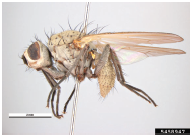 Figure 1. An adult onion maggot fly (Delia antiqua). Pest and Diseases Image Library, Bugwood.org.
PEST IDENTIFICATION
Onion maggot adults are brownish-gray flies that look similar to the common house fly (Figure 1). The adults of the seedcorn maggot are similar to those of the onion maggot but about one-half to one-third the size.2,3 Female flies lay eggs near the base of onion plants near the soil line. Larvae of both onion and seedcorn maggots that hatch from the eggs are creamywhite and about a half inch long (Figure 2).3 Larvae pupate in the soil turning into small, brown pupae (Figure 3).1,2
ONION MAGGOT LIFE CYCLE
Onion maggots overwinter in the soil as pupae, usually near the roots of infested plants. The first generation of adult flies emerges from the soil in the spring, and dates of emergence can be estimated using growing degree day models. Once they emerge, female adult flies can fly up to one mile searching for onions and other suitable hosts on which to lay their eggs. Females are most active in onion fields in the late evening and early morning. At other times, they move out of the field to more protected areas.1,2 Eggs are laid singly or in small groups in soil cracks near onion plants. Eggs survive best in cool, moist soils and usually do not survive once soil temperatures rise over 95°F at depths of one-half to one inch. Larvae hatch from the eggs and begin feeding on onion roots and basal stem tissue. When they are fully mature, larvae migrate into nearby soil and pupate. There are usually three generations of onion maggots per year in most onion-growing regions in the U.S.1
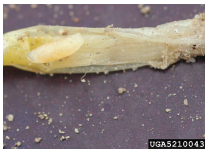 Figure 2. The larva, or maggot, of the seedcorn maggot (Delia platura) looks similar to onion maggot larva. Pest and Diseases Image Library, Bugwood.org.
DAMAGE FROM ONION MAGGOT FEEDING
Larval feeding can destroy the root systems of young plants and create wounds on bulbs that can serve as sites of infection for bulb-rotting bacteria and fungi. The first generation of larvae usually feed on seedlings through the three to five leaf stage.2,3 Tunneling from the feeding of first generation larvae can result in wilting and seedling death. A single larva can kill several onion seedlings, resulting in gaps without plants in a section of row.1 Feeding on bulbs can result in affected plants wilting and becoming chlorotic.4 Less damage is caused by second and third generation larvae, as developing bulbs on older plants are less affected than younger seedlings. It is more difficult for larvae to penetrate older bulbs, but larvae can enter bulbs through pre-existing wounds. Feeding damage on the basal plate can result in distorted growth. The greatest damage from second- and third-generation larvae is the resulting bulb decay.1,3
MANAGEMENT
The presence and numbers of onion maggot adults can be monitored using yellow sticky cards placed around the edges of fields just above the canopy. Fly counts on the cards should be done twice a week.2,3 The dates of emergence of adults can also be estimated using growing degree day (GDD) models.
A base 39.3°F (4°C) degree model should be used because fly development can occur down to that temperature. In New England, the first-generation adults usually start to emerge when the GGD total reaches 735, second-generation adults at 1752 GGD, and third generation adults at 2975 GGD.2 Rotating fields to non-Allium crops can help lower onion maggot damage, but--as mentioned above--the adult female flies can fly up to a mile from where they emerge to find suitable host plants on which to lay their eggs. Avoid planting onions near fields that were planted to Allium species the previous year, fields with high levels of undecomposed organic matter, or onion cull piles. Plant onions at least three-quarters of a mile away from these potential sources of onion maggot adults.1,2,3
When possible, use GDD totals to delay planting onion sets until after the emergence of the first generation of onion maggot adults to avoid that initial window of egg laying. Planting after soil temperatures in the first inch of soil are above 95°F will also help reduce levels of damage from larval feeding.1,2,3 When direct seeding, use a press wheel or chaindrag behind the planter to cover the seed row, or consider using no-till seeding to help discourage egg laying near those plants.
Floating row covers or screen cages can be used as a physical barrier to help keep egg-laying female onion maggots away from young seedlings. The edges of the cover material need to be covered with soil. Covers or cages should not be used in fields planted with onions or other Alliums in the previous season, as they can trap emerging adults with the plants. Remove the covers after the flight of the first generation adults or once upper soil temperatures have reached 95°F.2,4 Minimize any mechanical injury to the plants, such as during post-planting cultivation or ground moving.
Deep plowing of onion fields after harvest can help reduce the survival of overwintering pupae; however, it can have negative impacts on erosion and other aspects of soil health. Remove and dispose of any culls and volunteer onion plants.1,2,3
Natural enemies of onion maggot include ground beetles, rove beetles, parasitic wasps and flies, entomopathogenic fungi, and nematodes. These organisms can help reduce the number of certain onion maggot developmental stages and lower damage levels. However, beneficial insects can be harmed by some standard insecticide applications. So, the dates of application and specific products used should be chosen to help minimize harm to these populations.1,2
Some regional pest management guides recommend treating seeds with insecticides before to planting to help manage onion maggot.1,3 The seed treatment products recommended depend on maggot species that are present (onion, seed corn, or both), as some of the products may be effective against one species but not the other. Products containing spinosad, cyromazine, thiamethoxam, clothianidin, and imidacloprid are registered for control of maggot species on onions.5,6,7 Spinosad (active ingredient in LumiverdTM Insecticide) is active against both species, but reports from New York indicate some decline in effectiveness.5 Cyromazine (Trigard® OMC Insecticide) is reportedly more effective against onion maggot than seedcorn maggot. Thiamethoxam (Cruiser®70 WS Insecticide) may no longer be highly effective for either species.5,6,7 Seed treatments that combine two or more of these products can help to control the first generations of both onion and seedcorn maggots.
Preplant soil applications of insecticides are recommended in some management guides. The insecticides are most effective when applied in-furrow or moved into the root zone with irrigation water after narrow-band, over-the-row applications.1,2 For transplants, applications should be directed at the base of plants shortly after transplanting. Check regional management guides for products recommended in your area. Foliar insecticide applications to older, standing onion crops are generally not considered to provide adequate control of onion maggot. Insecticides to manage second and third generations of onion maggot are often unnecessary and not adequately effective.1,3 Always consult current product labels for application instructions and restrictions.
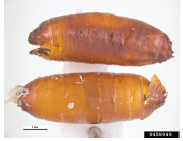 Figure 3. The pupal stage on the onion maggot overwinters in the soil. Whitney Cranshaw, Colorado State University, Bugwood. org.
SOURCES
1Cranshaw, W. 2008. Onion maggot. In Schwartz, H and Mohan, S., Eds. Compendium of Onion and Garlic Diseases and Pests, Second Edition. American Phytopathological Society.
22016. Onion maggot. UMass Extension Vegetable Program. https://www.umass.edu/agriculture-food-environment/vegetable/fact-sheets/onion-maggot
3Dara, S. K. et al. 2024. Maggots. Onion and garlic pest management guidelines. University of California, IPM. https://ipm.ucanr.edu/agriculture/onion-and-garlic/maggots/#gsc.tab=0
42022. Onions, garlic: Onion maggot. Hortsense. Washington State University. https://hortsense.cahnrs.wsu.edu/fact-sheet/onions-garlic-onion-maggot/
5Salgado, L. and Nault, B. 2024. Maggots-be-gone: An update on insecticide seed treatment performance. Onion World. https://onionworld.net/2024/12/06/maggots-be-gone-an-updateoninsecticide-seed-treatment-performance/
6Reiners, S., Bihn, E., Curtis, P., Helms, M., Heck, D., Pethybridge, S., Smart, C., Nault, B., Seaman, A., and Sosnoskie, L. (Eds.) 2025. 2005 Cornell integrated crop and pest management guidelines for commercial vegetable production. Cornell Cooperative Extension.
7Dara, S., Bell, N., and Waters, T. 2025. Vegetable pests. Pacific Northwest Pest Management Handbooks – Vegetable Crops. https://pnwhandbooks.org/insect/vegetable/vegetable-pests/hosts-pests/onion-onionmaggot-seedcorn-maggot
Websites verified 9/23/2025
ADDITIONAL INFORMATION
For additional agronomic information, please contact your local seed representative. Performance may vary, from location to location and from year to year, as local growing, soil and environmental conditions may vary. Growers should evaluate data from multiple locations and years whenever possible and should consider the impacts of these conditions on their growing environment. The recommendations in this article are based upon information obtained from the cited sources and should be used as a quick reference for information about vegetable production. The content of this article should not be substituted for the professional opinion of a producer, grower, agronomist, pathologist and similar professional dealing with vegetable crops.
BAYER GROUP DOES NOT WARRANT THE ACCURACY OF ANY INFORMATION OR TECHNICAL ADVICE PROVIDED HEREIN AND DISCLAIMS ALL LIABILITY FOR ANY CLAIM INVOLVING SUCH INFORMATION OR ADVICE. 6115_627800 Published 10/02/2025