- United States
- expand_more

-
Products
Select Your Brand Below to View Full Portfolio of Offerings
-
Resources
Click Below for Specialized Tips for Your Growing Environment
-
About
Discover More About Our Commitment to Advance Health and Nutrition Globally, Together With You.
-
Innovation

Learn about our approach to innovation.




» The larvae of diamondback moths are among the most damaging insect pests of vegetable Brassica crops.
» Feeding by diamondback moth larvae can dramatically reduce crop yields and lower product quality.
» A combination of cultural practices and insecticide applications can be used to help manage diamondback moths in vegetable brassicas.
Caterpillars are the most important pests of Brassica crops in many growing regions, and of these caterpillars, diamondback moths (Plutella xylostella) are among the most widely distributed and destructive.1,2 Diamondback moths (DBM) occur worldwide, and their host range includes many cruciferous crops, including broccoli, Brussels sprouts, cabbage, cauliflower, kale, rapeseed, and turnip. Feeding by DBM larvae can result in substantial yield reductions and economic losses for growers.2,3,4
IDENTIFICATION
Larvae of DBM are small (1/3 to 1/2 inch long), light greenish-yellow, tapered at both ends, and covered with tiny, erect, black hairs (Figure 1A). When disturbed, the larvae wiggle rapidly, drop from plants, and hang by a silk-like thread. Pupa form on the undersides of leaves wrapped in loosely woven cocoons (Figure 1B).1,2,3
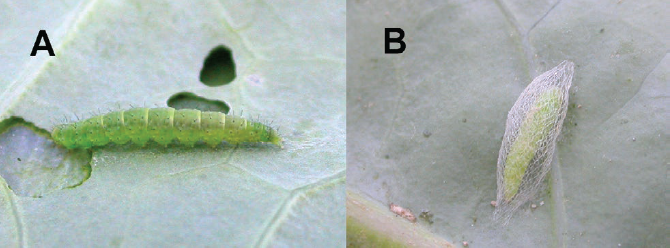 Figure 1. (A) The larval stage of the diamondback moth. (B) the pupal stage in its cocoon.
The bodies of adult moths are 1/3-inch long, slender, and grayish-brown, with wings that flare outward and upward near the rear-end. The wingspan is 15 mm (0.6 inches). The male moths have a light-brown to yellow stripe running along the back, which can appear to be small diamond shapes when at rest, hence the name “diamondback moth”. The moths have long antennae (Figure 3).2,3,4
The moths fly during daylight hours and move rapidly when disturbed.2,3 The adults do not have the ability to travel extended distances and usually fly no more than six feet above the ground. Females lay yellow to pale-green, oval-shaped eggs. Eggs can be laid as individuals or in small clusters of up to eight eggs.4
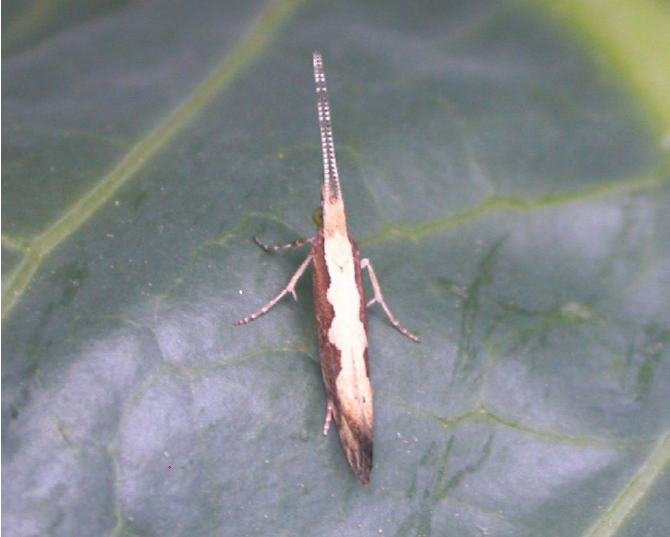 Figure 2. Diamondback moth adult showing the diamond pattern on its back.
DAMAGE
The host range of DBM includes broccoli, Brussels sprouts, cabbage, cauliflower, kale, rapeseed, turnip, and other brassica crop and weed species. Damage occurs by direct feeding, usually on the outer leaves in the upper foliage. However, feeding damage can occur on any above-ground plant parts. The type of damage depends on the larval stage doing the feeding. First instar (just hatched) larvae feed by burrowing into the leaf and mining the internal leaf tissue. Later instar larvae feed primarily on the undersides of leaves, creating irregular holes or windows while leaving the upper epidermis of the leaf intact, producing a “window-pane” effect (Figure 4). Older instars (mature larvae) eat through the leaf entirely.1,2,3,4
Larvae also feed on flower buds and floral stalks. Larvae can burrow into broccoli and cauliflower heads, substantially reducing product quality. Feeding on the inner heart leaves of cabbage before heading can also cause major damage and reduce marketability. Feeding on the growing points of young plants can result in stunting and reduced yields. The presence of larvae and/or insect frass also reduces product quality and marketability.1,3,4
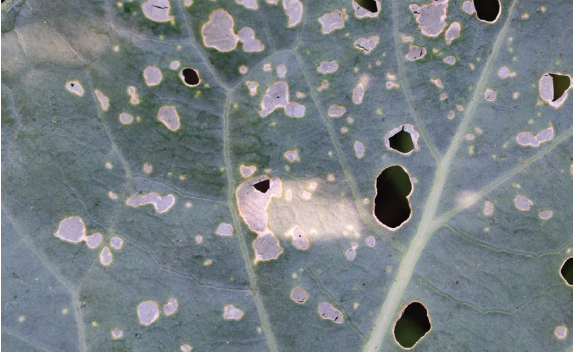 Figure 3. The “window-pane” pattern of damage from larval feeding.
CYCLE
Diamondback moths have fairly short life cycles.2 Adults can survive the non-cropping season on wild or cultivated cruciferous crops in regions with warmer winters. They usually die off in regions with colder winters and must migrate from southern to northern regions over the course of the season.1,4 However, the details of DBM overwintering are somewhat controversial with more for entomologists to discover.5 When adult moths arrive or become active, the females lay eggs mostly on the undersides of young leaves. The eggs usually hatch in five or six days and begin feeding on the leaves of the host plant. Larvae progress through four instar stages over ten to fourteen days (during warm weather conditions), when they enter the pupal stage. Pupae are typically found on the lower and outer leaves of the plant. Following metamorphosis of the pupae, adult moths emerge in five to 15 days. The life span of an adult is usually about two weeks, and females lay eggs for approximately 10 days.1,2,4
MONITORING
Crop scouting is used to monitor the presence and numbers of DBM adults and larvae to help determine the need for insecticide applications.4 Monitoring should be done weekly in the seedling, thinning, and pre-heading crop stages.1 It is recommended that at a minimum, twenty randomly selected plants be examined for larvae and signs of feeding. Pheromone traps can be used to monitor adult moths and determine peak flight times. However, management decisions should be based on larval counts and feeding damage.1,3
MANAGEMENT
Certain cultural practices can help reduce the pressure from DBM in a field. Crop rotation away from Brassica crops for several years can help reduce overwintering populations in future seasons. Avoid stagger-planting Brassica crops in adjacent blocks in the same field during the season, as the moths from a maturing crop can easily move to a younger neighboring crop. In southern Mexico, a three-month Brassica crop-free period is annually enacted to help break the DBM cycle. Carefully inspecting seedlings before transplanting can help prevent the introduction of DBM into a field, and using overhead irrigation can help reduce early instar larvae numbers by washing them off the plants.1,4
The primary method used for managing DBM in Brassica vegetable crops is the application of insecticides. Insecticide applications should begin when counts reach an average of one larva or one feeding hole per ten plants.1,2,3 Some of the insecticide active ingredients recommended for DBM management programs include bifenthrin, carbaryl, cyfluthrin, cyhalothrin, permethrin, and spinosyn-based products. Always consult current product labels for application instructions and restrictions. Product reentry intervals (REI) and preharvest intervals (PHI) need to be considered to align with planned fieldwork and the number of days until harvest.
Resistance to insecticides has developed in some DBM populations, and some instances of resistance to multiple insecticide modes of action have been reported.1,2 IPM practices, such as crop rotation, can help reduce the need for insecticide applications. Some regional pest management guides also encourage the use of lower-risk pesticides to help minimize the effects on non-target organisms, including natural enemies and pollinators.4 Biological control agents, including Bacillus thuringiensis (Bt) and Isaria fumosorosea (an insect parasitizing fungus), are microbiological agents that are available to help with DBM management. Natural enemies, including parasitic wasps (Diadegma insularis and Trichogramma pretiosum), ground beetles, spiders, syrphid fly larvae, and true bugs, are also available and have been shown to help manage DBM in brassica vegetable crops.1,4
SOURCES
1Natwick, E., Joseph, S., Dara, S. 2020. Diamondback moth. How to manage pests: cole crops. University of California IPM, Pest Management Guidelines. http://ipm.ucanr.edu/PMG/selectnewpest.cole-crops.html
2Ballew, J. 2025. Cabbage, broccoli & other cole crop insect pests. Clemson Cooperative Extension Factsheet HGIC 2203. https://hgic.clemson.edu/factsheet/cabbage-broccoli-other-cole-crop-insect-pests/
3Andaloro, J. and Baker, P. 1983. Diamondback moth. Vegetable crop fact sheet. Cornell University Integrated Pest Management. https://ecommons.cornell.edu/handle/1813/43269
4Deiss, F. 2024. Comprehensive guide to identifying and managing the diamondback moth. CABI BioProtection Portal. https://bioprotectionportal.com/resources/identify-and-manage-diamondback-moth/
5Dancau, T., Mason, P., Cappuccino, N. 2018. Elusively overwintering: a review of diamondback moth (Lepidoptera: Plutellidae) cold tolerance and overwintering strategy. The Canadian Entomologist 150(2):156-173.
Websites verified 5/8/2026
ADDITIONAL INFORMATION
For additional agronomic information, please contact your local seed representative.
Performance may vary, from location to location and from year to year, as local growing, soil and environmental conditions may vary. Growers should evaluate data from multiple locations and years whenever possible and should consider the impacts of these conditions on their growing environment. The recommendations in this material are based upon trial observations and feedback received from a limited number of growers and growing environments. These recommendations should be considered as one reference point and should not be substituted for the professional opinion of agronomists, entomologists or other relevant experts evaluating specific conditions.
BAYER GROUP DOES NOT WARRANT THE ACCURACY OF ANY INFORMATION OR TECHNICAL ADVICE PROVIDED HEREIN AND DISCLAIMS ALL LIABILITY FOR ANY CLAIM INVOLVING SUCH INFORMATION OR ADVICE.
10015_849450 Published 05/15/2026