- United States
- expand_more

-
Products
Select Your Brand Below to View Full Portfolio of Offerings
-
Resources
Click Below for Specialized Tips for Your Growing Environment
-
About
Discover More About Our Commitment to Advance Health and Nutrition Globally, Together With You.
-
Innovation

Learn about our approach to innovation.


Click here to download a PDF version of this spotlight.
» The incidence and severity of Fusarium wilt of watermelon is affected by environmental and cultural conditions.
» Soil temperatures, pH, fertilizers, and crop rotation can influence soil populations and disease development of Fusarium wilt.
» Adjusting conditions and cultural practices can help manage Fusarium wilt of watermelon.
Fusarium wilt of watermelon is caused by the fungus Fusarium oxysporum f. sp. niveum (FON), of which there are four races (0, 1, 2, and 3). These races are distinguished by their ability to infect watermelon varieties with various disease resistance genes.1,2 Many commercial varieties have resistance to races 0 and 1, and as a result, race 2 has become the most widely distributed race of FON in the US. Race 3 is relatively new to the US and has been found in Florida, Georgia, and Maryland.3
The economic impact of Fusarium wilt on watermelon production has increased over the past few years resulting from several factors. These factors include the phase-out of the soil fumigant methyl bromide, a reduction in the amount of land available for crop rotation, and the spread of more virulent forms of FON. In addition, there has been a shift in the market to greater production of seedless (triploid) watermelon varieties, some of which lack the FON disease resistance genes commonly available in seeded (diploid) varieties.4
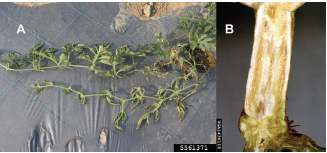 Figure 1. (A) Wilting vines of Fusarium wilt-infected watermelon. Cheng-Fang Hong, University of Georgia, Bugwood.org. (B) Vascular discoloration of a Fusarium wilt-infected watermelon stem. Clemson University - USDA Cooperative Extension Slide Series, Bugwood.org
SURVIVAL, DISTRIBUTION, AND INFECTION
The pathogen (FON) can survive in the soil and crop debris for up to 16 years as thick-walled resting spores called chlamydospores.1,5,6 The fungal pathogen can also survive and reproduce on the roots of some non-host plants and watermelon varieties with resistance to FON. Therefore, the disease can develop in fields that have not been planted with susceptible varieties of watermelon for many years.
The pathogen can be disseminated in infested soil, infected transplants or plant parts, and potentially on contaminated seed. Running water in the field, equipment, vehicles, tools, and workers that encounter FON infested soil and infected plant matter can serve to spread the pathogen within a field and to new locations. While the pathogen can be found on and in watermelon seed, the rate of infection from seedborne inoculum is less than five percent.1,5,6
FON spores in the soil are stimulated to germinate by chemicals given off by watermelon roots. The fungus penetrates at the root tips or through wounds, grows into the root tissue, and colonizes the xylem (water conducting) tissue. The disruption of the xylem causes the wilting symptoms associated with Fusarium wilt. Several factors and conditions can affect the process of pathogen survival, exposure to host roots, spore germination, and infection by the fungus. Changes in these conditions can alter the amount of infection, the rate of disease development, and ultimately any disease related yield losses.1
CONDITIONS AND DISEASE
Fusarium wilt is usually most severe in light, sandy, acidic soils.1,6,7 Cool, somewhat moist conditions in the spring favor infection of the root systems of young watermelon plants, even though disease symptoms often do not develop until later in the growing season when conditions are hot and dry as water demands on the plants increase.5,7,8
Fusarium wilt diseases on many crops are usually most severe at temperatures around 82ºF; however, Fusarium wilt of watermelon does best at slightly cooler temperatures. The optimal temperature range for the growth of FON is between 75° and 90°F. The fungus usually does not grow at temperatures below 54°F or above 95°F. Studies in Florida have found that Fusarium wilt of watermelon develops most rapidly at 80°F, and disease levels drop off rapidly when temperatures are below 68°F or above 86°, with little or no infection at temperatures above 91°F.1,6
A soil pH range between 5.5 and 6.5 usually favors the development of Fusarium wilt on watermelon, and it has been shown that raising the soil pH of a melon field above 6.5 can result in a decrease of Fusarium wilt severity.6 The types and levels of nutrients (fertilizers) can also affect the incidence and severity of Fusarium wilt on watermelon. It has been shown that elevated levels of nitrogen on melons (cantaloupe) can result in increased levels of Fusarium wilt and result in earlier symptom development.1,6 In one study, earlier symptom development and increased disease severity on watermelon was seen in plants treated with ammonium sulfate when compared to plants treated with urea or urea plus calcium superphosphate. The treatments with urea were found to suppress FON spore germination in the soil. Higher disease levels and lower yields were associated with the use of ammonium nitrogen fertilizers as compared to nitrate-based fertilizers in some studies. However, other studies have found no difference in Fusarium wilt levels on watermelon associated with the forms of nitrogen used.6
Resistance to Fusarium wilt in watermelons is often listed as “intermediate” or “tolerant”, as some resistant varieties can develop wilt symptoms under some conditions, notably, high soil levels of FON.6 Studies showed that fully susceptible or slightly resistant watermelon varieties developed wilt symptoms in soils with lower FON levels. The severity of wilt also increased on some moderately to highly resistant varieties as soil levels of FON increased, with some highly resistant varieties showing similar levels of wilt as susceptible varieties in soils with very high FON populations. However, some highly resistant varieties showed no increase in disease despite increased pathogen levels.6 Growing Fusarium wilt resistant varieties has been shown to slow the buildup of FON in the soil as compared to growing susceptible varieties.
The development and severity of Fusarium wilt on watermelon can be affected by the presence of root-knot nematodes (RKN). When both FON and RKN pathogens are present in a field, the severity of Fusarium wilt has been found to increase with increasing populations of either pathogen. Studies have shown that the presence of RKN is also able to result in the development of wilt symptoms on FON resistant varieties in soils with moderate populations of FON. However, in soils with high FON levels, some resistant varieties have shown wilt symptoms when no RKN was present.6
CONDITION INFORMATION AND MANAGEMENT
The most effective management strategies for Fusarium wilt of watermelon are the use of disease resistant varieties and planting in fields not infested with FON.6 However, there are cultural management strategies that can help enhance the effectiveness of disease resistance, reduce the likelihood of introducing FON into new locations, and limit the buildup or lower populations of FON in infested fields
Infection of watermelon plants occurs early in the season, when soil temperatures are relatively low (below 80°F). Delaying planting/transplanting until soils warm up to 80°F has been shown to result in lower levels of Fusarium wilt. This is especially important when planting Fusarium wilt susceptible varieties.3 Raised-beds covered with black-plastic mulch can also help raise early season soil temperatures in the root zone and lower the incidence and severity levels of Fusarium wilt.5
Routinely follow good sanitation practices with vehicles, equipment, tools, and workers’ clothing to help prevent the spread of the Fusarium wilt pathogen.5 It is best to work in non-infested fields before working in infested fields and to thoroughly clean tools and equipment between fields. Because the pathogen can survive in soil and crop debris in the absence of a living plant host for up to 16 years, rotation to non-hosts crops will not result in a rapid reduction in soil populations of FON. However, long-term crop rotations and planting resistant watermelon varieties can help prevent the buildup of FON that can occur when watermelons are repeatedly grown in infested fields.4 Rotations away from watermelon for five to ten years is recommended where feasible.5,6 Fallowing land completely for three years also has been shown to result in lower populations of FON.
Avoid overfertilizing, especially applying more nitrogen than is needed by the crop, and use nitrate or organic (urea) forms of nitrogen rather than ammonium forms. Soil amendments that increase the soil pH to 6.5 or above may help reduce the severity of Fusarium wilt on watermelons.6
Soil solarization, the practice of covering fields with clear plastic mulch for several weeks during the hottest time of the year, has been used to help manage Fusarium wilt of watermelons in some regions, such as Israel. Solarization has demonstrated the potential for increased yields, delayed infection, and reduced wilt severity.6 However, solarization does not provide complete control of the disease and may not be effective in some locations or climatic conditions. Disadvantages of solarization include the need to take fields out of production during the warmest part of the season, the expense and labor associated with applying the plastic mulch, and the need to dispose of the plastic after it is removed.2,6
SOURCES
1Martyn, R. 2017. Fusarium wilt of watermelon. In Keinath, A., Wintermantel, W., and Zitter, T., Eds. Compendium of cucurbit diseases and pests, second edition. American Phytopathological Society.
2Fusarium wilt of watermelon in Georgia. University of Georgia Extension. https://fieldreport.caes.uga.edu/publications/B1485/fusarium-wilt-of-watermelon-in-georgia/
3Keinath, A., Coolong, T., Lanier, J., and Ji P. 2019. Managing Fusarium wilt of watermelon with delayed transplanting and cultivar resistance. Plant Disease 103:44-50.
4Everts, K. and Himmelstein, J. 2015. Fusarium wilt of watermelon: Towards sustainable management of a re-emerging plant disease. Crop Protection 73:93-99.
5Quesada-Ocampo, L. 2023. Fusarium wilt of watermelon. NC State Extension, Vegetable pathology factsheets. https://content.ces.ncsu.edu/fusarium-wilt-of-watermelon
6Martyn, R.D. 2014. Fusarium wilt of watermelon: 120 years of research. In Janick, J. (Ed.) Horticultural Reviews: Volume 42. https://www.researchgate.net/publication/278315976_Fusarium_Wilt_of_Watermelon_120_Years_of_Research
7Eastburn, D. 2016. Management of Fusarium wilt in watermelon. Seminis Agronomic Spotlight. https://www.vegetables.bayer.com/us/en-us/resources/growing-tips-andinnovation-articles/agronomic-spotlights/management-of-fusarium-wilt-in-watermelon.html
8Rodriguez Salamanca, L. 2014. Managing diseases caused by Fusarium: The case of watermelon wilt. Michigan State University Extension. https://www.canr.msu.edu/news/managing_diseases_caused_by_fusarium_the_case_of_watermelon_wilt
Websites verified 1/20/2026
For additional agronomic information, please contact your local seed representative. Performance may vary, from location to location and from year to year, as local growing, soil and environmental conditions may vary. Growers should evaluate data from multiple locations and years whenever possible and should consider the impacts of these conditions on their growing environment. The recommendations in this article are based upon information obtained from the cited sources and should be used as a quick reference for information about vegetable production. The content of this article should not be substituted for the professional opinion of a producer, grower, agronomist, pathologist and similar professional dealing with vegetable crops.
BAYER GROUP DOES NOT WARRANT THE ACCURACY OF ANY INFORMATION OR TECHNICAL ADVICE PROVIDED HEREIN AND DISCLAIMS ALL LIABILITY FOR ANY CLAIM INVOLVING SUCH INFORMATION OR ADVICE.
7044_726950 Published 01/27/2026