- United States
- expand_more

-
Products
Select Your Brand Below to View Full Portfolio of Offerings
-
Resources
Click Below for Specialized Tips for Your Growing Environment
-
About
Discover More About Our Commitment to Advance Health and Nutrition Globally, Together With You.
-
Innovation

Learn about our approach to innovation.


» Clubroot can cause substantial yield reductions of Brassica vegetables, including broccoli, cabbage, and cauliflower.
» Clubroot is caused by an obligate parasitic protist that can survive in the soil for more than ten years.
» Management strategies for clubroot focus on helping to prevent the introduction of the pathogen and making conditions less favorable for disease development.
Clubroot is an important disease of Brassica vegetables, including broccoli, cabbage, and cauliflower. It is caused by Plasmodiophora brassicae, an organism which was once considered to be a fungus but is now classified as a protist (think amoeba).1,2,3 Clubroot occurs worldwide and affects most members of the Brassicaceae, including vegetable, oilseed, and weed species. The pathogen can remain viable in the soil for up to 20 years, and the disease is difficult to control once the pathogen becomes established in a field.1,2,4 Severe clubroot can result in yield losses of up to 50% on crops such as broccoli and cabbage, as well as a potential loss of land value.
SYMPTOMS
Clubroot causes the root system to become dysfunctional, resulting in stunting, yellowing, and wilting aboveground symptoms. Plants that are infected when young may be severely stunted and eventually die. Plants infected at an older stage may not show any above-ground symptoms other than slowed growth, reduced product size, and reduced marketability. Affected plants can wilt in hot weather and may partially recover overnight until root dysfunction becomes too severe, when the wilt becomes permanent. Affected plants may bolt prematurely.1,3,5
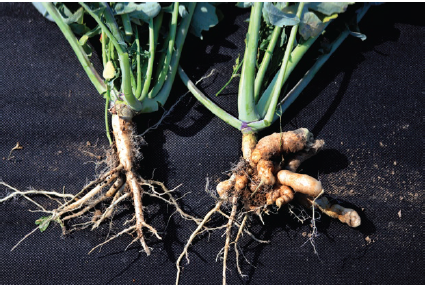 Figure 1. Galling of roots on clubroot infected plants.
Below-ground symptoms include swelling, galling, and distortion of the roots and lower stem (hypocotyl). Root symptoms can range from very small swellings to large, club-shaped roots (Figure 1). Root swelling is caused by an increase in the size and number of root cortical cells, and symptom severity depends on the age of plants at the time of infection, root morphology, and the period of exposure to infection. Root galls can grow up to six inches wide on some crops.2,3 Initially, root galls are firm and white but turn brown and decay as the season progresses.2,5
HOST RANGE
Clubroot is mostly restricted to members of the Brassicaceae. There are specialized forms (races) of the pathogen that cause varying degrees of disease severity on different host genotypes (species and varieties).1,4 In general, cabbage, Chinese cabbage, Brussels sprouts, and some turnip varieties are most susceptible to club root. Broccoli, cauliflower, collards, kohlrabi, kale, rutabaga, some turnips, and radishes are moderately susceptible. Some turnip and radish varieties are mildly susceptible, and a few species—including horseradish—are very resistant.1,4
The clubroot pathogen can infect the root hairs of some non-Brassicaceae plants, including some members of the Gramineae (grasses), Rosaceae (rose family), Polygonaceae (dock), and Leguminosae (legumes, including red clover). These infections do not result in clubroot-like symptoms, and it is not clear if infections of these plants play any role in the clubroot disease cycle on cruciferous plants.1,2
CYCLE AND CONDITIONS
The clubroot pathogen survives in the soil and infested plant debris as thick-walled resting spores, which can remain viable in the soil for ten years or more (Figure 2). Resting spores can be spread by anything that moves infested soil, including equipment, tools, animals, drainage water, and wind. The pathogen can also be brought into a field in irrigation water from contaminated sources and on infected transplants. 1,2,3
The clubroot disease cycle is complicated. Resting spores are stimulated to germinate by the presence of roots of susceptible host plants. Primary zoospores are released from the resting spores and swim in films of water to find susceptible roots. These zoospores infect root-hair cells, where they form a primary plasmodium (a multinucleate, amoeba-like mass of protoplasm). This infection does not result in visible symptoms. The primary plasmodium then produces secondary zoospores, which can infect adjacent cells or move through the soil to infect other root-hair cells on the same or neighboring plants. Secondary zoospores can infect and colonize the root cortex, produce a secondary plasmodium, and result in the typical clubroot symptoms.1,2,3,4,5 Eventually, the secondary plasmodium differentiates into thick-walled resting spores, which are released into the soil as the affected root tissue
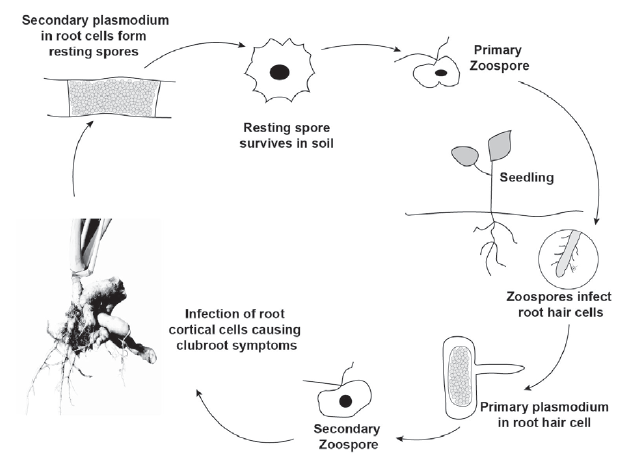 Figure 2. The disease cycle of clubroot on Brassica plants.
decays. There is usually one disease/life cycle per season, and the pathogen usually spreads slowly through the soil.
Clubroot development is favored by soil moisture close to saturation and soil temperatures above 68 °F. The resting spores germinate best in moist, acidic soil with temperatures between 54 and 81 °F. Soil moisture levels above 50% water holding capacity provide water films that allow zoospores to swim through the soil.1,2,3 Clubroot occurs most commonly in acidic soils with pH levels below 7.0, but the disease has been observed on plants in soils with pH levels as high as 8.1.1,5
MANAGEMENT
Disease resistance to clubroot has been identified in some Brassica crops, including varieties of broccoli and cabbage. However, the effectiveness of this resistance is complicated by the existence of many pathotypes (races) of the pathogen. Varieties that show resistance to some strains of the pathogen may be more susceptible to other strains.1,2
There is no economically feasible method to eradicate the clubroot pathogen once established in a field. Most management efforts focus on helping to prevent the introduction of the pathogen into the field. Strategies include planting Brassica vegetables only on well-drained sites with no history of club root, avoiding irrigation using contaminated water sources, and planting only disease-free transplants showing no clubroot symptoms. If symptomatic transplants are detected, the entire lot should be rejected. Transplants should be grown in non-contaminated, soil-free planting mix or in non-infested seed beds. It is recommended that growers avoid reusing seedling trays, as they can serve as a source of inoculum. Irrigate seedlings only with clean, pathogen-free sources of water.1,3,4,5
Use sanitation practices to clean farm equipment, tools, and workers’ footwear regularly to restrict the movement of contaminated soil from infested to non-infested fields. Remove soil and crop debris, pressure wash, scrub, or use blasts of compressed air to remove any remaining soil and debris. Apply a disinfectant to help eliminate any remaining inoculum.1,3,4,5
After planting, scout the crop regularly, from transplant through harvest, for foliar and root symptoms of clubroot infection to help identify any new sites of infection. Small areas of infestation may be spot-treated with soil fumigants, such as metam sodium, to help eliminate the pathogen.3,4
Because of its ability to survive in the soil for decades in the absence of susceptible host plants, crop rotation is not effective for the complete eradication of the clubroot pathogen. However, rotation to non-host crops, combined with the control of cruciferous weeds and volunteers, can help reduce the buildup of clubroot inoculum in the soil.1,2,3,5
Applying lime to infested fields prior to planting can help reduce infection rates and yield losses, especially in soils with low inoculum levels.1,4 Amend soils with lime to raise soil pH levels between 7.3 and 7.5 prior to planting. Quick lime [hydrated lime, Ca(OH)2] can affect pH quickly and can be applied in the spring at least six weeks before planting. Agricultural lime and dolomitic lime (CaCO3) act more slowly and may need to be applied the fall before planting.1,4 Lime applications may need to be repeated annually, and not all soils respond to lime treatment.5
A few fungicides, including PCNB, fluazinam, and cyazofamid, are registered for use on Brassica vegetables to help manage clubroot. However, some university trials have found that fungicide applications provided little or no control of clubroot on broccoli.3,4
SOURCES
1Zitter, T. and McGrath, M. 2021. Clubroot of crucifers. Cornell Vegetables. https://www.vegetables.cornell.edu/pest-management/disease-factsheets/clubroot-ofcrucifers/
2Dixon, G. 2007. Clubroot. In Rimmer, S., Shattuck, V., and Buchwaldt, L., Eds. Compendium of Brassica Diseases. American Phytopathological Society. https://doi.org/10.1094/9780890547274
3Ocamb, C. 2026. Cabbage and cauliflower (Brassica oleracea)-clubroot. In Pscheidt, J. and Ocamb, C., eds, Pacific Northwest Plant Disease Management Handbook. https://pnwhandbooks.org/plantdisease/host-disease/cabbage-cauliflower-brassica-oleraceaclubroot
4Howard, R., Strelkov, S., and Harding, M. 2010. Clubroot of cruciferous crops – new perspectives on an old disease. Canadian Journal of Plant Pathology, 32(1):43–57. https://doi.org/10.1080/07060661003621761
5Koike, S. and Subbarao, K. 2007. Clubroot. UC IPM cole crop pest management guidelines. UC ANR publication 3442. https://ipm.ucanr.edu/agriculture/cole-crops/clubroot/#gsc.tab=0
Websites verified 7/17/2026
ADDITIONAL INFORMATION
For additional agronomic information, please contact your local seed representative. Performance may vary, from location to location and from year to year, as local growing, soil and environmental conditions may vary. Growers should evaluate data from multiple locations and years whenever possible and should consider the impacts of these conditions on their growing environment. The recommendations in this material are based upon trial observations and feedback received from a limited number of growers and growing environments. These recommendations should be considered as one reference point and should not be substituted for the professional opinion of agronomists, entomologists or other relevant experts evaluating specific conditions.
BAYER GROUP DOES NOT WARRANT THE ACCURACY OF ANY INFORMATION OR TECHNICAL ADVICE PROVIDED HEREIN AND DISCLAIMS ALL LIABILITY FOR ANY CLAIM INVOLVING SUCH INFORMATION OR ADVICE.
10011_893800 Published 07/17/2026