- United States
- expand_more

-
Products
Select Your Brand Below to View Full Portfolio of Offerings
-
Resources
Click Below for Specialized Tips for Your Growing Environment
-
About
Discover More About Our Commitment to Advance Health and Nutrition Globally, Together With You.
-
Innovation

Learn about our approach to innovation.



» Black rot is considered one of the most destructive diseases of vegetable brassicas worldwide.
» The bacterial pathogen can be seedborne, and the disease is favored by warm, moist conditions.
» Management strategies focus on preventing infection through avoidance and sanitation practices.
Black rot is a disease of brassicas (crucifers), caused by the bacterial pathogen Xanthomonas campestris pathovar campestris, and is considered one of the most destructive diseases of vegetable brassicas worldwide. The disease is most commonly seen on broccoli, cabbage, cauliflower, and kale, but also affects Brussels sprouts, turnips, kohlrabi, and other Brassica species.1,2,3 Black rot is a vascular disease that can spread systemically within the plant, resulting in substantial yield losses and even plant death. Infections can lead to small heads, poor product quality, and shortened shelf life.2,4
SYMPTOMS
Young seedlings are particularly susceptible to black rot, and early infections can show up on the cotyledons (Figure 1). Often, these first leaves fall off, but the plants are still infected with the bacterium. Infected plants become stunted and chlorotic, and may die as the disease progresses. The disease may remain latent (symptomless) when temperatures are low, but infected seedlings can serve as sources of inoculum for spreading the disease throughout the planting as temperatures warm.2,3
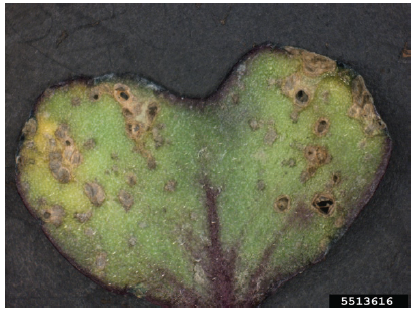 Figure 1. Cabbage cotyledon showing bacterial blight lesions. Tom Creswell, Purdue University, Bugwood.org.
On older plants, symptoms first develop on leaf margins or are associated with injury, such as insect feeding sites. Lesions developing on leaf margins start as irregularly shaped, dull yellow areas. These lesions become V-shaped with the point of the V expanding toward the leaf midrib (Figure 2). With time, lesions’ centers become necrotic (turn brown and die). The lesions can expand and coalesce until the whole leaf is affected. The veins in the affected areas turn from green to dark brown or black. The dark discoloration of the vascular tissue can extend down into the stems and up into the head of
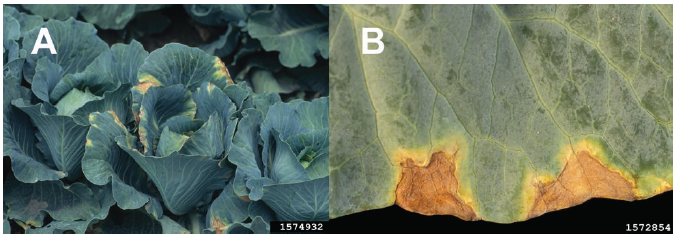 Figure 2. Black rot lesions on cabbage leaves. (A) Bright yellow lesions at the leaf margins. (B) Typical V-shaped marginal chlorosis and necrosis caused by black rot. Gerald Holmes, Strawberry Center, Cal Poly San Luis Obispo, Bugwood.org.
the plant (Figure 3). Cross-sections of affected stems can show a ring of discolored vascular tissue. Black rot lesions can open the door to infection by secondary pathogens, such as soft-rot bacteria, resulting in the rotting phase of the disease.1,2,5
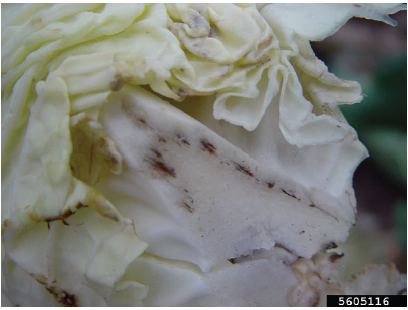 Figure 3. Blackened vascular tissue at the base of a cabbage head. Gerald Holmes, Strawberry Center, Cal Poly San Luis Obispo, Bugwood.org.
CYCLE AND CONDITIONS
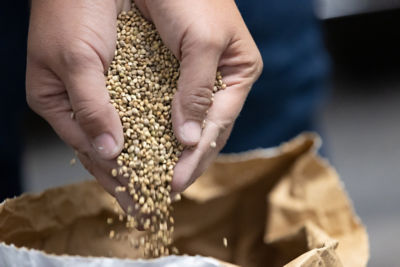
The black rot bacterium can be seedborne (survive on/ in infected seed). Infection by and spread of the black rot pathogen is favored by warm, humid conditions, splashing water, or physical contact with wet plants. These conditions are often present during transplant production, where densely spaced plants are grown in warm, humid greenhouses. It is possible for low levels of infected seed to give rise to infected seedlings in the greenhouse, which then introduce black rot into production fields.1,2,4
The black rot pathogen can be brought into production fields on infected seed or transplants, or it can survive in the offseason on infested crop debris for up to two years. It can also survive on other Brassica hosts, such as cruciferous weeds. However, the role of weed hosts on the development of epidemics in Brassica crops is not well understood. 1,3,5
Disease development is favored by warm, moist conditions. The pathogen is spread in the field by splashing water, insects, wind-blown plant debris, on equipment, and on the hands and clothing of workers. The bacterium can be spread several yards from infected plants during periods of heavy rain or overhead irrigation.1,2 Temperatures between 80 and 95°F favor infection and pathogen growth.4,5 The bacteria often enter the leaf through openings on the edge of the leaf called hydathodes. Once inside the leaf, the bacteria multiply and start causing black rot symptoms.
DISEASE MANAGEMENT
There are no curative treatments that can completely eliminate black rot once infections have occurred. So, management strategies focus on preventing infection, mostly by keeping the pathogen away from the crop.4 Strict sanitation practices should be followed both in the greenhouse during transplant production and in the field to eliminate sources of inoculum. In the greenhouse, clean and sanitize trays, benches, and remove any debris from previous plantings. Use only disease-free seed and transplants. Inspect emerged seedlings or purchased transplants for symptoms of black rot and remove any symptomatic seedlings. Use seeding trays with wider plant spacing to promote increased airflow around plants, and use bottom watering systems (ebb and flow) to help minimize free moisture on leaf surfaces. Avoid clipping seedings, as the wounds can serve as sites of infection.1,2,3,4
It is best to purchase disease free seed. Hot water seed treatments can help reduce the level of bacterial infection of seeds, but this may only be feasible for small-scale producers. For cabbage and broccoli, small batches of seed should be heated to 122°F (50°C) for 25 minutes. Cauliflower seed should be held at 122°F for 15 minutes.1,2
Some forms of disease resistance are available in brassica vegetables, including broccoli and cabbage.5 However, up to eleven different races of the black rot pathogen have been identified, and the available forms of resistance may only be effective against one or a few of the races.3,5,6
Where possible, Brassica crops should be planted in a three- to four-year rotation schedule with non-brassica crops to provide at least three years between brassica crops. Avoid planting in low areas with poorly drained soil. Where feasible, plant on raised beds covered with plastic mulch to help lower canopy humidity and reduce splashing of soilborne inoculum onto the crop. Also, avoid using overhead irrigation and keep workers and equipment out of fields when plants are wet with rain, irrigation, or dew. Avoid wounding plants and provide adequate fertilization.2,4,5
While the role of weed hosts in the development of crop diseases is not well understood, managing cruciferous weeds in the field may help reduce or eliminate sources of black rot inoculum. Tilling in crop residue promptly after harvest will accelerate decomposition and help eliminate another source of inoculum. Managing insect pests, especially chewing insects, can help prevent injuries that can be sites of infection.2,5
Applications of fixed copper or copper hydroxide fungicides can help lower the rate of spread of black rot in some situations. However, the levels of black rot control achieved by using copper-based products have been inconsistent in university trials.1,2,4,5
Resistance to copper bactericides has been documented in black rot pathogen on brassicas in the Caribbean. Copper resistant strains of Xcc were found in Trinidad following years of routine use of copper-based bactericides on brassica crops. Copper resistance was also found in strains of Xcc isolated from brassica crops in Mauritius from 2019 to 2021. Using copper products to help manage black rot will probably become even less effective if resistant strains of Xcc become established in the US.7,8 Always consult product labels for application instructions and restrictions.
SOURCES
1Williams, P. 2007. Black rot. In Rimmer, S., Shattuck, V., and Buchwaldt, L., Eds. Compendium of Brassica Diseases. American Phytopathological Society. Ppg 60-62.
2Pfeufer, E. and Davis, D. 2019. Black rot of crucifers. University of Kentucky, Plant Pathology Fact Sheet PPFS-VG-01. https://plantpathology.mgcafe.uky.edu/files/ppfs-vg-01.pdf
3Vicente, J.G. and Holub, E.B. 2013. Xanthomonas campestris pv. campestris (cause of black rot of crucifers) in the genomic era is still a worldwide threat to brassica crops. Molecular Plant Pathology, 14: 2-18. https://doi.org/10.1111/j.1364-3703.2012.00833.x
4Pape, A. 2024. Black rot of crucifers. University of Wisconsin-Madison, Plant Disease Facts D0019. https://hort.extension.wisc.edu/articles/black-rot-crucifers/
5Ng, M. and Ghimire, S. 2023. Black rot on crucifers. University of Connecticut, Integrated Pest Management. Reprinted from Grower 92(6). https://ipm.cahnr.uconn.edu/black-rot-ofcrucifers/
6Afrin, K., Rahim, M., Park, J., Natarajan, S., Rubel, M., Kim, H., and Nou, I. Screening of cabbage (Brassica oleracea L.) germplasm for resistance to black rot. Plant Breed. Biotech. 2018;6:30-43. https://doi.org/10.9787/PBB.2018.6.1.30
7Behlau, F., Gochez, A. M., Lugo, A. J., Elibox, W., Minsavage, G. V., Potnis, N., White, F. F., Ebrahim, M., Jones, J. B., and Ramsubhag, A. 2017. Characterization of a unique copper resistance gene cluster in Xanthomonas campestris pv. campestris isolated in Trinidad, West Indies. Eur. J. Plant Pathol. 147:671-681. https://doi.org/10.1007/s10658-016-1035-2
8Boyer, C., Lefeuvre, P., Richard, D., Lobin, K. K., and Pruvost, O. 2024. Complete genome sequence of a copper-resistant Xanthomonas campestris pv. campestris strain isolated from broccoli in Mauritius suggests adaptive gene gain through horizontal gene transfer. Phytopathology 114:328-333. https://doi.org/10.1094/PHYTO-05-23-0177-SC
Websites verified 5/6/2026.
ADDITIONAL INFORMATION
For additional agronomic information, please contact your local seed representative.
Performance may vary, from location to location and from year to year, as local growing, soil and environmental conditions may vary. Growers should evaluate data from multiple locations and years whenever possible and should consider the impacts of these conditions on their growing environment. The recommendations in this material are based upon trial observations and feedback received from a limited number of growers and growing environments. These recommendations should be considered as one reference point and should not be substituted for the professional opinion of agronomists, entomologists or other relevant experts evaluating specific conditions.
BAYER GROUP DOES NOT WARRANT THE ACCURACY OF ANY INFORMATION OR TECHNICAL ADVICE PROVIDED HEREIN AND DISCLAIMS ALL LIABILITY FOR ANY CLAIM INVOLVING SUCH INFORMATION OR ADVICE.
10011_837000 Published 05/06/2026.