ToBRFV resistant tomato portfolio 

Confidence on every level – ToBRFV resistant varieties you can count on


To help provide new solutions to growers in their fight against ToBRFV, Vegetables by Bayer is testing and launching new tomato hybrids in various glasshouse segments at grower locations globally. Our portfolio currently includes tomato hybrids with Intermediate Resistance to ToBRFV and we are focused on rapidly developing varieties with high ToBRFV resistance in combination with excellent agronomic performance and consumer and retail benefits. Huib Koerts, the segment lead EMEA APAC at De Ruiter®, explains more.


The power of stacked resistance

“Vegetables by Bayer has not chosen the easy route towards a durable and reliable resistance against ToBRFV. We opted for stacking different resistance genes, each of which intervenes at different moments during the interaction between the virus and the host plant. We believe that such stacked resistance will stand up to new ToBRFV-mutations for a long time," Huib explains. "Incorporating multiple resistance genes takes longer and is more costly but we expect it to ultimately offer more reliable resistance. As a market leader, we want a high level of resistance in our new varieties, which can go hand in hand with good agronomic performance."


Gaining speed without sacrificing reliability

De Ruiter has also revamped its approach to testing and launching products. Huib elaborates: "In the early stages of development, we conduct testing in our quarantine greenhouse in Wageningen and at multiple locations with growers, to establish a strong foundation to market introduction. We aim to speed up the process without compromising reliability. I believe we have been able to address this challenge effectively by conducting a broad range of in-house and external trials with growers and research institutes. Our quarantine greenhouse provides valuable insights into the resistance levels of our portfolio under the most extreme conditions and highest virus pressure. Additionally, it helps breeders to better understand the genetic background of varieties and accelerates the development of resistant varieties with good agronomics.”


A broad and resistant portfolio

The De Ruiter portfolio continues to expand. "We are introducing IR-resistant varieties in various segments. For example, there's Strabini, a cocktail plum tomato with excellent agronomics compared to Strabena, which is a susceptible variety. Then there's Ferreira, a beef tomato with production characteristics and size like susceptible varieties, but with added IR. With this variety, we are the market leader in North America and Canada, and we are now introducing Ferreira in the major European markets.

“Additionally, we have the cocktail cluster tomato DRTC9517, a variety with a resistance level that matches the highest resistances currently available, while maintaining good production and taste. Furthermore, our rootstocks Maxifort, Equifort, and DR0141TX remain the market standard. Growers confirm that their strength and endurance are the key factors for a successful crop, something which has been corroborated in multiple trials at various research institutes."


Confidently moving into the future

Huib is looking ahead with confidence. "I expect that we can demonstrate the effectiveness of our approach next year,” he says. “I anticipate that we can introduce varieties with good performance both agronomically and in terms of resistance (or conduct trials of them) in all segments. Currently, we are planning to have resistant varieties in six different segments by 2024, and the goal is to have a resistant variety available in each of the major segments by 2025. These varieties will be tested at multiple locations in the forthcoming growing season, to guarantee a reliable market introduction."

Meet our Strabini tomato variety

Our first glasshouse tomato variety with intermediate resistance to ToBRFV.

Meet Ferreira and Novero

Our beef tomatoes with intermediate ToBRFV resistance.

Learn about our resistant tomato varieties

Jan Barten, Strategic Project Lead, talks about our tomato varieties that are showing high levels of resistance to ToBRFV.

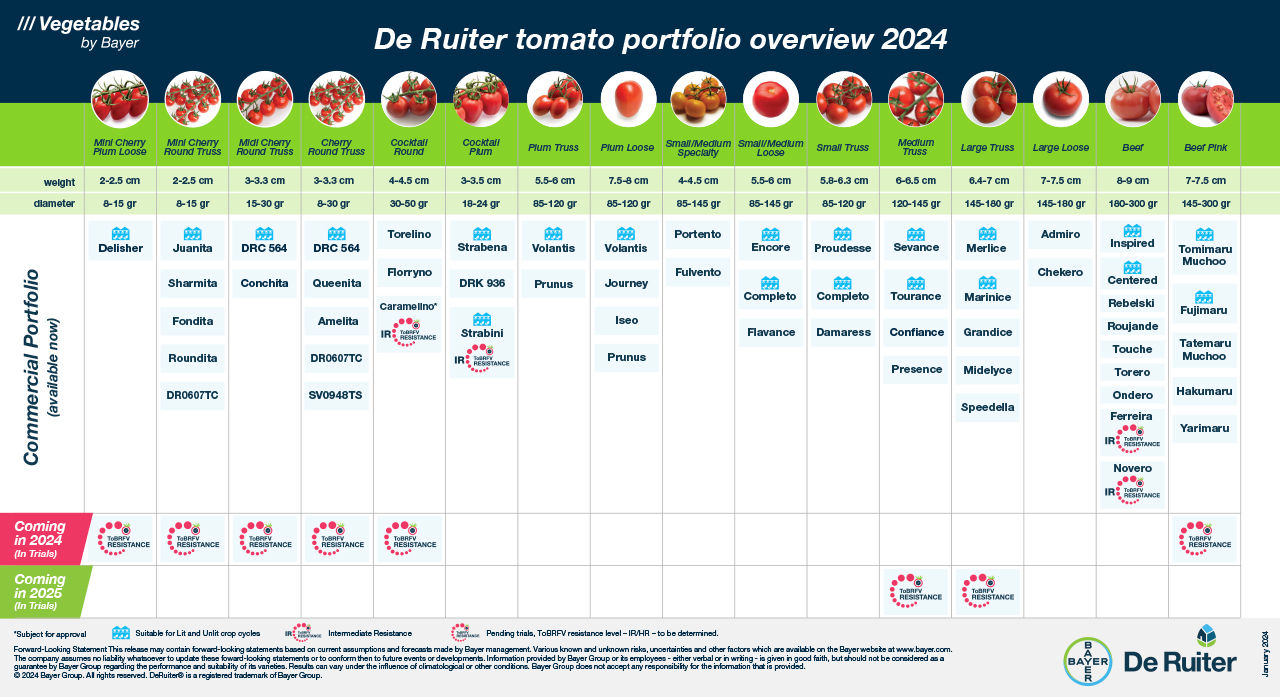
Overview of De Ruiter tomato portfolio highlighting ToBRFV resistance varieties

Frequently Asked Questions

Vegetables by Bayer offers ToBRFV-resistant varieties across multiple glasshouse segments under the De Ruiter brand. The current portfolio includes:

Variety

Segment

Resistance Level

Strabini

Cocktail plum

Intermediate Resistance (IR)

Ferreira

Beef tomato

Intermediate Resistance (IR)

Novero

Beef tomato

Intermediate Resistance (IR)

DRTC9517

Cocktail cluster

Matches highest resistances currently available

Strabini was De Ruiter's first glasshouse tomato variety with Intermediate Resistance to ToBRFV, launched in 2021. Its fruits remain firmly attached to the truss, making it easy to package and present without plastic wrap.

Ferreira is a beef tomato that delivers production characteristics and fruit size comparable to susceptible varieties, with the added benefit of IR to ToBRFV. It is the market leader in North America and Canada in its segment.

Novero is a second beef tomato option with Intermediate Resistance, expanding grower choice within that segment.

DRTC9517 is a cocktail cluster tomato with a resistance level that matches the highest resistances currently available on the market, while maintaining strong production and taste performance.

In addition, De Ruiter rootstocks Maxifort, Equifort, and DR0141TX remain the market standard for grafted tomato production. Their strength and endurance have been confirmed in multiple trials at various research institutes, making them a reliable foundation for any resistant variety program.

The portfolio continues to expand, with the goal of having a resistant variety available in each of the major glasshouse segments. For a full overview, download the De Ruiter Tomato Portfolio PDF or explore the ToBRFV Knowledge Center.

Stacked resistance means incorporating multiple resistance genes into a single variety, where each gene intervenes at a different point during the interaction between the virus and the host plant. Rather than relying on a single resistance mechanism, stacked resistance creates several independent barriers that the virus must overcome simultaneously.

For ToBRFV specifically, this approach matters for one critical reason: durability. ToBRFV is known to mutate, and a variety protected by only one resistance gene is more vulnerable to being overcome by a new viral strain. When multiple genes are stacked, a mutation that defeats one resistance mechanism still has to contend with the others, significantly reducing the likelihood that the variety will break down over time.

"We opted for stacking different resistance genes, each of which intervenes at different moments during the interaction between the virus and the host plant. We believe that such stacked resistance will stand up to new ToBRFV-mutations for a long time." Huib Koerts, Segment Lead EMEA APAC, De Ruiter

Stacked resistance does require more time and investment to develop than a single-gene approach. Vegetables by Bayer has deliberately chosen this path because the long-term reliability it provides is worth the additional development cost, particularly for growers who need confidence that their resistance will hold up under sustained and evolving virus pressure.

What this means in practice for growers:

  • Varieties with stacked resistance are designed to remain effective even as ToBRFV continues to evolve

  • The resistance is validated under extreme conditions, including testing in De Ruiter's quarantine greenhouse in Wageningen under the highest virus pressure

  • Stacked resistance is developed alongside strong agronomic performance, so growers do not have to trade yield or fruit quality for protection

This is the foundation of Vegetables by Bayer's long-term ToBRFV resistance strategy across the De Ruiter portfolio.

Stay up to date about ToBRFV

Need more information?

This browser is no longer supported. Please switch to a supported browser: Chrome, Edge, Firefox, Safari.