January 28, 2025
Skip to Main Content

Bayer Vegetables Language Master (en-us)
-
Products

Content added in this column will appear with shaded background.
- Resources
- About
- Innovation
Click here to download a PDF version of this Cultivation Insights article.
» Several species of Fusarium can cause diseases of greenhouse (GH) grown peppers.
» Fusarium stem and fruit rot has been observed on GH peppers since 1990.
» Fusarium root and crown rot, first observed on GH peppers in Ontario in 2021, is now causing substantial losses in some areas.
There are several species of fungi in the genus Fusarium that can cause diseases on peppers (Capsicum annuum), including Fusarium solani and members of the Fusarium oxysporum species complex. In the summer of 1990, disease symptoms were observed on greenhouse peppers in Ontario, Canada.1 The disease affected stems and fruit, and an estimated 50% yield loss was reported. The fungal pathogen Fusarium solani was identified as the causal agent of this disease, and the disease was named Fusarium stem and fruit rot of pepper. Fusarium stem and fruit rot is now considered an important disease of greenhouse grown peppers that can result in substantial economic losses.1,2,5
In 2021, a root and crown rot disease was observed on greenhouse peppers, and the disease has become an increasingly damaging problem for greenhouse pepper producers in the Ontario area. This disease caused substantial yield losses in greenhouse peppers in 2024, and the causal agent has been tentatively identified as a species in the Fusarium oxysporum species complex (FOSC).8
FUSARIUM STEM AND FRUIT ROT
Symptoms: The initial symptoms of Fusarium stem and fruit rot are dark brown to black, sunken lesions forming at the stem nodes where the plants have been pruned, where fruit have been removed, and at other wound sites. With early infections the lesions form near the base of the stem, but lesions will form on nodes in the upper canopy later in the season. The stem lesions expand and can eventually girdle the stem.2,4,5 With time, small, cinnamon to orange spore-producing structures (perithecia) can form on the surface of the lesions.2 Affected plants may be mildly to severely stunted, and leaves may become mottled.1,6 Black, water-soaked lesions can develop on the fruit, usually near the stem end near the calyx. These lesions can enlarge and coalesce, eventually growing down the sides of the fruit. Pink to white fungal growth can form on the surface and in the cavity of affected fruit.1,2
Disease Cycle and Conditions: Fusarium solani is a common soilborne fungus that has a wide host range and is found worldwide. Several host specific physiological races have been identified.2 The pathogen is probably introduced into greenhouses on infected seedlings and infested rockwool seedling cubes. Once introduced, fungal spores (ascospores) can spread the pathogen from plant to plant within the house.4,7 The ascospores can infect plants at wound sites and leaf scars. Ascospore germination and infection are favored by 8- to 12-hour periods of high humidity (>95 % RH) at temperatures from 15 to 30°C (59 to 86°F).2,7 Initial infections tend to occur on the bases of stems, near where stems are in contact with the rockwool substrate.1,3,4 Succulent, rapidly growing plants appear to be the most susceptible to infection, and ripening fruit are more susceptible than green fruit. Wounding of the fruit near the calyx can increase the susceptibility of the fruit to infection. Latent infections can delay the time from infection to the appearance of symptoms for as much as three months.2 There may be some variation in the susceptibility of pepper varieties to Fusarium stem and fruit rot.3
Management: Because the severity of Fusarium stem and fruit rot is affected by temperature and humidity, adjustments to the greenhouse environment can help manage the disease. Avoid extended periods of high humidity and high temperatures through air flow, ventilation, and temperature management.4 Slowly increase the temperature in the morning before dawn, adjust irrigation schedules to prevent excessive wetness and dryness of rockwool blocks, and position drip emitters to keep fertilizer solutions off the stems to prevent salt buildup.1,2 Follow appropriate sanitation procedures to help prevent the introduction and spread of the pathogen within the house. Thoroughly clean surfaces, tools, drip systems, and supports, removing all crop debris, between crops. Use disease-free transplants, and check rockwool blocks for pathogen growth and fruiting bodies (perithecia) before bringing them into the house.2,4 Discard or steam sterilize any materials (slabs, bags, cubes, growth media) in which infected plants were growing.
Use sharp knives and clippers when pruning plants and harvesting to minimize wounding and promote faster healing. Dip tools in disinfectant after each plant contact.1,2,4 Avoid handling diseased plants and fruit. Remove infected branches, fruit, or whole plants from the house during the season, but take care not to spread the pathogen to other plants while doing so.2 Do not discard infested plant debris or locate cull piles near the greenhouse. Burn or bury infested crop debris.2 No chemical (fungicide) treatments are currently available for managing Fusarium stem and fruit rot on greenhouse grown peppers.1,4
FUSARIUM ROOT AND CROWN ROT
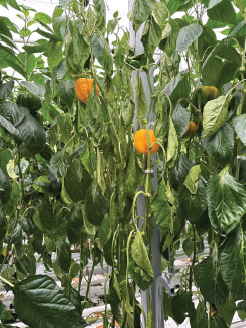
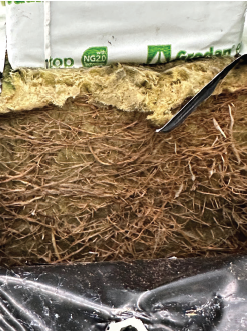
Symptoms: The symptoms of Fusarium root and crown rot include reduced growth and sudden wilting of pepper plants (Figure 1), in some cases resulting in plant death. Brown-black discoloration and necrosis (decay) can develop on crown and root tissues (Figure 2). However, there is no discoloration of the vascular tissue.6,8
Cycle and Conditions: The causal agent of Fusarium root and crown rot of pepper has been tentatively identified as a belonging to the Fusarium oxysporum species complex (FOSC).6,9 Other members of the FOSC cause vascular wilt diseases on crops such as pepper and tomato.9 The pathogens causing Fusarium root and crown rot on peppers are generally not pathogenic to tomato or eggplant.6 Because the identification of this pathogen is tentative, very little is known about the disease cycle, such as where the pathogen overwinters, how it spreads, and what conditions favor disease development.
Management: Very little work has been done on methods for managing Fusarium root and crown rot of peppers. An initial study on using chemical and biological fungicides to treat seedlings found that some treatments provided some level of control, some were no better than the untreated control, and some treatments appeared to increase disease levels.8 More research is needed to help us better understand this disease and how to manage it.
SOURCES
1Jarvis, W., Khosla, S., and Barrie, S. 1994. Fusarium stem and fruit rot of sweet pepper in Ontario greenhouses. Canadian Plant Disease Survey 74:2.
2OMAFA-MRA. 2024. Fusarium stem and fruit rot of greenhouse pepper. Ontario Ministry of Agriculture, Food, and Agribusiness and Ministry of Rural Affairs. https://www.ontario.ca/page/fusarium-stem-and-fruit-rot-greenhouse-pepper.
3Fletcher, J. 1994. Fusarium stem and fruit rot of sweet peppers in the glasshouse. Plant Pathology 43:225-227.
4Lamb, E and Rosskopf, E. 2003. Fusarium stem rot. In Pernezny, K., Roberts, P., Murphy J., and Goldberg, N., Eds. Compendium of pepper diseases. American Phytopathological Society, St. Paul.
5OMAFRA. 2010. Growing greenhouse vegetables in Ontario. Ontario Ministry of Agriculture, Food and Rural Affairs. Publication 836.
6Cerkauskas, R. F. 2017. Etiology and management of Fusarium crown and root rot (Fusarium oxysporum) on greenhouse pepper in Ontario, Canada. Canadian Journal of Plant Pathology, 39:121–132.
7Smudja, Mirej. 1999. Epidemiology of Fusarium fruit and stem rot of greenhouse grown sweet pepper. Retrospective Theses and Dissertations, 1919-2007. T, University of British Columbia. http://dx.doi.org/10.14288/1.0099330.
8Marchand, G. and McCreay, C. 2024. Following the yellow brick road: Fusarium in greenhouse peppers. Canadian Greenhouse Conference, Niagara Falls, Ontario, October 2024.
9Black. L. 2003. Fusarium wilt. In Pernezny, K., Roberts, P., Murphy J., and Goldberg, N., Eds. Compendium of pepper diseases. American Phytopathological Society, St. Paul.
Websites verified 1/27/2024
ADDITIONAL INFORMATION
For additional agronomic information, please contact your local seed representative. Performance may vary, from location to location and from year to year, as local growing, soil and weather conditions may vary. Growers should evaluate data from multiple locations and years whenever possible and should consider the impacts of these conditions on their growing environment. The recommendations in this article are based upon information obtained from the cited sources and should be used as a quick reference for information about greenhouse cucumber production. The content of this article should not be substituted for the professional opinion of a producer, grower, agronomist, pathologist and similar professional dealing with this specific crop.
BAYER GROUP DOES NOT WARRANT THE ACCURACY OF ANY INFORMATION OR TECHNICAL ADVICE PROVIDED HEREIN AND DISCLAIMS ALL LIABILITY FOR ANY CLAIM INVOLVING SUCH INFORMATION OR ADVICE.
6411_450350 Published 01-27-2025