August 28, 2018
Skip to Main Content

Bayer Vegetables Language Master (en-us)
-
Products

Content added in this column will appear with shaded background.
- Resources
- About
- Innovation
Click here to download a PDF version of this Growing Tips article.
In high tech greenhouses, it can grow well across North America, producing uniform, savory fruits.
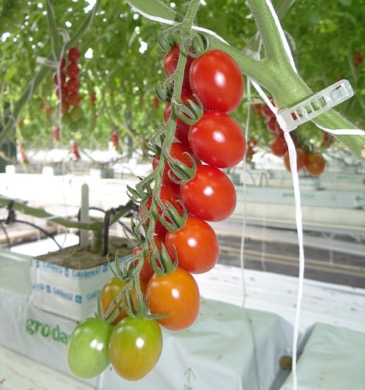
TYPE: RED COLOR GRAPE TOMATO
PLANT TYPE: INDETERMINATE (OPEN)
AVERAGE FRUIT WEIGHT: 13 GRAMS
USE: HIGH TECH GREENHOUSES
DISEASE RESISTANCES*:
HR: TOMV:0–2/TOTV/FF:A–E/FOL:1,2/VA:1/VD:1
IR: ON / MA/MI/MJ
Grafting
DR0603TC offers an excellent disease resistance package. Grafting is strongly recommended to confer extra stamina and ensure good production levels in long crops. Consider high vigor rootstocks like DR0141TX, Multifort, and Maxifort for this variety. In most cases, a 2:1 grafting ratio will be sufficient for growers’ needs, but 1:1 is possible. If the crop is grown in an environment with heat, humidity, and stress, each rootstock should be loaded with no more than three heads per plant.
Planning Your Crop
The success of DR0603TC depends on establishing the correct head density. Independently of the season, the head density must be adjusted to accommodate the microclimate. Because of its average vigor, adjusting the head density before heading into summer heat is particularly important, to ensure the leaf area has sufficient time to establish itself.
A good reference point for growers in Canada is to use roughly five heads per square meter, which should be in place during the summer. During long crop cycles, this variety will become very generative during summer time, producing leaves that are short and open. This means density is crucial to both vigor and longevity.
Plant Vigor, Pruning, and Management
DR0603TC is an easy to grow variety for its balanced response early in the season. It generally starts the season well balanced, offering growers an easy start. If transplanted between December and February, it typically does not deliver first trusses with semi-rounded fruits. One of its hallmarks since being introduced has been high vigor uniformity of fruit shape throughout the growing season.
DR0603TC can deliver beautiful trusses with between 12 to 18 flowers. For more uniform trusses bearing 10 to 16 fruits, prune the tail end of the truss. As a general rule of thumb, pruning the last 2–3 fruits also works well.
Planning your labor is very important to ensure all work is done on time. For crops transplanted in January, we advise a summer plant density of 50 percent of the final target.
Irrigation, Nutrition, and Harvesting
To help minimize issues with fruit cracking, avoid watering too early when DR0603TC plants are not yet active. From a nutrition perspective, monitoring electrical conductivity (EC) is crucial. Avoid large differences between EC in feed and EC in substrate in order to help minimize fruit cracking.
When it comes to harvest, DR0603TC offers compact, uniform trusses that are easy to work with. It can be harvested loose, with fruits coming off the vine easily while avoiding fruit fall issues. Truss splitting is also rare.
When harvesting as a truss, you may need to harvest a few loose tomatoes to avoid cracking while the last fruits ripen. Another option would be a more aggressive pruning to cause the plant to bear fewer fruits per truss.
For additional information, please contact one of your De Ruiter Seed technical sales representatives in North America.
Nutrition
So far, no studies have been conducted on the nutrient absorption behavior of Bountice. However, it calls for dedicated fertilization due to its vigorous plant aspect and fruit coloring. Bountice received nutrition and irrigation based on the main crop in trials, leading to more incidences of blotchy ripening. To counter this response, we strongly recommend close attention to potassium, calcium and magnesium levels in the fertilizer mix in the irrigation. In combination with nutrition, timely leaf removal also helps deliver better fruit color.
Additional Information
*KEY TO DISEASE RESISTANCE
FF:A-E: LEAF MOLD, RACES A-E
FOL: FUSARIUM WILT - FUSARIUM OXYSPORUM F.SP.LYCOPERSICI RACES 1-2
MA/MI/MJ: ROOT-KNOT NEMATODE
ON: POWDERY MILDEW
TOMV: TOMATO MOSAIC TOBAMOVIRUS STRAIN 0-2
TOTV: TOMATO TORRADO VIRUS
VA/VD: VERTICILLIUM WILT - VERTICILLIUM DAHLIAE RACE 1
HR — HIGH RESISTANCE: THE ABILITY OF A PLANT VARIETY TO HIGHLY RESTRICT THE ACTIVITIES OF A SPECIFIC PATHOGEN OR INSECT PEST AND/OR TO RESTRICT THE SYMPTOMS AND SIGNS OF A DISEASE, WHEN COMPARED TO SUSCEPTIBLE VARIETIES. VARIETIES WITH HIGH RESISTANCE MAY EXHIBIT SOME SYMPTOMS WHEN SPECIFIED PATHOGEN OR PEST PRESSURE IS SEVERE. NEW AND/OR ATYPICAL STRAINS OF THE SPECIFIC PATHOGEN OR PEST MAY OVERCOME THE RESISTANCE.
IR — INTERMEDIATE RESISTANCE: THE ABILITY OF A PLANT VARIETY TO RESTRICT THE GROWTH AND DEVELOPMENT OF THE SPECIFIED PEST OR PATHOGEN, BUT MAY EXHIBIT GREATER RANGE OF SYMPTOMS COMPARED TO VARIETIES WITH HIGH RESISTANCE. INTERMEDIATE RESISTANT PLANT VARIETIES WILL SHOW LESS SEVERE SYMPTOMS OR DAMAGE THAN SUSCEPTIBLE PLANT VARIETIES WHEN GROWN UNDER SIMILAR ENVIRONMENTAL CONDITIONS AND/OR PEST OR PATHOGEN PRESSURE.
PERFORMANCE MAY VARY, FROM LOCATION TO LOCATION AND FROM YEAR TO YEAR, AS LOCAL GROWING, SOIL AND WEATHER CONDITIONS MAY VARY. GROWERS SHOULD EVALUATE DATA FROM MULTIPLE LOCATIONS AND YEARS WHENEVER POSSIBLE AND SHOULD CONSIDER THE IMPACTS OF THESE CONDITIONS ON THE GROWER’S FIELDS.
THE RECOMMENDATIONS IN THIS ARTICLE ARE BASED UPON FIELD OBSERVATIONS AND FEEDBACK RECEIVED FROM A LIMITED NUMBER OF GROWERS AND GEOGRAPHIES. THESE RECOMMENDATIONS SHOULD BE CONSIDERED AS ONE REFERENCE POINT AND SHOULD NOT BE SUBSTITUTED FOR THE PROFESSIONAL OPINION OF AGRONOMISTS, ENTOMOLOGISTS, OR OTHER RELEVANT EXPERTS EVALUATING SPECIFIC CONDITIONS.
DE RUITER® IS A REGISTERED TRADEMARK OF MONSANTO INVEST B.V. ©2018 MONSANTO INVEST B.V. ALL RIGHTS RESERVED.