- Canada
- expand_more

-
Products
Select Your Brand Below to View Full Portfolio of Offerings
-
Resources
Click below for Specialized Tips for Your Growing Environment
-
About
Discover More About Our Commitment to Advance Health and Nutrition Globally, Together With You.
-
Innovation

Learn about our approach to innovation.

Click here to download a PDF version of this spotlight.
» Downy mildew is considered to be the most destructive disease of spinach worldwide, with yield losses of up to 100%.
» The development of downy mildew on spinach is favored by cool, wet conditions.
» Strategies for managing spinach downy mildew include the use of resistant varieties, cultural practices, and foliar fungicides.
Downy mildew of spinach occurs worldwide. It is considered to be the most destructive disease of spinach and a substantial constraint to production in many areas.1,2,3. The disease causes substantial reductions in yield and quality of spinach, and yield losses of up to 100% have been reported.4 Even low levels of downy mildew can result in the rejection of spinach lots, and spinach fields with as little as 1% incidence of downy mildew may be deemed unacceptable for packing.5,6
Downy mildew of spinach is caused by the fungus Peronospora effusa (formerly Peronospora farinose f. sp. spinaciae, Pfs).7 An increase in the rate of development of new races of P. effusa began in the mid-2000s, and these new races have made it more difficult to manage the disease using downy mildew resistant varieties.5 The disease has also become more prevalent on spinach grown in high tunnel systems.8
SYMPTOMS
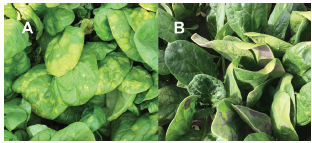 Figure 1. Foliar symptoms of spinach downy mildew: (A) irregular, chlorotic lesions form on the upper surface of the leaves, and (B) blue-topurple, downy growth develops on the undersides of leaves.
Symptoms of downy mildew usually develop seven to ten days after infection. However, there can be a longer latent period between infection and symptom expression.1,6,9 The initial symptoms are dull, yellow, irregular shaped spots onthe upper sides of leaves and cotyledons (Figure 1a). Lesions can develop on leaves of any age, and the lesions become bright yellow over time. Blue-to-purple, downy growth forms on the undersides of leaves (Figure 1b). This growth consists of the spores and spore-forming structures of the pathogen and is easiest to observe in the early morning. The lesions enlarge and eventually become tan in color and dry. Severely infected leaves may become curled and distorted, and multiple infections can lead to a blighting of the leaves. Heavily infected plants may be stunted and eventually die. Latent infections can result in the development of symptoms on leaves after harvest, once the product is packed in bags or cartons.2,7,8,10
CYCLE AND CONDITIONS
There are no known alternate hosts for the spinach downy mildew pathogen. The pathogen most likely survives on infested spinach debris and volunteer spinach plants.1,6,10 The pathogen produces two kinds of spores, asexually produced spores (sporangia) and sexually produced spores (oospores).
The sporangia are the spores that form on the undersides of leaves. They are dispersed by wind and splashing water, and they can travel long distances in air currents. Sporangia are responsible for rapid disease spread within a field. The sporangia land on spinach leaves, where they germinate and infect, resulting in new lesions.1,3 Spore formation, dispersal, and infection are favored by cool, wet conditions. Optimal temperatures for infection are between 59° and 70°F, but disease can develop over a wide range of temperatures (subfreezing to 118°F).7 Infection is favored by the presence of water on leaf surfaces, but leaves do not need to be wet for infection to occur if humidity levels are high. Dense canopies associated with high planting populations result in humid environments that promote infection and sporulation by the pathogen.2,10 In the Imperial Valley of California as well as the desert region near Yuma, Arizona, overlapping spinach plantings beginning in the fall with harvest through the following spring. In these regions, downy mildew spores have been detected in spore traps throughout the entire growing season, and they may be present at some level year-round.5
Oospores form after the fusion of two compatible mating-type strains of the downy mildew pathogen. Sexual reproduction results in genetic recombination and increased genetic variation, including the formation of new races of the pathogen. Oospores have been found in leaf tissue and roots of infected plants, and the oospores in plant tissue and the soil are viable and able to germinate.1 Oospores of P. effusa can be found on the seed from infected spinach plants, and studies have shown that seed transmission of spinach downy mildew is possible but so far appears to occur at low levels. Oospores have also been observed in infested plant debris and may be a source of inoculum for future spinach crops planted in fields with a history of the disease.3,7
DISEASE MANAGEMENT
Resistant spinach varieties were first developed in the 1950s and 60s, and resistance has been a primary strategy for managing spinach downy mildew ever since. Most of the spinach varieties grown in California and Arizona are hybrids that have some form of resistance against downy mildew.1 However, P. effusa forms new races that can overcome disease resistance. Downy mildew races are denominated by the International Working Group for Peronospora effusa (IWGP). Currently, 20 named races of the pathogen have been identified, with races 18 and 19 first reported in 2021 and race 20 in 2024.7,9,11 Host resistance to races 1 and 2, developed in the 1950s and 60s, were once thought to be conveyed by single, dominant genes, but the resistance to race 1 was later found to be conveyed by two closely linked genes at a gene locus. Now several gene loci (locations of genes on chromosomes) containing downy mildew resistance genes have been characterized.1
The resistance gene RPF1 is reported to convey resistance to at least 12 of the 20 known races, including races 1, 7, 9, 11, and 13. RPF2 is reported to convey resistance to at least 11 races, and RPF3 to convey resistance to more than 9 races. Most of the spinach varieties labeled as resistant to downy mildew are not resistant to all races of the pathogen. Peronospora effusa race 9 has been shown to be pathogenic on most of the differential spinach varieties, except those with resistance genes near the RPF3 locus.2,8,12 It is recommended that growers select varieties that have resistance against the races most likely to be present in their area and to grow several varieties with different forms of resistance.8,10
Cultural practices can also be used to help manage downy mildew on spinach. Fall crops of spinach should not be planted near fields where spring spinach crops were grown. Volunteer spinach plants in and around new plantings should be destroyed. Highly infected crops that will not be harvested should be destroyed as soon as possible to reduce the spread of the disease to neighboring fields. Crop residue should be plowed under shortly after harvest, even if the crop showed no symptoms of downy mildew. Rotate away from spinach for at least two to three years if possible.1,7,8,10 Avoid the use of overhead irrigation or schedule water applications for early in the morning to promote rapid drying and to minimize the number of hours of leaf wetness. Do not place row covers over wet plants.1,7,8 In high tunnel systems, increase air circulation and reduce humidity levels. Maintain a fallow period of at least two weeks between spinach crops grown in high tunnels.
The application of foliar fungicides can also be an important tool for managing spinach downy mildew. However, 45% of spinach production is organic, and the number of fungicides approved for management of DM in organic production systems is limited. There are many fungicides registered for downy mildew control on spinach. The fungicides currently available are protectants, meaning that they protect plants against new infections but will not eliminate established infections. It is recommended to make the first application before symptoms develop or as soon as the disease is detected. Therefore, plants should be inspected weekly for symptoms of downy mildew, starting early in the season or as soon as row covers are removed. Fungicide resistant isolates of P. effusa reduce the usefulness of fungicide applications. Consult regional production and pest management guides for recommendations on the products that are most effective and registered for use on spinach in your area. Fungicide applications may need to be made regularly throughout the growing season, so it is important to check the REI (reentry intervals) and PHI (pre-harvest intervals) restrictions for the products being used. Seed treatment fungicides may also help reduce the chance of introducing downy mildew on infected spinach seed. Always consult the product label for application instructions and restrictions.1,2,3,7,8,10
SOURCES
1Kandel S., Mou, B., Shishkoff, N., Shi, A., Subbarao, K., and Klosterman, S. 2019. Spinach downy mildew: Advances in our understanding of the disease cycle and prospects for disease management. Plant Disease 103:791-803.
2UC IPM. 2012. Agriculture: Spinach pest management guidelines - downy mildew. https://www2.ipm.ucanr.edu/agriculture/spinach/Downy-Mildew/
3Klosterman, S., Clark, K., Anchieta, A., Kandel, S., Mou, B., McGrath, M., Correll, J., and Shishkoff, N. 2024. Transmission of spinach downy mildew via seed and infested leaf debris. Plant Disease 108(4):951-959.
4Kandel, S., Hulse-Kemp, A., Stoffel, K., Koike, S., Shi, A., Mou, B., Van Deynze, A., and Klosterman, S. J. 2020. Transcriptional analyses of differential cultivars during resistant and susceptible interactions with Peronospora effusa, the causal agent of spinach downy mildew. Sci Rep 10, 6719.
5Choudhury, R., Koike, S., Fox, A., Anchieta, A., Subbarao, K., Klosterman, S., and McRoberts, N. 2016. Season-long dynamics of spinach downy mildew determined by spore trapping and disease incidence. Phytopathology 106:1311-1318.
6Choudhury, R. and McRoberts, N. 2023. Survey of spinach downy mildew management practices and communication network. Plant Health Progress 24(3):386-388.
7McGrath, M. 2023. Spinach downy mildew. Cornell vegetables: Resources for commercial growers. https://www.vegetables.cornell.edu/pest-management/disease-factsheets/spinachdowny-mildew/
8Madeiras, A. 2017. Spinach downy mildew. University of Massachusetts Extension, Vegetable Program. https://ag.umass.edu/vegetable/fact-sheets/spinach-downy-mildew
9Clark, K., Anchieta, A., da Silva, M., Kandel, S., Choi, Y., Martin, F., Correll, J., Van Denyze, A., Brummer, E., and Klosterman, S. 2022. Early detection of the spinach downy mildew pathogen in leaves by recombinase polymerase amplification. Plant Disease 106(7):1793-1802.
10Ocamb, C. and du Toit, L. 2025. Spinach (Spinacia oleracea) – downy mildew. 2025 Pacific Northwest Plant Disease Management Handbook. https://pnwhandbooks.org/plantdisease/host-disease/spinach-spinacia-oleracea-downy-mildew
11Correll J., Smilde D., and Venancio R. 2024. Denomination of Pe: 20, a new race of downy mildew in spinach. ANR Blogs. https://ucanr.edu/blogs/blogcore/postdetail.cfm?postnum=59726
12Olaoye, D., Bhattarai, G., Feng, C., Correll, J., and Shi, A. 2024. Evaluation of downy mildew resistance in spinach (Spinacia oleracea). Euphytica: International Journal of Plant Breeding, 220(3). https://doi.org/10.1007/s10681-023-03289-9
Websites verified 2/18/2026
For additional agronomic information, please contact your local seed representative. Performance may vary, from location to location and from year to year, as local growing, soil and environmental conditions may vary. Growers should evaluate data from multiple locations and years whenever possible and should consider the impacts of these conditions on their growing environment. The recommendations in this material are based upon trial observations and feedback received from a limited number of growers and growing environments. These recommendations should be considered as one reference point and should not be substituted for the professional opinion of agronomists, entomologists or other relevant experts evaluating specific conditions.
BAYER GROUP DOES NOT WARRANT THE ACCURACY OF ANY INFORMATION OR TECHNICAL ADVICE PROVIDED HEREIN AND DISCLAIMS ALL LIABILITY FOR ANY CLAIM INVOLVING SUCH INFORMATION OR ADVICE.
6511_755500 Published 02/18/2026