- Canada
- expand_more

-
Products
Select Your Brand Below to View Full Portfolio of Offerings
-
Resources
Click below for Specialized Tips for Your Growing Environment
-
About
Discover More About Our Commitment to Advance Health and Nutrition Globally, Together With You.
-
Innovation

Learn about our approach to innovation.


Click here to download a PDF version of this spotlight.
» Secondary macronutrients are important for proper growth and development of vegetable crops.
» Secondary macronutrients Ca, Mg, and S are needed in smaller amounts than N, P, and K.
Plants absorb elements from their environment to use for growth and metabolic functions. The seventeen essential elements used by plants are divided into macronutrients and micronutrients, depending on the amount required by the plant. Individual macronutrients make up 0.4 to 90% of the dry weight of plant tissues while individual micronutrients usually make up 0.02% or less (Table 1).1 The macronutrients include carbon (C), hydrogen (H), oxygen (O), nitrogen (N), phosphorus (P), potassium (K), sulfur (S), calcium (Ca), and magnesium (Mg). Plants obtain C, H, and O from carbon dioxide (CO2) and water (H2O). The other nutrients are primarily taken up by the roots in the soil solution. Of the macronutrients N, P, and K are needed by plants in the highest amounts, and the relative amounts are listed on most fertilizer packaging as an N:P:K ratio. The other three macronutrients (Ca, Mg, and S) are referred to as secondary macronutrients because they are needed in lesser quantities than N, P, and K and are often present in soils at levels sufficient to meet plant needs.2
The availability of nutrients in forms that plants can absorb is dependent, in part, on the pH of the soil solution, with some nutrients more available in acidic conditions (low pH) and others more available in alkaline conditions (high pH) (Figure 1). Plants usually take up nutrients in proportion to the available levels in the soil. However, the overabundance of some nutrients can inhibit the uptake of certain other nutrients. For example, excess amounts of K can inhibit the uptake of N, Ca, and Mg.1
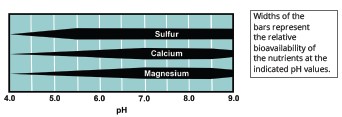 Figure 1. The effect of pH on the plant availability of three secondary macronutrients.
The location of nutrient deficiency symptoms on plants is affected by how mobile the elements are within the plant. An element that is highly mobile (easy for the plant to move) can be translocated from older tissues to younger developing tissues if levels in the plant are insufficient. So, for these elements, deficiency symptoms usually develop first on older tissues. Symptoms usually develop first on younger tissues with elements that are not very mobile in the plant.1,2,3 The specific symptoms resulting from nutrient deficiencies are associated with the various functions the nutrient is involved with in the plant.
CALCIUM (Ca)
Calcium is used as part of the cell wall structure of plant cells, including the middle lamella layer that holds cells together. Calcium is also important for cell membrane integrity and in the translocation and retention of other nutrients, and Ca is also used by plants as a messenger for response to environmental changes.1,3,4
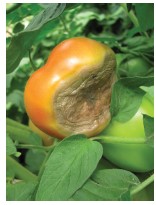 Figure 2. Symptoms of blossom end rot on tomato fruit resulting from a localized calcium deficiency within the plant.
There is a delicate balance between the amounts of Ca, Mg, and K within the plant. Too much of any one of these nutrients can suppress the uptake of the other two. The uptake of Ca by the roots can also be affected by levels of NH4 in the soil.4,5 The uptake of Ca is a passive process, meaning that the rate of uptake is dependent on the amount of Ca in the soil and that the plant does not expend energy to extract Ca from the soil. It is absorbed by the part of the root just behind the root tip. So, the presence of healthy, actively growing roots is important for the absorption of Ca, and uptake can be affected by root diseases and other factors that affect root function and growth.4
Calcium is not highly mobile within the plant, and the levels in specific tissues are affected by transpiration and the movement of water within the plant. Moisture levels in the soil and humidity levels around the canopy affect the translocation of water and the movement of Ca.4,5 A deficiency of Ca can result in the failure of terminal bud and root tip development.
Chlorosis and necrosis of leaf margins can develop on new leaves, resulting in contorted growth, as is seen with tip burn of lettuce and cole crops. Chlorotic and necrotic spots can also develop on leaves deficient in Ca. Blossom end rot of tomato and pepper, blackheart of celery, and cavity spot of carrot are all the result of localized Ca deficiencies within the plant (Figure 2). Symptom development is often associated with an inability of the plant to translocate Ca to the tissue where it is needed rather than a lack of available Ca in the soil or within the plant as a whole.4,5
Maintaining even soil moisture levels and avoiding alternating periods of overly dry and overly wet soils can help minimize the development of blossom end rot and other Ca deficiency related symptoms. Using agricultural lime to help correct overly acidic soils can help increase the availability of Ca to the plant, and the foliar application of Ca fertilizers (CaCl or CaNO3) to young, growing tissues can help alleviate localized Ca deficiencies in some situations.5
MAGNESIUM (Mg)
Magnesium is used as part of the chlorophyll molecule needed for photosynthesis. It is also used as an enzyme cofactor and activator, making certain enzymes work better. Mg is relatively mobile in plants, easily translocated from older to younger tissues if necessary, and deficiency symptoms usually develop on older plant tissues. The uptake of Mg can be inhibited by excessive levels of K, Ca, and NH4.1,4,5
Deficiencies of Mg manifest as interveinal chlorosis and necrosis on older leaves. Severe deficiencies can result in the stunting of plants.4,5 On sweet corn, Mg deficiency symptoms may be seen early in the season in cold, wet soil conditions. On potatos, deficiencies can cause a chlorosis of leaves beginning on the leaf tips and margins of older leaves, progressing to the internal portions of the leaf. On celery, chlorosis usually starts at the tips of older leaves and progresses to the margins and interveinal tissues. On tomatoes (especially greenhouse grown) interveinal chlorosis symptoms develop on the older leaves, with a mild purpling of affected leaves. Foliar applications of Mg-containing fertilizers can help manage deficiency symptoms. Soil and tissue nutrient analysis can also help detect excess levels of K, Ca, and N.5
SULFUR (S)
Sulfur is a constituent (building block) of several amino acids including cystine, cysteine, glutathione, and methionine. Sulfur is also a cofactor for some enzymes.1,4 Sulfur is usually absorbed by the plant as the sulfate ion (SO42-), which is a component of many fertilizers.5
Sulfur deficiency symptoms are most frequent on plants grown in sandy, low organic matter soils. Legumes (bean and peas) are sensitive to S deficiencies while sweet corn is relatively insensitive. Plants that are deficient in S typically develop a light green color, similar to that seen with N deficiency. S is not very mobile within the plants, and symptoms usually appear first on younger tissues, which distinguishes it from N deficiency. Excessive levels of S can result in toxicity symptoms of interveinal chlorosis and scorching of leaf margins that progresses inward. Exposure to the air pollutant sulfur dioxide (SO2) can result in symptoms that resemble frost damage or herbicide injury.5
MANAGING DEFICIENCIES
Suspected nutrient deficiencies should be verified with tissue analysis. For best results, follow the directions for sampling and sample submission provided by the lab where the analysis will be done. Be sure to submit the specific tissues recommended by the lab. Soil analysis can help identify soils that could benefit from specific fertilizer combinations. Measurements of soil pH and alkalinity can also indicate conditions in which the levels of certain plant available nutrients may be limited.2,5
Nutrients can be absorbed through plant leaves. However, foliar application of deficient nutrients should only be considered a temporary fix, as these treatments will not provide a continuous source of the deficient nutrient. Identifying why that nutrient is deficient (low levels in the soil, soil conditions put the nutrient in forms unavailable to plants, or the nutrient is not able to move within the plant adequately) will help in determining the best means for addressing the deficiency. With foliar applications, use low rates of fertilizers for young plants and higher rates as canopies develop. Most fertilizers can usually be tank-mixed with other products for foliar applications, but the mixes should be tested on small areas first to ensure safety for the crop. Wetting agents can help when the nutrients are applied to waxy leaf and stem surfaces.5 Always follow all product label instructions, restrictions, and regulations.
SOURCES
1Sanchez, E., Di Gioia, F., Berghage, R., Flax, N., and Ford, T. 2023. Hydroponics systems and principles of plant nutrition: Essential nutrients, function, deficiencies, and excess. PennState Extension. https://extension.psu.edu/hydroponics-systems-and-principles-ofplantnutrition-essential-nutrients-function-deficiency-andexcess#:~:text=Macronutrients%20include%20carbon%2C%20hydrogen%2C%20oxygen,the%20amount%20required%20by%20plants.
2Taber, H. and Nair, A. 2016. Suggested soil micronutrient levels and sampling procedures for vegetable crops. Iowa State University Extension and Outreach, HORT 3063. https://www.extension.iastate.edu/vegetablelab/suggested-soil-micronutrient-levels-andsampling-procedures-vegetable-crops.
3Nutrition of greenhouse crops. Purdue University. https://www.purdue.edu/hla/sites/cea/wpcontent/uploads/sites/15/2021/01/Nutrition-ofgreenhouse-crops.pdf.
4Hochmuth, G. 2022. Fertilizer management for greenhouse vegetables Florida greenhouse vegetable production handbook, vol 3. University of Florida IFAS Publication #HS787. https://doi.org/10.32473/edis-cv265-1990.
5Vitosh, M. 2015. Secondary and micro-nutrients for vegetable and field crops. Michigan State University, MSU Extension, Bulletin E486. https://www.canr.msu.edu/resources/secondary_and_micro_nutrients_for_vegetable_and_field_crops_e486.
6Micronutrients. Clemson University. https://www.clemson.edu/public/regulatory/ag-srvc-lab/soil-testing/pdf/micronutrients.pdf.
Websites verified 5/5/2025
ADDITIONAL INFORMATION
For additional agronomic information, please contact your local seed representative. Performance may vary, from location to location and from year to year, as local growing, soil and environmental conditions may vary. Growers should evaluate data from multiple locations and years whenever possible and should consider the impacts of these conditions on their growing environment. The recommendations in this article are based upon information obtained from the cited sources and should be used as a quick reference for information about vegetable production. The content of this article should not be substituted for the professional opinion of a producer, grower, agronomist, pathologist and similar professional dealing with vegetable crops.
BAYER GROUP DOES NOT WARRANT THE ACCURACY OF ANY INFORMATION OR TECHNICAL ADVICE PROVIDED HEREIN AND DISCLAIMS ALL LIABILITY FOR ANY CLAIM INVOLVING SUCH INFORMATION OR ADVICE.
5013_537050 Published 05/06/2025