- Canada
- expand_more

-
Products
Select Your Brand Below to View Full Portfolio of Offerings
-
Resources
Click below for Specialized Tips for Your Growing Environment
-
About
Discover More About Our Commitment to Advance Health and Nutrition Globally, Together With You.
-
Innovation

Learn about our approach to innovation.


» Adult and larval pepper weevils feed on flower buds and fruit resulting in flower and fruit abortion.
» Crop rotation and sanitation practices can lower pepper weevil populations in the field.
» Crop scouting and insecticide applications can help minimize yield losses from pepper weevil infestations.
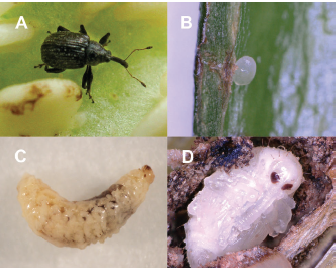 Figure 1. Foliar symptoms of ToBRFV on tomato: (A) mosaic discoloration of leaves, (B) leaf narrowing and distortion.
The pepper weevil (Anthonomus eugenii) is one of the most destructive insect pests on peppers in North America. The insect is endemic throughout Central America, the Caribbean, and southern parts of the United States from Florida to California.1,2 The pepper weevil can move northward during the growing season, infesting pepper crops in areas such as New Jersey. Yield losses as high as 80% have been reported.3,4,5
Pepper weevils are among the most damaging pests of peppers, and peppers are the primary host for this insect. All commercial pepper varieties currently available are susceptible to pepper weevil damage.1,4,6
The body of the adult pepper weevil is about 1/8 inch long (2 to 3.5 mm), arched, dark in color with a brassy luster, and has a long snout/beak (Figure 1a). Larva are white to gray in color with yellowish-brown heads and are 1/4 inch long when fully grown (Figure 1c). Pupa resemble adults with no wings and are initially white, becoming yellowish with brown eyes (Figure 1d).1,5
WEEVIL DAMGE ON PEPPERS
Female weevils lay eggs in small fruit and flowers, most often in the upper canopy. The process of egg laying punctures the fruit and flowers. The hatched larvae feed on flower buds and on internal fruit tissue. Adult beetles make exit holes in the walls of the fruit when they emerge (Figure 2). Adult weevils also feed on fruit and flower buds. Feeding causes flowers and young fruit to abort and prematurely drop. An indication of pepper weevil infestation is the presence of several dropped fruit at the base of a plant. Fruit that continue to develop can be deformed. On larger fruit, larvae feed on the inner core and fruit walls. The infested fruit may show no external symptoms other than the puncture wounds made during egg laying. The calyx and stems of infested fruit may turn yellow, and the inner core can become brown and moldy. If no flowers or fruit are present, adults can feed on stems and leaves but this rarely causes major damage to the plant.1,3,5,6,7
PEPPER WEEVIL LIFE CYCLE
Pepper weevils are tropical insects, and they survive winters on crop and weed host plants in southern regions. Pepper weevils do not have a diapause phase, a hibernation-like state in which they would stop developing during periods of adverse conditions. During periods of fallow, pepper weevils survive on weed species such as black nightshade and silverleaf nightshade.1,2,3
In areas with winters that are too cold for the weevils to overwinter, the insects can be brought in on pepper fruit or transplants grown in locations where weevils are present. Research studies in Delaware, Maryland, and New Jersey have found that southern-grown peppers brought to re-packing houses are a primary source of infestation for pepper weevils on locally grown peppers. Infested peppers discarded at retail outlets can also be a source of pepper weevils. Flying adults are the primary means for the spread of pepper weevils from field to field once they have been introduced to an area.2,3,5
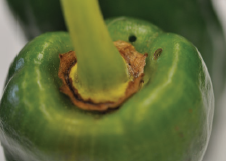 Figure 2. Fruit symptoms: (A) brown necrotic lesions, (B) rugose fruit surface, necrosis of stem and calyx.
Female pepper weevils create holes in flower buds or in the bases of young fruit. They lay their eggs in these holes and then seal them with a fluid that hardens and becomes dark brown. After egg hatch, larvae develop in three stages before the pupal stage occurs in two to three weeks. After three to six days the pupae become adults. The life cycle, egg to adult, can take about 14 days to complete on pepper. A complete generation‑egg to egg‑takes 20 to 30 days, depending on the temperature. Three to five generations can occur in many pepper growing areas.1,3,4,5,6
MANAGING PEPPER WEEVIL DAMAGE
Pepper weevils are difficult to manage once an infestation is established and larvae are present inside the fruit. A combination of pest exclusion, scouting, sanitation, and insecticide applications can be needed to minimize yield losses.2 In areas where pepper weevils can overwinter, field sanitation, weed management, and crop rotation are important. Crop-free periods with destruction of alternate hosts (including solanaceous weeds) can eliminate larvae and pupae and lower weevil populations in an area.1,8
If possible, avoid planting peppers within one and a half miles of other solanaceous crops such as eggplant.9 In areas where pepper weevils do not usually overwinter, avoid planting near pepper re-packing or processing facilities. Inspect transplants for evidence of weevil infestation and avoid transplants produced in areas where weevils are commonly present.4
During the season, remove and destroy any fallen fruit. Control nightshade and other solanaceous weeds in and around the planting. After final harvest, promptly remove fruit from the field and destroy cull piles. Shred and disc pepper residue in the field as soon as possible.1,4
Scouting for pepper weevil should begin prior to flowering. Scouting involves looking for adult weevils through visual examination of plants or the use of pheromone-bated yellow sticky traps (Figure 3).4 Traps should be placed around the perimeter of the field at canopy height. Traps should be checked twice a week, more often if pepper weevils are known to be present in the area. The yellow sticky traps will capture other insects, including other weevil species, so correct identification of pepper weevils is very important.5 Treatments with insecticides registered for management of pepper weevil on pepper should start when the first weevil has been captured. One weevil in a trap is indicative of approximately 8% fruit infestation.10 Scouting can also be done by visual inspection of the terminal buds of pepper plants, looking for adult weevils. Scouting should be done in the morning when weevils are present in higher numbers.11 Because adult weevils can be elusive and difficult to spot, one study suggested that an action threshold based on the percentage of bud damage is easier to use. Plants should be evaluated twice a week, as damaged buds abort and fall off the plants after a few days. Using this method, an action threshold of 5% bud damage is recommended.12
Once an action threshold has been reached and buds begin to form, insecticides should be applied at short intervals. Insecticides are only effective against the adult stage of the weevil because immature stages of the weevil are protected within the buds or fruit.2 Several insecticides are registered for control of pepper weevil on pepper, but efficacy is variable, and most of the insecticides will suppress the weevils but not completely eradicate them. Products containing isocycloseram, tiamethoxam, and oxamyl have been the primary insecticides used for weevil management for the past several years.13 Check local pest management guides for a list of registered and recommended insecticides. Some level of economic loss is common even with regular insecticide treatment.1,5,9 Rotate the use of insecticides with different modes of action to delay the development of insecticide resistance in the pepper weevil population.7 The longterm use of insecticides for controlling pepper weevil has resulted in the development of weevil populations that are resistant to some insecticides, as well as reductions in populations of natural enemies.13
Some insecticides recommended for weevil management can be harmful to bees and other beneficial insects. Care should be taken to prevent the direct application of these products to flowering crops and to prevent spray-drift from reaching flowering crops or weeds where bees are foraging.4 Consider using active ingredients that may both be safer for beneficials and help to manage pepper weevils.13 Always consult current product labels for application instructions and restrictions.
SOURCES
1Riley, D. 2025. Pepper weevil (Anthonomus eugenii). University of Georgia Integrated Pest Management Program. https://ipm.uga.edu/2025/08/05/anthonomus-eugenii-cano/
2Labbé, R., Hilker, R., Gagnier, D., McCreary, C., Gibson, G.A.P, Fernández-Triana, J., Mason, P.G., and Gariepy, T.D. 2018. Natural enemies of Anthonomus eugenii (Coleoptera: Curculionidae) in Canada. Canadian Entomologist. 150:404-411. https://dx.doi.org/10.4039/tce.2018.3
3 Ingerson-Mahar, J., Eichinger, B., and Holmstrom, K. 2015. How does pepper weevil (Coleoptera: Curculionidae) become an important pepper pest in New Jersey? Journal of Integrated Pest Management 6. https://doi.org/10.1093/jipm/pmv022
4Natwick, E.T., Trumble, J.T., and Aguiar, J.L. 2012. Pepper weevil. UC Pest Management Guidelines: Peppers. UC ANR Publication 3460. https://ipm.ucanr.edu/agriculture/peppers/pepper-weevil/#gsc.tab=0
5King, S. 2008. Pest management strategic plan for bell and non-bell peppers in Delaware, Eastern Shore Maryland, and New Jersey. Northeast IPM Center, Cornell University. https://www.researchgate.net/publication/242743815_Pest_Management_Strategic_Plan_for_Bell_and_Non-Bell_Peppers_in_Delaware_Eastern_Shore_Maryland_and_New_Jersey
6 Patrock, R.J. and Schuster, D.J. 1992. Feeding, oviposition and development of pepper weevil (Anthonomus eugenii Cano) on selected species of solanaceae. Trop. Pest Manage. 38:65–69. https://doi.org/10.1080/09670879209371648
7Seal, D. and Shuster, D. 1995. Control of pepper weevil, Anthonomus eugenii, in west-central and south Florida. Proc. Fla. State Hort. Soc. 108:220–225. https://journals.flvc.org/fshs/issue/view/4167
8Sparks, A.N., Jr., Riley, D.G., and Torrance, T. 2022. Update on broad mites and pepper weevil in peppers [Extension conference presentation]. Southeast Regional Fruit & Vegetable Conference. https://seregionalconference.org/wp-content/uploads/2022/07/Broad-mitesand-pepper-weevil.pdf
9Ingerson-Mahar, J. 2017. Planning for pepper weevil. Plant & Pest Advisory, Rutgers Cooperative Extension. https://plant-pest-advisory.rutgers.edu/planning-for-pepper-weevil/.
10Bottenberg, H. and Lingren, B. 1998. Field performance of a new pepper weevil pheromone formulation. Proc. Fla. State Hortic. Soc. 111: 48–50. https://journals.flvc.org/fshs/issue/view/4174
11 Riley, D.G., Schuster, D.J., and Barfield, C.S. 1992. Sampling and dispersion of pepper weevil (Coleoptera: Curculionidae) adults. Environm. Entomol. 21: 1013–1021. https://doi.org/10.1093/ee/21.5.1013
12Cartwright, B., Teague, T.G., Chandler, L.D., Edelson, J.V, and Bentsen, G. 1990. An action threshold for management of the pepper weevil (Coleoptera: Curculionidae) on bell peppers. J. Econ. Entomol. 83: 2003–2007. https://doi.org/10.1093/jee/83.5.2003
13Adeleye, V., Seal, D., and Liburd, O. 2025. Management of pepper weevil (Anthonomus eugenii Cano) (Coleoptera: Curculionidae) using biorational and conventional insecticides in south Florida. Insects. 16:1101. https://doi.org/10.3390/insects16111101
Websites verified 10/20/2026
ADDITIONAL INFORMATION
For additional agronomic information, please contact your local seed representative. Performance may vary, Performance may vary, from location to location and from year to year, as local growing, soil and environmental conditions may vary. Growers should evaluate data from multiple locations and years whenever possible and should consider the impacts of these conditions on their growing environment. The recommendations in this material are based upon trial observations and feedback received from a limited number of growers and growing environments. These recommendations should be considered as one reference point and should not be substituted for the professional opinion of agronomists, entomologists or other relevant experts evaluating specific conditions.
BAYER GROUP DOES NOT WARRANT THE ACCURACY OF ANY INFORMATION OR TECHNICAL ADVICE PROVIDED HEREIN AND DISCLAIMS ALL LIABILITY FOR ANY CLAIM INVOLVING SUCH INFORMATION OR ADVICE.
6415_102736 Published 10/20/2026