- Canada
- expand_more

-
Products
Select Your Brand Below to View Full Portfolio of Offerings
-
Resources
Click below for Specialized Tips for Your Growing Environment
-
About
Discover More About Our Commitment to Advance Health and Nutrition Globally, Together With You.
-
Innovation

Learn about our approach to innovation.

Click here to download a PDF version of this spotlight.
» Choanephora blight of peppers can result in substantial yield losses when conditions are favorable for the disease.
» Warm, wet conditions with extended rainy periods promote the development of Choanephora blight of pepper.
» Cultural practices to reduce inoculum levels and promote good air circulation can help reduce disease levels.
Choanephora blight (also known as wet rot) is caused by the fungal pathogen Choanephora cucurbitarum and occurs worldwide on peppers grown in tropical regions. However, it is usually not a common disease of peppers in most areas.1,2 The disease can affect buds, leaves, petioles, stems, flowers, and fruit, with younger tissues being the most susceptible to infection.3 The disease has been observed sporadically in the US, mainly in the southeastern states, including Florida and Georgia. Outbreaks of Choanephora blight occurred in southwestern Florida from 1966 through 1986, and in more widespread parts of Florida in the fall of 2002.3,4 In 2025, multiple outbreaks of Choanephora blight developed in Georgia.5
Choanephora cucurbitarum is a pathogen of several crop species, including bean, beet, cotton, cucurbits, eggplant, pea, soybean, and sweet potato.2 There is some speculation that the pathogen causing the disease on pepper in Georgia may be a different species of Choanephora or a new population that has developed resistance to some fungicides because fungicides that are effective against Choanephora cucurbitarum infecting squash plants (FRAC groups 3 and 11) have not shown much effect against the disease on peppers.5
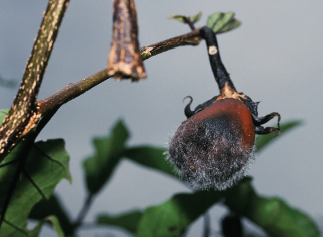 Figure 1. Fruit rot symptoms of Choanephora blight of pepper. Note the fungal sporulation (fuzzy growth) on the infected fruit.
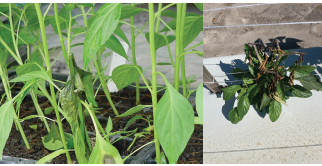 Figure 2. Leaf wilting (left) and branch die-back (right) resulting from Choanephora blight.
SYMPTOMS
Choanephora blight can affect all plant parts except for the roots.6 Symptoms are usually first observed on apical growing points, flowers, and fruits. Initially, water-soaked areas develop on the affected tissue, later spreading to cause the blighting of apical growing points.1 The pathogen may first colonize senescing flower petals and then spread into the developing fruit. Mushy, dark, water-soaked lesions on infected fruits enlarge and cause fruit rot (Figure 1).5 Flowers that become infected may abort.6 The pathogen can grow down into the stems and cause wilting and eventually die back in individual branches or entire plants (Figure 2).2,7 Silvery, whisker-like,
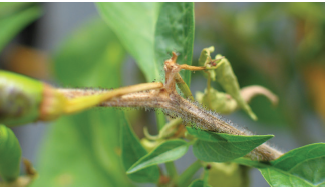 Figure 3. Sporulation of Choanephora cucurbitarum on a pepper stem. The silvery sporangiophores are topped by the dark sporangiola, which are the infecting spore for this pathogen.
hairy strands of fungal growth with dark spore structures (sporangia) at their tips form on infected tissues, and are a diagnostic characteristic of Choanephora blight (Figure 3).3,7
CYCLE AND CONDITIONS
Choanephora blight can develop at any time of the season, from transplanting to harvest.6 The fungal pathogen is a weak parasite that often colonizes dead or senescing tissues before infecting living pepper tissue. Peppers are most susceptible to infection from the seedling stage to early flowering, and the infection of fruit often starts with the colonization of senescing flower petals. The pathogen can then spread to flower stalks, buds, and leaves.7
Warm, humid conditions with extended periods of rain favor the spread of the pathogen and infection of peppers. Temperatures of 77 to 86°F (25 to 30°C) are optimal for disease development, and growth and sporulation of the fungus stop when temperatures drop below 58°F (14.4°C).2,3,7 Humidity promotes the formation of fungal spores (sporangiola) on infected tissues, contributing to disease spread.1,2 Because younger tissues are more susceptible to infection than older tissues, but disease spread and development are higher in warm conditions, the disease tends to be more common and severe on peppers planted in late summer or fall for a fall crop than on spring-planted peppers. With fall crops, young tissues are present when the temperatures are higher. Spring-planted crops are near harvest by the time temperatures are high enough for the disease to become much of a problem.2,3,6 Wounds are not necessary for infection to occur, but wounded plants may be infected more frequently.2,7
Choanephora produces several types of spores, and the sporangiola produced on senescing tissues are the primary spore type for initiating infection.2 The fungus survives in the soil and on infested plant debris, and can be disseminated by wind, splashing water, on clothing, tools, and equipment, as well as by insects, including bees and beetles.1,2,6,7
MANAGEMENT
Managing Choanephora blight can be difficult during periods of warm and wet weather.2 Cultural practices that lower the amount of pathogen inoculum in the field can help lower the rates of infection and yield losses. Regular rotation to non-host crop species and the prompt incorporation or removal of crop debris after harvest can help lower pathogen levels. Improving air circulation in the canopy, by planting on wider row spacing and increasing plant-to-plant spacing within the row, can help lower humidity levels and allow plants to dry more quickly after it rains. Using drip irrigation rather than overhead sprinklers and planting on sites with well-drained soils will also help lower humidity levels and keep canopies dry. Avoid overfertilizing with nitrogen, which can promote the development of dense canopies.2,3,5
Selecting varieties of peppers that drop their petals quickly after fruit set can help reduce infection levels by removing the senescing tissue that leads to the infection of young fruit.7
The application of fungicides may help manage Choanephora blight and reduce yield losses from the disease. However, research trials have found that fungicides may not provide consistent and acceptable levels of disease control on peppers. Because the sites of infection are often deep in the canopy, it can be difficult to protect these sites with fungicide sprays. Isolates of Choanephora collected from peppers in the recent outbreaks in Georgia are currently being evaluated to determine if they are resistant to fungicides commonly used to help manage the pathogen on other crops.1,2,5,7
SOURCES
12024. Choanephora blight (wet rot). Bayer pepper & eggplant disease field guide. https://www.vegetables.bayer.com/us/en-us/resources/disease-guides/pepper-eggplant/choanephora-blight-wet-rot.html
2Kucharek, T., Benny, G., and Pernezny, K. Choanephora blight (wet rot). In Pernezny, K., Roberts, P., Murphy J., and Goldberg, N., Eds. Compendium of pepper diseases. American Phytopathological Society.
3Blazquez, C. 1986. Choanephora wet rot of pepper. Proc. Fla. State Hort. Soc. 99:321-325. https://journals.flvc.org/fshs/article/download/94929/90950/123518
4Roberts, P., Urs, R., Kucharek, T., Semer, C., Benny, G., and Pernezny, K. 2007. Outbreak of Choanephora blight caused by Choanephora cucurbitarum on green bean and pepper in Florida. https://apsjournals.apsnet.org/doi/abs/10.1094/PDIS.2003.87.9.1149B
5Yu, P., Kaur, N., Dutta, B. 2025. Choanephora fruit rot: An emerging disease in peppers and future directions. University of Georgia, Integrated Pest Management. https://ipm.uga.edu/2025/10/02/choanephora-fruit-rot-an-emerging-disease-in-peppers-andfuture-directions/
62025. Pepper diseases, wet rot. University of Florida, IFAS https://plantpath.ifas.ufl.edu/u-scout/pepper/wet-rot.html
7Cerkauskas, R. 2004. Choanephora blight. AVRDC Fact Sheet, Publication 04-576. https://worldveg.tind.io/record/39513/files/f0111.pdf
Websites verified 12/1/2025
ADDITIONAL INFORMATION
For additional agronomic information, please contact your local seed representative. Performance may vary, from location to location and from year to year, as local growing, soil and environmental conditions may vary. Growers should evaluate data from multiple locations and years whenever possible and should consider the impacts of these conditions on their growing environment. The recommendations in this article are based upon information obtained from the cited sources and should be used as a quick reference for information about vegetable production. The content of this article should not be substituted for the professional opinion of a producer, grower, agronomist, pathologist and similar professional dealing with vegetable crops.
BAYER GROUP DOES NOT WARRANT THE ACCURACY OF ANY INFORMATION OR TECHNICAL ADVICE PROVIDED HEREIN AND DISCLAIMS ALL LIABILITY FOR ANY CLAIM INVOLVING SUCH INFORMATION OR ADVICE.
6411_705050 Published 12/04/2025