- Canada
- expand_more

-
Products
Select Your Brand Below to View Full Portfolio of Offerings
-
Resources
Click below for Specialized Tips for Your Growing Environment
-
About
Discover More About Our Commitment to Advance Health and Nutrition Globally, Together With You.
-
Innovation

Learn about our approach to innovation.



» Plant breeders use male sterility and self-incompatibility traits to create hybrid varieties of broccoli, cabbage, and cauliflower.
» Self-incompatibility helps prevent pollen from fertilizing flowers on the same plant.
» Plants with male-sterility genes do not produce functioning pollen.
CREATING HYBRID BRASICCA VARIETIES
Hybridization (cross-breeding) creates varieties of broccoli, cabbage, and cauliflower (Brassica oleracea) with traits that meet the needs of growers and retailers, and the peferences of consumers.1 To produce hybrid varieties, inbred lines are created in a process of repeated self-pollination of plants with desired traits to develop plants with the same genetic traits from both the pollen parent (male) and seed parent (female). Crossing two genetically different inbred lines produces hybrid seeds with characteristics superior to the inbred parents through heterosis (hybrid vigor). Benefits associated with hybrid varieties include increased yield and product quality, disease and insect resistance, and tolerance of unfavorable environmental conditions.2,3,4
Brassica flowers have both male and female parts. To create hybrids, it is important to prevent the fertilization of flowers by their own pollen (self-pollination) to ensure that all the seeds produced are the result of cross-fertilization. However, because Brassica flowers are small, it is not feasible to prevent self-pollination by removing the male flower parts (emasculation) as is done with some plants, such as detasseling corn.1,2 To obtain controlled and consistent hybridization, broccoli, cabbage, and cauliflower breeders use self-incompatibility and male sterility systems to create seed of hybrid varieties at a commercial scale.2,4,5
CREATING BRASSICA HYBRIDS USING SELF-INCOMPATIBILITY
To date, most Brassica vegetable hybrid varieties have been developed using the self-incompatibility (SI) system inherent in many wild and cultivated Brassica species to prevent self-fertilization and inbreeding.4,6 Self-incompatibility in Brassicas is controlled by the S locus, which contains two genes, each of which has multiple alleles (versions of a gene). One gene codes for a specific S-locus receptor protein, and the other codes for the corresponding pollen coat protein.6 The detection of the specific pollen coat protein by the receptor protein triggers a series of reactions that inhibit self-pollination when a pollen grain lands on the stigma (female part) of one of its own flowers, preventing the pollen grain from germinating and fertilizing the ovule (Figure 1). Pollination is not inhibited if pollen from another plant of the same species—but with a different version of the S gene—lands on the stigma, and fertilization can take place. By creating inbred lines, each with a different version of the S gene, breeders can use them as parents to create hybrid
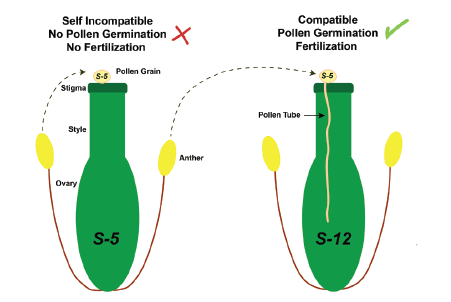 Figure 1. Self-incompatibility (SI) genes prevent the germination of pollen on flowers of the same plant. (Not to scale)
varieties.4 Many Brassica vegetable varieties are self-compatible, so breeders have to develop self-incompatible inbreds to efficiently create the desired hybrids. Different versions of the S gene are called haplotypes and are designated as S-1, S-2, S-3, etc. It has been estimated that there may be over 100 different haplotypes of the S gene among the species of Brassica.6 A similar interspecific incompatibility system prevents one Brassica species from fertilizing the flowers of another Brassica species to maintain species integrity.
Some problems with using the SI system to create self-incompatible inbreds include that self-incompatibility is not always stable, and spontaneous reversions to self-compatibility can contaminate hybrid seed with seed produced through self-fertilization. In fact, Brassica SI hybrid purity rarely reaches 100%.2,5 There can also be difficulties in creating and maintaining the SI inbred lines, and the labor needed to do so can be intensive.5
CREATING BRASSICA HYBRIDS USING MALE STERILITY
While SI systems inhibit pollen germination to prevent self-fertilization, male sterility systems prevent selected inbreds from producing viable pollen altogether. A male-sterile inbred can then be crossed with another inbred line that produces viable pollen to create the desired hybrid variety. Male sterility-based inbreds are more stable, and the purity of these inbreds is near 100%.
Two types of male sterility are present in plants: genic (GMS) and cytoplasmic (CMS) male sterility.3 GMS is conveyed by either dominant (DGMS) or recessive (RGMS) genes located in the nucleus of the plant cells. With DGMS, only one copy of the dominant GMS gene is needed to produce the male-sterile condition, whereas RGMS requires two copies of the recessive GMS gene (one from each parent). RGMS systems are used in some broccoli/cabbage/cauliflower breeding programs, but DGMS systems are used more commonly.3
In contrast to GMS systems, where the male-sterility genes are located in the cell’s nucleus, the sterility genes in cytoplasmic male sterility (CMS) systems are located in the cell’s mitochondria, which are located in the cytoplasm, outside of the cell’s nucleus. During fertilization, cytoplasmic material only comes from the seed parent (female). The pollen cell only contributes genetic material from its nucleus (nuclear genes). Therefore, traits conveyed by mitochondrial genes are inherited only from the seed parent.2,7
CMS genes prevent the production of functional pollen but do not interfere with the function of the female parts of the flower. CMS systems eliminate the need to remove anthers or to rely on self-incompatibility traits when creating hybrids.1,2,7 Most CMS genes used in Brassica vegetable (B. oleracea) breeding have been introduced from other crucifer species, such as radish and rapeseed.
Three breeding lines are used in a CMS system (Figure 2). A CMS inbred line that carries the mitochondrial male sterile gene is used as the seed (female) parent. A second inbred line that is isogenic (same genes) with the CMS line but has the normal (male-fertile) mitochondrial gene is called a maintainer line. The maintainer line is used as the pollen (male) in crosses with the CMS line to generate more seed of the CMS line. The third line is a male-fertile inbred line which is heterogenic (different genes) from the CMS line. This third line is used as the pollen parent in crosses with the CMS line to create the desired F1 hybrid. The F1 plants have a combination of nuclear genes from the CMS and restorer lines that can result in hybrid vigor and a mix of parental traits.1,3,7
Several CMS genes have been identified in some Brassica species and related genera. The Ogura (Ogu) CMS system, first found in Japanese radish, is the most widely used CMS system in Brassica crop breeding.1,2,7 The first version of the Ogura CMS system (Ogu R1) results in yellow leaves at low temperatures, because along with the Ogu CMS gene, other cytoplasmic elements, notably chloroplasts, are introduced from the original radish plant. A second version (Ogu R2) fixed the yellow-leaf problem but caused other issues. Newer versions of the system (Ogu R3 and Ogu-INRA) have eliminated these problems, and these versions of the CMS system are now widely used to create hybrid varieties of Brassica vegetable crops.3
The self-incompatibility (SI) and male-sterile (MS) systems are not mutually exclusive. Sometimes SI lines are used in male sterility systems, and self-compatible lines may be used as parental lines or maintainer lines to help reduce labor costs by allowing for pollination by bees.5
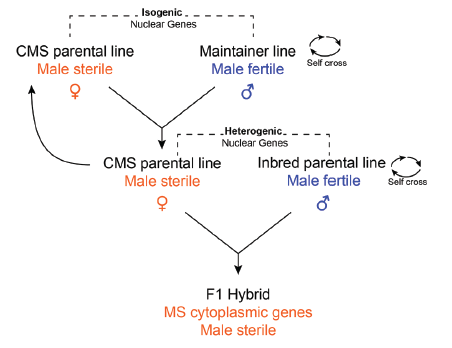 Figure 2. The process of creating hybrid Brassica vegetable varieties using a cytoplasmic male sterility system.
SOURCES
1Romero-Muñoz, M. and Pérez-Jiménez, M. 2024. Optimizing Brassica oleracea L. breeding through somatic hybridization using cytoplasmic male sterility (CMS) lines: from protoplast isolation to plantlet regeneration. Plants, 13:3247. https://doi.org/10.3390/plants13223247
2Yamagishi, H. and Bhat, S. R. 2014. Cytoplasmic male sterility in Brassicaceae crops. Breeding Science, 64(1):38–47. https://doi.org/10.1270/jsbbs.64.38
3Ji, J., Huang, J., Yang, L., Fang, Z., Zhang, Y., Zhuang, M., Lv, H., Wang, Y., Liu, Y., Li, Z., & Han, F. 2020. Advances in research and application of male sterility in Brassica oleracea. Horticulturae 6(4):101. https://doi.org/10.3390/horticulturae6040101
4Kucera, V., Chytilová, V., Vyvadilová, M., and Klíma, M. 2006. Hybrid breeding of cauliflower using self-incompatibility and cytoplasmic male sterility. Horticultural Science. 33. 148-152. https://doi.org/10.17221/3754-HORTSCI
5Xiao, Z., Han, F., Hu, Y., Xue, Y., Fang, Z., Yang, L., Zhang, Y., Liu, Y., Li, Z., Wang, Y., Zhuang, M., and Lv, H. 2019. Overcoming cabbage crossing incompatibility by the development and application of self-compatibility-qtl- specific markers and genome-wide background analysis. Front. Plant Sci. 10:189. https://doi.org/10.3389/fpls.2019.00189
6Kitashiba, H and Nasrallah, J. B. 2014. Self-incompatibility in Brassicaceae crops: Lessons for interspecific incompatibility. Breeding Science 64:23-37. https://www.jstage.jst.go.jp/article/jsbbs/64/1/64_23/_article
7Xu, F., Yang, X., Zhao, Na, Hu, Z., Mackenzie, S. A., Zhang, M., Yang, J. 2022. Exploiting sterility and fertility variation in cytoplasmic male sterile vegetable crops. Horticulture Research, Volume 9:uhab039. https://doi.org/10.1093/hr/uhab039
Websites verified 11/4/2026
ADDITIONAL INFORMATION
For additional agronomic information, please contact your local seed representative.
Performance may vary, from location to location and from year to year, as local growing, soil and environmental conditions may vary. Growers should evaluate data from multiple locations and years whenever possible and should consider the impacts of these conditions on their growing environment. The recommendations in this material are based upon trial observations and feedback received from a limited number of growers and growing environments. These recommendations should be considered as one reference point and should not be substituted for the professional opinion of agronomists, entomologists or other relevant experts evaluating specific conditions.
BAYER GROUP DOES NOT WARRANT THE ACCURACY OF ANY INFORMATION OR TECHNICAL ADVICE PROVIDED HEREIN AND DISCLAIMS ALL LIABILITY FOR ANY CLAIM INVOLVING SUCH INFORMATION OR ADVICE.
10012_1007450 Published 11/04/2026