- Canada
- expand_more

-
Products
Select Your Brand Below to View Full Portfolio of Offerings
-
Resources
Click below for Specialized Tips for Your Growing Environment
-
About
Discover More About Our Commitment to Advance Health and Nutrition Globally, Together With You.
-
Innovation

Learn about our approach to innovation.


Click here to download a PDF version of this spotlight.
» Branched broomrape is a parasitic plant that attaches to tomato root systems to extract water and nutrients.
» Broomrape infestations can reduce yield and quality in tomato production systems.
» Management strategies can be used to help limit the spread and reduce populations of branched broomrape in tomato fields.
Broomrape species are parasitic plants that attach to the root systems of host plants in order to obtain the water and nutrients they need for growth. There are seven known species of broomrape, four of which are economically important to US agriculture. Of these, branched broomrape (Phelipanche ramosa, formerly Orobanche ramosa) is the most important pest of tomatoes, primarily in California.1,2 Branched broomrape is native to the Mediterranean region, but is now found in Europe, western Asia, Australia, and the US.3 Branched broomrape was first detected in the US in 1890 and is now federally listed as a noxious weed. It has been found in Alabama, California, Kentucky, Illinois, New Jersey, North Carolina, South Carolina, Texas, and Virginia.1,3
Broomrapes are obligate holoparasites, meaning they require a living plant host to survive, and that they get all of their water and nutrients from their host. Branched broomrape is an economically important pest of tomato and a number of other broadleaf crops, including beans, cabbage, carrot, celery, eggplant, lettuce, pepper, peanut, potato, squash, and sunflower.1,3 Broomrape infestations can reduce tomato yields up to 80% in regions where the weed commonly occurs.
A QUARANTINE PEST IN CALIFORNIA
Branched broomrape is classified as an “A” noxious weed by the California Department of Food and Agriculture, based on its wide host range and potential for rapid reproduction and dispersal.3 When broomrape is detected, affected fields are subject to specific agricultural restrictions to help prevent spreading the weed to other locations.1,2,4 An eradication program was implemented in California in the 1950s and ran through the 1970s when the pest was considered eradicated. However, branched broomrape was detected in a field in Yolo County in 2017, and by 2022, over 400 acres of cropland were affected. It is not clear if the recent broomrape reinfestations in California are the result of new introductions or from longdormant seeds from past infestations remaining in the soil.1,2
BRANCHED BEOOMRAPE LIFE CYCLE
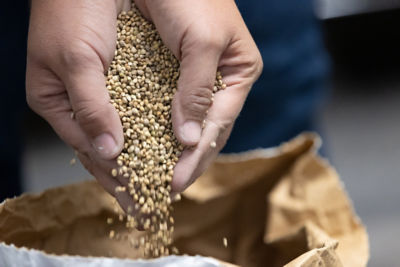
Branched broomrape produces tiny seeds (smaller than finely-ground black pepper), which can survive in the soil for decades. The seeds can be dispersed by wind, water, and anything that moves soil from one field to another.2 The seeds require a period of warm stratification pre-conditioning with temperatures between 59° and 68°F for 5 to 21 days before they can germinate. Once stratified, seed germination depends on the presence of a susceptible host that releases a signaling compound (strigolactone) from its root system.1,3 The radicle of a germinated seed grows through the soil and attaches to the host plant root. The radical produces a structure called a haustorium, which fuses with the vascular system (xylem and phloem) of the host root to allow the extraction of water and nutrients (Figure 1).
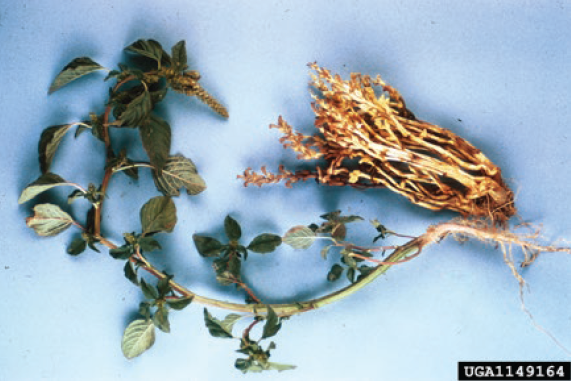 Figure 1. Branched broomrape attached to a host plant root system. USDA APHIS PPQ - Oxford, North Carolina, Bugwood.org.
The broomrape plant remains underground until it is ready to flower, at which time multiple shoots emerge from the soil and develop into yellowish stems that grow six to twelve inches tall. The stems do not produce any leaves and completely lack chlorophyll. The flowers that form are tubular, usually less than an inch long, and pale purple with white cushions on the lower lobes (Figure 2). Each flower can produce thousands of tiny seeds within 14 days after flowering, two to three weeks after stem emergence. The seeds can remain dormant and viable in the soil for over 20 years. Seeds and seed-infested soil can be spread by animals, machinery, vehicles, flowing water, and in contaminated fodder and manure. 1,3
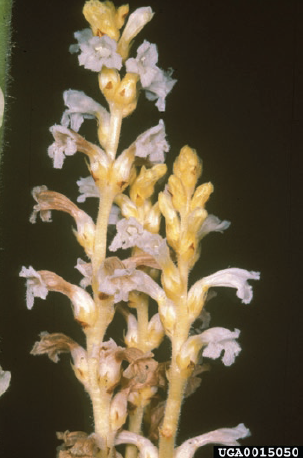 Figure 2. Stems and flowers of a branched broomrape plant. Lytton John Mussleman, Old Dominion University.
MANAGEMENT
The early stages of the broomrape life cycle occur underground, making it difficult to detect and manage infestations in tomato fields. Preventing seed production can also be difficult because the time between emergence and seed production is very short.1 Management of branched broomrape is usually most successful when an integrated set of strategies is used.4 Detecting new infestations and initiating a management program promptly will help limit damage and spread to new areas. When an infestation is detected in California, a regulatory hold is placed on the infested field for at least two years. During the hold period, only approved non-host crops may be grown in that field. Once an infestation is detected, the broomrape plants should be removed from the field, taking care to remove all plants and limiting any seed dispersal. Removing plants before they start producing seeds is best. Placing plants in plastic bags and leaving thebags in the sun for 14 days can help limit the release ofviable broomrape seeds. Bagged plants can be destroyed by burning or other heat treatment methods, such as autoclaving. Tomatoes harvested from a field on a hold order should only be transported to processing facilities following infested provision guidelines.1,4
Do not move soil or plant debris from areas under a hold order.4 Clean and sanitize all vehicles, equipment, and tools that have been in affected fields and which may be contaminated with seed-infested soil, plant debris, or manure. After removing soil and debris, apply a recommended chemical disinfectant, such as one containing quaternary ammonium, to help eliminate the viability of any remaining seed. A 2021 review article indicated that soil fumigants, including chloropicrin, metam-potassium, and 1,3-dichloropropene, were not verified as being effective for the management of branched broomrape at the time of publication.1
Cultural practices can also be used to help reduce the amount of broomrape seeds in the soil seedbank in infested fields or to help minimize the addition of new seeds to the seedbank. Crop rotation with non-host plants helps prevent the production of new seeds and may allow seeds already in the soil to lose viability over time. False-host plants (trap crops) can help lower the number of seeds in the soil by releasing root exudates that stimulate broomrape seed germination without providing hosts to support the growth of broomrape seedlings. Examples of trap-crops that may help manage branched broomrape include alfalfa, cowpea, green pea, flax, garlic, green bean, soybean, and sesame. Rotating to submerged rice (paddy rice) can also help reduce broomrape populations, as the seeds lose viability in flooded soil.1
Soil solarization also may be used to help reduce broomrape populations. Two consecutive years of solarization resulted in a 90% reduction in broomrape emergence in one study. However, this strategy requires that the field be taken out ofproduction during the summer growing season. Solarization also may not affect seeds buried deeper in the soil profile, and subsequent tillage can bring those seeds back into the root zone.1 A similar problem is associated with the use of deep inversion to bury broomrape seeds below the root zone. Eventually, those seeds can move back into the root zone through tillage.
Herbicide applications can be part of an integrated management program for branched broomrape, especially in highly infested fields where it is not feasible to eradicate the weed. A lack of chlorophyll and the inability of broomrape plants to photosynthesize also limit the types of herbicides that can be used to suppress broomrape, and herbicides that act on the process of photosynthesis will probably not provide effective control.1 A combination of pre-plant and post-plant applications of acetolactate synthase-inhibiting herbicides, such as sulfosulfuron, was shown to result in 90% control of Egyptian broomrape in a study conducted in Israel. Sulfosulfuron is not registered for use on tomatoes in California.1 However, a 24C special needs label (SNL) for the management of branched broomrape in processing tomatoes was granted for the herbicide rimsulfuron in California in 2022. Rimsulfuron was already labeled for pre- and post-emergence applications to tomatoes for managing other weed species. The SNL allows for the application of rimsulfuron through chemigation (application through the irrigation system).5 Chemigation allows for the delivery of the herbicide to the tomato root zone during the period when broomrape seeds are germinating and seedlings are attempting to attach to tomato root systems. This helps improve the effectiveness of the herbicide in the management of broomrape.5,6 A study in 2022 evaluated applying 4 fl oz of rimsulfuron (activeingredient) over three (1.33 fl oz/application) and four (1 fl oz/application) treatment dates, and a non-treated control. Broomrape emergence in the rimsulfuron-treated plots showed an 83% reduction as compared to the non-treated plots, and no phytotoxicity to the tomato crop was observed. There were no statistically significant differences in broomrape emergence between the two herbicide treatment scheduless, and there was no effect of herbicide treatment on tomato yield in this study.6 Always consult current pesticide product labels and follow all instructions and restrictions for application.
SOURCES
1Osipitan, O., Hason, B., Goldwasser, Y, Fatino, M., and Mesgaran, M. 2021. The potential threat of branched broomrape for California processing tomato: A review. California Agriculture. 75(2):64-70. https://californiaagriculture.org/article/108646-the-potential-threat-of-branched-broomrapefor-california-processing-tomato-a-review/attachment/213581.pdf
2Dooley, E. 2023. Parasitic weeds threaten tomato plants on California farms. UC Davis. https://www.ucdavis.edu/food/news/parasitic-weeds-threaten-tomato-plants-on-californiafarms
3Kelch, D. 2017. Branched broomrape Orobanche ramosa. CDFA Pest Rating Proposals and Final Ratings. https://blogs.cdfa.ca.gov/Section3162/?p=3853
4Voluntary compliance agreement overview for growers, processors, and transporters in infested areas. California Department of Agriculture and the California Broomrape Board. http://tomatonet.org/cdfa-ca-broomrape-board-info
5Hanson, B. 2022. Rimsulfuron 24C registration for broomrape management in tomato. UC Weed Science (weed control, management, ecology, and minutia). https://ucanr.edu/blog/uc-weed-science-weed-control-management-ecology-and-minutia/article/rimsulfuron-24c
6Fatino, M., Hanson, B., 2024. Large scale study of branched broomrape control for California processing tomatoes. California Fruit and Vegetable – 12/6/2024. https://calfruitandveg.com/2024/12/06/large-scale-study-of-branched-broomrape-control-forcalifornia-processing-tomatoes/
Websites verified 1/5/2026
ADDITIONAL INFORMATION
For additional agronomic information, please contact your local seed representative. Performance may vary, from location to location and from year to year, as local growing, soil and environmental conditions may vary. Growers should evaluate data from multiple locations and years whenever possible and should consider the impacts of these conditions on their growing environment. The recommendations in this article are based upon information obtained from the cited sources and should be used as a quick reference for information about vegetable production. The content of this article should not be substituted for the professional opinion of a producer, grower, agronomist, pathologist and similar professional dealing with vegetable crops.
BAYER GROUP DOES NOT WARRANT THE ACCURACY OF ANY INFORMATION OR TECHNICAL ADVICE PROVIDED HEREIN AND DISCLAIMS ALL LIABILITY FOR ANY CLAIM INVOLVING SUCH INFORMATION OR ADVICE.
6923_714000 Published 01/06/2026