- Canada
- expand_more

-
Products
Select Your Brand Below to View Full Portfolio of Offerings
-
Resources
Click below for Specialized Tips for Your Growing Environment
-
About
Discover More About Our Commitment to Advance Health and Nutrition Globally, Together With You.
-
Innovation

Learn about our approach to innovation.
Click here to download a PDF version of this spotlight.
» Pink root disease, poor stand establishment, and herbicide injury can reduce yield potential and bulb quality of onions.
» Minimizing root diseases, obtaining uniform plant stands, and proper herbicide application can help optimize yields and bulb quality.
MANING PINK ROOT
Pink root of onion is caused by the fungal pathogen Setophoma terrestris, which resides in the soil and infects plants through the roots or basal stem plate. The first observed symptoms of the disease are usually on the leaves, developing because of the plant’s reduced ability to translocate water and nutrients from the soil to the leaves. However, the foliar symptoms are not distinct enough to allow for a specific diagnosis. Root systems and bulb tissues need to be evaluated to accurately determine the cause of the problem. Infected plants are easily uprooted, and the roots show a pink discoloration (Figure 1). The pink color is initially light in intensity, but the color deepens to dark pink to red with time. In acidic soils, the infected roots may turn yellow.123 Eventually, infected roots become purplebrown in color, shriveled, and decayed. The loss of root and stem function and the subsequent loss of photosynthetic area from declining leaves combine to reduce the size and quality of the developing bulbs, sometimes leading to rotting of bulb tissues. Plants infected as seedlings may be killed. Symptoms are more severe during periods of high soil temperatures and on plants subjected to moisture stress.1 Pink root is also more likely to develop on plants suffering from nutrient deficiencies.2
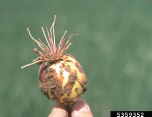 Figure 1. Symptoms of pink root on the roots of onion. Howard F. Schwartz, Colorado State University, Bugwood.org.
The use of disease resistant onion varieties is the primary method used to help manage pink root on onion, and both high (HR) and intermediate (IR) levels of pink root resistance are available in some commercial onion varieties. These resistance traits are often best expressed at soil temperatures above 82°F (28°C).1 Poor rooting varieties tend to be more prone to infection by the pink root pathogen.4
Good irrigation and nutrient management can help limit the damage caused by pink root as non-stressed plants tend to be less susceptible to the disease.4,5
In locations where the pathogen has become established, long term (three to seven year) rotations away from onions and related crops can help prevent the buildup of inoculum in the soil.1,2,5 However, even long-term rotations are unlikely to result in a complete elimination of the pathogens in the soil. Healthy onion sets should be used to help prevent the introduction of the pathogen and to limit the incidence of disease. Soil fumigation with fumigants, such as metam sodium, chloropicrin, and 1,3-D dichloropropene, has been shown to reduce disease incidence and increase yields in locations with high disease pressures.1,4,5 Non-fumigant, fungicide products, including fluopyram, are also registered to help manage pink root. Depending on label recommendations, the products can be applied as pre-plant, incorporated treatments or as postplant chemigation applications through drip, overhead, and in-furrow irrigation systems, or as soil drench applications.
STAND ESTABLISHMENT
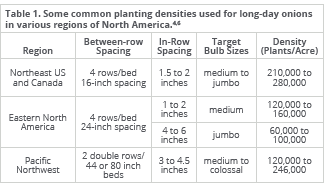
Plant density in an onion field can be adjusted to manipulate the final bulb size, plant structure, time to maturity, and severity of foliar diseases. Total marketable yield of onions often increases with increasing planting density, but as planting densities increase, average bulb size and per-bulb weight often decrease. Row arrangements and in-row plant spacings vary with region, soil type, and target bulb size (Table 1).4,5 Uniform plant stands provide equal competition pressure from all sides, to help promote the development of more consistent bulb size. Pressure from surrounding plants can also help regulate the rate of bulb growth, reducing the incidence of conditions like basal plate splitting.
Stand establishment and uniformity are affected by several factors. Seed and transplants should be planted into beds with firm, fine-textured soil with adequate organic matter and pH levels from 6.0 to 7.8.7 Plant when the soil is dry enough to avoid soil compaction problems and warm enough to promote germination and seedling growth. Soil temperatures need to be above 40°F (5°C), with an optimal temperature of 75°F (24°C). Planting too early can delay germination, resulting in seed rot and damping off, while planting too late can stimulate early bulb development resulting in smaller bulbs at harvest. Onion seed should be planted at a depth between ½ and 1 inches. Many growers plant with precision seeders (belt or vacuum), and use pelleted or encrusted seed to improve the shape and uniformity of the onion seed, which helps create more uniform plant stands.
A crop rotation schedule with five to seven years between onion crops can help reduce inoculum levels of soilborne pathogens and pests. Using only high quality, disease-free seed and transplants and applying seed treatment fungicides can help manage seed and seedling diseases that can cause reduced and uneven plant stands.1
HERBICIDE USE
Onions are highly susceptible to yield loss from weed competition because they are initially slow growing, shallow rooted, and do not form complete canopies that can inhibit weed growth.8,9 Weed management is further complicated because onions are typically planted at high densities, making cultivation difficult, and relatively few herbicides are registered for use onions. Weed management efforts usually focus on cultural practices along with the pre-plant and post-plant application of herbicides.
Pre-plant herbicides, including metam sodium, paraquat, glyphosate, oxyfluorfen, and ethofumesate can help eliminate early weed growth. Post-plant, pre-emergence applications can help manage non-emerged weeds. Post-emergence applications can help selectively manage weeds later in the season. Many post-emergence herbicide products can only be applied after the onion seedlings reach certain developmental stages (e.g.,1- to 5-leaf stages depending on the product).10
There is evidence that some early herbicide applications may affect the growth of the basal plate and result in an increase in the number of multi-centered bulbs produced. Multi-centeredness is known to be a genetically inherited trait of onions, but stress factors, especially early in plant development, may also contribute to the development of multi-centered bulbs. There is a preference, especially for processing onions, for bulbs with single centers (known as bullets) or bulbs with small-double (or tight-double) centers. Bullets and small-double bulbs are known as functionally single-centered for processing purposes (Figure 2). Bulbs with large double-centers or multiple-centers are less desirable for processing. Some studies have found that the timing of herbicide applications may affect the formation of
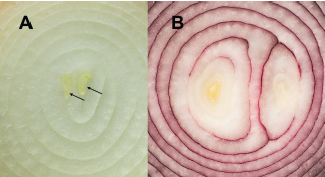 Figure 2. (A) An onion bulb with a small-double center that is small enough to allow the bulb to be classified as functionally single-centered. (B) A red onion bulb with a double center.
multiple-centered bulbs. In one study, pre-plant applications of ethofumesate resulted in higher percentages of multicentered bulbs than did pre-emergence applications of the same herbicide.9 Be sure to always consult current product labels and follow all application instructions and restrictions.
SOURCES
1Schwartz, H. Pink root. 2008. In Schwartz, H. and Mohan, S. Eds. Compendium of Onion and Garlic Diseases and Pests, Second Edition. American Phytopathological Society.
2Dutta, B. 2017. Diseases of Vidalia onions. In Onion production guide. Eds., Boyhan et al. University of Georgia Cooperative Extension Bulletin 1198. https://fieldreport.caes.uga.edu/publications/B1198/onion-production-guide/
3Reiners, S. and Seaman, A. (Eds). 2016. Cornell Integrated Crop and Pest Management Guidelines for Commercial Vegetable Production.
4Pscheidt, J. and Ocamb, C. 2025. Onion (Allium cepa)-pink root. Pacific Northwest Pest Management Handbook. https://pnwhandbooks.org/plantdisease/host-disease/onion-allium-cepa-pink-root
5Swett, C., Aegerter, B., Turini, T., and Putman, A. 2019. Pink root. UC IPM Pest Management Guidelines: Onion and Garlic. UC ANR Publication 3453. https://ipm.ucanr.edu/agriculture/onion-and-garlic/pink-root/
4Eastburn, D. 2020. Onion planting density. Seminis Agronomic Spotlights.https://www.vegetables.bayer.com/us/en-us/resources/growing-tips-and-innovation-articles/agronomic-spotlights/onion-planting-density.html
5Brewster, J.L. 2008. Onions and Other Vegetable Alliums 2nd Edition. Cabi Publishing.
6Shock, C., Feibert, E., and Saunders, L. 2004. Plant population and nitro-gen fertilization for subsurface drip-irrigated onion. HortScience 39:1722–1727.
7Volesky, N., Murray, M., Olds, A., and Carey, B. 2024. Planting and spacing. Utah Vegetable Production Guide. Utah State University. https://extension.usu.edu/vegetableguide/onion/planting-spacing
8Smith, R., Fennimore, S., Wilson, R. 2018. Integrated weed management. Onion and Garlic Pest Management Guidelines. UC IPM. https://ipm.ucanr.edu/agriculture/onion-and-garlic/integrated-weed-management/
9Felix, J. and Ishida, J. 2020. Weed control in direct-seeded onion with various postemergence herbicide combinations. https://agsci.oregonstate.edu/system/files/iweed_control_in_onion_2020.pdf
10Batts, R., Monks, D., Mitchem, W., and Jennings, K. 2024. Weed management in onions. Weed Management in North Carolina. NC State Extension. https://content.ces.ncsu.edu/weed-management-in-onions
Websites verified 11/24/2025
ADDITIONAL INFORMATION
For additional agronomic information, please contact your local seed representative. Performance may vary, from location to location and from year to year, as local growing, soil and environmental conditions may vary. Growers should evaluate data from multiple locations and years whenever possible and should consider the impacts of these conditions on their growing environment. The recommendations in this article are based upon information obtained from the cited sources and should be used as a quick reference for information about vegetable production. The content of this article should not be substituted for the professional opinion of a producer, grower, agronomist, pathologist and similar professional dealing with vegetable crops.
BAYER GROUP DOES NOT WARRANT THE ACCURACY OF ANY INFORMATION OR TECHNICAL ADVICE PROVIDED HEREIN AND DISCLAIMS ALL LIABILITY FOR ANY CLAIM INVOLVING SUCH INFORMATION OR ADVICE.
6111_691550 Published 12/09/2025