- Canada
- expand_more

-
Products
Select Your Brand Below to View Full Portfolio of Offerings
-
Resources
Click below for Specialized Tips for Your Growing Environment
-
About
Discover More About Our Commitment to Advance Health and Nutrition Globally, Together With You.
-
Innovation

Learn about our approach to innovation.

Click here to download a PDF version of this spotlight.
» Adequate nitrogen levels are important for good onion growth, but too much nitrogen can cause problems in the field and in storage.
» Shallow, sparse root systems limit the uptake of nutrients by onions.
» The greatest need for nutrients is during the period of bulb development.
Onions require relatively high levels of available nitrogen (N), phosphorus (P), and potassium (K) for optimum production compared to other vegetable crops. The shallow, sparse, and hairless root systems result in a need for relatively high soil nutrient concentrations to meet nutrient requirements. This can also make it challenging to ensure the availability of adequate levels of N without risking high levels of N loss from the system due to leaching, as the reported recovery of N by onions can be as low as 30 to 40 percent.1 About 80% of the nutrients taken up by onion plants end up in the bulb.2 Most (65%) of the N absorbed by onions ends up in the above ground plant parts, with about 43% found in the bulb and 22% in the leaves, and these proportions remain fairly constant even with over application of N. The N levels do have more of an effect on bulb size than on the production of roots and leaves, and higher N levels can decrease the amount of bolting but may increase the formation of thick necks.
Onions grow fairly slowly and have lower nutrient requirements until they reach the three-leaf stage (50 to 70 days after planting).1 The greatest uptake of nutrients occurs when the bulbs start to develop and during the bulb growth phase. Approximately 70% of the uptake of N and P occur during the final half of the onion growing season when bulbs are enlarging, and the availability of nutrients at this time help maximize yield potential.4
Recommendations for onion nutrient requirements may vary between regional production guides, depending in part on soil types, growing conditions, and length of the growing season. Listed requirements for N range from 75 to 150 lb/ acre. Recommendations for P (P2O5) and K (K2O) levels vary from zero to 200 lb/acre depending on soil test rates for those nutrients.3
NITROGEN REQUIREMENTS
Onions can take up N in both the ammonium (NH4+) and nitrate (NO3-) forms, and a crop of onions removes about 140 pounds of nitrogen per acre. Higher yields are associated with increasing N levels, up to a point.4 Deficiencies of N can result in erect growth of pale green to yellow leaves, and the tips of older leaves may yellow or become bleached (Figure 1).5 Onions may only use 60% of the available N; a total of 250 to 300 lb from all sources may be needed to help maximize yield potential.1,2 When determining how much N should be applied, if any, all sources of N should be considered in the calculations, including pre-plant soil nitrate levels (residual nitrate), N in crop residue and other organic matter, preplant ammonium levels if ammonium fertilizer was recently applied or if there residues from high N crops such as alfalfa or sugar beet, and N that may be in the irrigation water.2,4 Soil nutrient tests from samples taken (preferably) in the spring of the year of planting onions can provide the level of residual nitrate and ammonium, and irrigation water should be tested periodically for N levels. Estimates of organic N in crop residues and organic matter also can be calculated. The total amount of N available from these nonfertilizer sources can then be subtracted from the 250 to 300 lb/acre requirement to determine the amount of additional N that needs to be applied. In some cases, the amount of N from these sources will exceed 300 lb/acre and no additional N will be needed.2 Muck soils, in particular, tend to contain high amounts of native N, which is released slowly over the season, meaning that N overapplication needs to be avoided, especially early in the season.
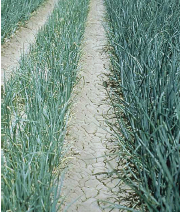 Figure 1. Nitrogen deficient onions (left) have more erect growth and pale green to yellow leaves.
Because the greatest need for N is later in the season, some of the additional N should be applied by side-dressing or fertigation through the irrigation system to help avoid tip burn on the leaves. Applications may be split, with 50 to 70 lb/acre applied just before planting and the remaining amount applied starting when the plants reach about 4 inches tall.4 Applying N through drip or other high efficiency irrigation systems that minimize water percolating out of the root zone will help reduce the loss of N from leaching. Periodic tissue nutrient testing during the growing season will help determine the need for additional N applications.2 Onion requirements for N are site specific and can vary from field to field. Therefore, recommendation for N application rates should be based on local conditions.1
ISSUES FROM OVER NITROGEN FERTILIZATION
Onion roots have a low tolerance for elevated salt and acidity. Over application of N and other fertilizers can kill roots, reducing emergence and plant size. Bulbs produced by an overfertilized onion crop are more likely to develop thick necks, tend to sprout earlier in storage, and may be predisposed to rot from bacteria and other storage pathogens.1,4 Overfertilized onions can also be more susceptible to foliar diseases.
Overfertilization with N can result in basal plate splitting, also known as basal plate blowout during the growing season. Symptoms of basal plate splitting include (as the name describes) splitting of the basal stem plate. Splitting can result in the development of small, secondary bulbs from the plate, reducing quality and marketability (Figure 2).6 The exposure of internal plate tissue from splitting can also increase the bulb’s susceptibility to secondary bulb rot pathogens resulting in bulb rot either in the field or in storage. Basal plate splitting is caused by conditions that result in rapid or uneven growth of the basal plate including overfertilization, uneven irrigation (soil conditions varying from wet to dry), and low planting density or uneven stands. Onion maggot feeding on the basal plate may also contribute to splitting. To reduce problems with basal plate splitting, use high quality seed and a well-prepared seed bed to help ensure uniform stands. Maintain even irrigation to reduce overly wet and dry soil moisture levels, and avoid overfertilization with N.6
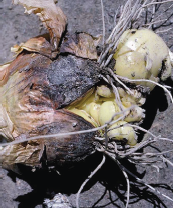 Figure 2. Secondary bulb formation resulting from basal plate splitting.
PHOSPHORUS AND POTASSIUM
Phosphorus fertilizers are typically applied pre-plant, either broadcasts before bed preparation or banded during the bedding process. Application levels should be based on preplant soil tests. Both pre-plant soil fumigation and tillage can reduce the presence of mycorrhizal fungi in the soil, which can increase the need for applying P. Onions usually remove 20 to 25 pounds of P per acre per year.2
Potassium is also typically applied before planting but should only be applied when needed as increased salt levels from application can affect seed germination and seedling growth. Potassium fertilizers can be incorporated in the fall or applied during the bedding process. In sandy soils, an in-season application may be necessary.2
SULFUR AND FLAVOR/PUNGENCY
Onion plants use sulfates to produce the chemicals that give them their distinct flavor or pungency. Most soils have high enough sulfur levels to meet the needs of onions, so applications of sulfur do not usually result in more pungent bulbs. However, if trying to produce mild-flavored onions, sulfur applications should be limited. Sulfate levels in the soil and irrigation water should be below 50 ppm.4 Mild onions can be easier to produce on sandy soils because sulfur is more easily leached out of these types of soil. Low sulfur levels can reduce yields because adequate levels of sulfur are needed for normal growth. Some onion varieties respond to low sulfur levels by increasing sugar and soluble solid levels, while other varieties show little or no response to changes in sulfur levels.4
MICRONUTRIENTS
Micronutrient levels are important for plant growth and good bulb development. Onions have a high response to insufficient levels of manganese, copper, zinc, and molybdenum, but a low response to boron levels.3 Copper deficiencies can result in twisted, chlorotic leaf tips and thick skins on bulbs.4 Manganese deficiencies can result in stunted growth and a striped chlorotic pattern on outer leaves. Symptoms of zinc deficiency include stunting of plant growth, twisting or corkscrewing of leaves, and leaves with a flattened appearance.5
SOURCES
1Disease resistance. International Seed Federation. https://worldseed.org/our-work/disease-resistance/overview/
2Schumann, G. and D’Arcy, C. 2010. Essential plant pathology. American Phytopathological Society. St. Paul. 3Khan, A., Ben-David, R., Richards, J., Bansal, U., Wang, C., McCartney, C., Stam, R., and Wang, N. 2023. Plant disease resistance research at the dawn of the new era. Phytopathology 113: 756-759. https://doi.org/10.1094/PHYTO-03-23-0108-FI
3Michelmore, R., Christopoulou, M., and Caldwell, K. 2013. Impacts of resistance gene genetics, function, and evolution on a durable future. Annual Review of Phytopathology 51: 291–319.
4Marques de Carvalho, L., Benda, N. D., Vaughan, M. M., Cabrera, A. R., Hung, K., Cox, T., Abdo, Z., Allen, L. H., & Teal, P. E. 2015. Mi-1-mediated nematode resistance in tomatoes is broken by short-term heat stress but recovers over time. Journal of nematology, 47(2), 133–140.
5Jacquet, M., Bongiovanni, M., Martinez, M., Verschave, Wajnberg, E., and Castagnone- Sereno, P. 2005. Variation in resistance to the root-knot nematode Meloidogyne incognita in tomato genotypes bearing the Mi gene. Plant Pathology 54:93–99. 52024. Recommended codes for pest organisms in vegetable crops. ISF International Seed Federation. https://worldseed.org/document/recommended-codes-for-pest-organisms-invegetable- crops-april-2024/
7Disease resistance abbreviations. Bayer Vegetables, United States. https://www.vegetables. bayer.com/us/en-us/resources/growing-tips-and-innovation-articles/disease-codeabbreviations.html
Websites verified 10/21/2025
ADDITIONAL INFORMATION
For additional agronomic information, please contact your local seed representative. Performance may vary, from location to location and from year to year, as local growing, soil and environmental conditions may vary. Growers should evaluate data from multiple locations and years whenever possible and should consider the impacts of these conditions on their growing environment. The recommendations in this article are based upon information obtained from the cited sources and should be used as a quick reference for information about vegetable production. The content of this article should not be substituted for the professional opinion of a producer, grower, agronomist, pathologist and similar professional dealing with vegetable crops.
BAYER GROUP DOES NOT WARRANT THE ACCURACY OF ANY INFORMATION OR TECHNICAL ADVICE PROVIDED HEREIN AND DISCLAIMS ALL LIABILITY FOR ANY CLAIM INVOLVING SUCH INFORMATION OR ADVICE.
5011_659600 Published 10/29/2025