- Canada
- expand_more

-
Products
Select Your Brand Below to View Full Portfolio of Offerings
-
Resources
Click below for Specialized Tips for Your Growing Environment
-
About
Discover More About Our Commitment to Advance Health and Nutrition Globally, Together With You.
-
Innovation

Learn about our approach to innovation.


Causal Agent
Tomato bushy stunt virus (TBSV)
Vector
Mechanically transmitted
Distribution
Argentina, Britain, California, Mexico, Morocco and Tunisia
Symptoms
Initial symptoms may vary from irregular white banding patterns on the leaves to necrotic lesions or rings. Leaves soon turn from green to a pale yellow, which may have interspersed green areas. Eventually. the affected leaves may fall from the plant. New leaves frequently are twisted and have necrotic tips. An abundance of side shoots occurs, giving the plant a bushy. stunted appearance. Lower leaves become chlorotic and purple as the disease progresses. Excessive fertilizer on young plants can result in soft stems that. when infected. may develop lesions at the soil-line. The seedling may be girdled at that point, resulting in death of the plant. Fruit symptoms can vary from chlorotic blotches to rings or line patterns.
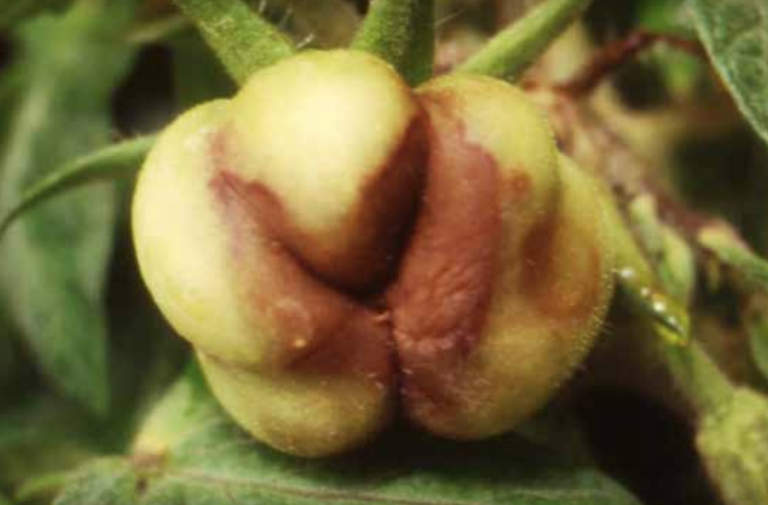 Fruit necrosis on an inoculated plant. (Courtesy of Marisol Luis, Instituto Universitario de Investigación Mixto Agroalimentario de Aragón, Universidad de Zaragoza)
Conditions for Development
TBSV is a very stable virus with a very diverse natural host range. It is soil-borne and readily transmissible in water. A natural vector of the virus is currently unknown, but it is believed that the virus infects plants through wounds in the roots. This virus has been found in river water, so it is possible that it is spread in irrigation water.
Control
Avoid planting in soils known to contain the virus. Once present in the soil, this virus is difficult to control.