- Canada
- expand_more

-
Products
Select Your Brand Below to View Full Portfolio of Offerings
-
Resources
Click below for Specialized Tips for Your Growing Environment
-
About
Discover More About Our Commitment to Advance Health and Nutrition Globally, Together With You.
-
Innovation

Learn about our approach to innovation.



Causal Agent
Chino def tomate virus (CdTV)
Vector
Whitefly (Bemesia tabaci)
Distribution
Northern Mexico and Southeastern USA
Symptoms
Chino (curling) and rolling of leaves, interveinal yellowing of newly infected leaves and purpling of older leaves are all characteristic symptoms of this disease. Plants may be severely stunted and distorted if infected at an early stage, and dramatically reduced fruit set may result.
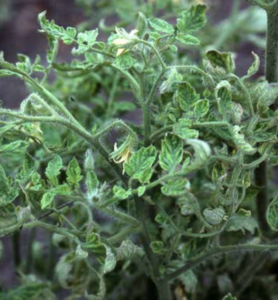 CdTV: chlorotic, leathery leaflets.
Conditions for Development
This virus has a relatively wide host range that includes beans, peppers and tomatoes, as well as malvaceous and solanaceous weeds. Peak transmission of the disease occurs when whitefly populations are high. Whiteflies can acquire the virus from nearby infected plants and transmit it to healthy tomatoes, sometimes resulting in up to 100% of the plants becoming infected. Mechanical transmission of the disease has not been demonstrated.
Control
Previous efforts to control whitefly populations with non systemic insecticides have generally been unsuccessful, due to the difficulty in getting good coverage of the lower leaves where the insects congregate. However, the more recently developed systemic insecticides have demonstrated dramatic effects in controlling whitefiies. Cultural practices, such as the adoption of crop-free periods where possible and roguing infected plants, should be incorporated into a control strategy to help reduce the likelihood of the whiteflies developing resistance to insecticides.