- Canada
- expand_more

-
Products
Select Your Brand Below to View Full Portfolio of Offerings
-
Resources
Click below for Specialized Tips for Your Growing Environment
-
About
Discover More About Our Commitment to Advance Health and Nutrition Globally, Together With You.
-
Innovation

Learn about our approach to innovation.


Causal Agent
Colletotrichum circinans
Distribution
Worldwide
Symptoms
The disease occurs late in the season as the crop matures and continues to develop on bulbs in storage. The fruiting bodies of the fungus turn from dark green to black as they mature, and form concentric rings around the neck and on the surface of dry outer bulb scales. If the humidity is high, the disease may spread to the inner scales, causing small, yellow lesions. If the disease continues to develop, the bulb may shrivel and sprout prematurely. Under warm, wet conditions this fungus can cause damping-off and leaf spotting.
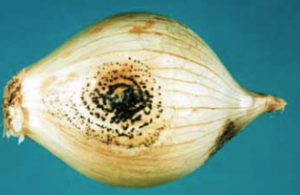 Concentric rings of fungal fruiting bodies form on the surface of bulb scales.
Conditions for Development
The fungus can over-winter in the soil and can be introduced on infected bulbs. Warm moist conditions favor conidial production and wind and rain splash spread the conidia. These conidia infect mature bulb scales and cause disease when free moisture and optimum temperatures [20-26°C (68-78°F)] for infection occur.
Control
Yellow and red skinned varieties can be used in areas where disease pressure is high. The use of healthy transplants as well as crop rotation for several years out of white onions can reduce disease severity. Harvesting onions during dry weather and curing them quickly at the proper temperature and moisture can reduce disease incidence. Fungicide programs similar to those used to control neck rot and downy mildew can be effective against smudge.