- Canada
- expand_more

-
Products
Select Your Brand Below to View Full Portfolio of Offerings
-
Resources
Click below for Specialized Tips for Your Growing Environment
-
About
Discover More About Our Commitment to Advance Health and Nutrition Globally, Together With You.
-
Innovation

Learn about our approach to innovation.
Click here to download a PDF version of this spotlight.
» Onion types/varieties vary in their ability to withstand long-term storage.
» Pre- and post-harvest conditions and activities impact the length of time onions can be stored.
» Cool, moderately dry conditions with adequate airflow have been shown to promote longer storage durations.
Onions are one of the few vegetable crops that can tolerate long-term post-harvest storage without freezing or processing. Successful onion storage will help maintain bulb quality by minimizing moisture loss, preventing sprouting and rooting, preventing mold growth and bulb rot, and preserving the flavor and texture profile of the bulb.
ONION TYPES AND STORAGE
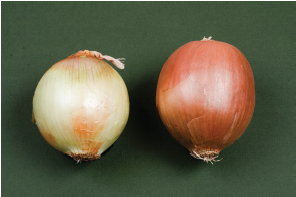
Onions are grouped into long-day, intermediate, and shortday types based on the daily hours of daylight required to initiate bulb formation. Long-day onion varieties require 14 to 16 hours of continuous daylight to trigger bulb formation, while short-day varieties require fewer than 12 hours. These photoperiod-based onion types generally differ in how long they can be stored.1,2 Many long-day varieties are designed for long-term storage. These varieties typically have multiple thick, dark-skinned out layers (scales) higher solids content, lose less water, are more resistant to sprouting and rooting, and can be stored for many months (Figure 1). Short-day varieties have thin, light-colored scales and lower solids content, and are often stored for less than thirty days. There are also some differences in storability among varieties within the different day-length groups.3 The rest of this article will focus on factors that affect the storability of long-day storage onions.
PREHARVEST FACTORS
Cultural practices during the growing season can affect the storability of onions. Providing adequate and regular irrigation to maintain favorable soil moisture levels allows for proper bulb initiation and development. However, stopping irrigation a few weeks before harvest helps promote bulb maturation, allowing outer scales to dry and necks to dry and thicken, lowering the incidence of bulb rot in storage.2
Proper fertilization can also help bulbs to develop properly. Excessive nitrogen (N) applications can delay bulb maturation and widen necks, resulting in increased water loss and bulb rotting in storage. Potassium rates that are too high or too low can reduce the storability of bulbs. Sulfur is a component of the compounds that provide onion flavor and pungency, and sulfur deficiencies can result in deteriorating flavor profiles over time. Calcium is an essential element for cell wall formation and strength, and adequate levels help reduce water loss and susceptibility to post-harvest pathogens.2
Onions can be treated with chemical agents, such as maleic hydrazide (MH), to promote bulb maturation and reduce the sprouting of bulbs in storage, increasing the dormancy period and prolonging storage shelf-life.2,4 MH should be applied when 50% of the tops (leaves) have fallen but are still green. Applying MH too early can disrupt bulb formation and maturity, while applications made after the leaves have started to desiccate may not result in the compound being translocated into the bulb tissue, resulting in inadequate suppression of sprouting.
LIFTING AND HARVESTING
When bulbs have matured and a sufficient percentage of the tops have fallen, onions are lifted by undercutting the plants to sever the root system several inches below the bulb. Recommendations for the amount of top fall needed before lifting vary from 20 to 80%, depending on conditions, but a level of 50% is fairly common.2,3,4 Mechanical damage and bruising of bulbs during lifting and harvesting can result in increased water loss and bulb rot in storage. Damaged and decayed bulbs should be removed and discarded before the onions are placed in storage, and bulbs should be handled carefully to protect the integrity of the scales.
CURING
Dry onions need to be cured before they are placed in storage. Curing helps harden the scales, reduces skin cracking, and allows the necks to dry and narrow, reducing susceptibility to pathogens. Bulbs should be cured until the tops and necks are fully dried. The tops can then be cut off about one inch above the bulb.2,3 Curing can be done in the field, indoors, or using a combination of both.
Field curing onions helps save on heating and energy costs associated with indoor curing. Field curing only works if the vapor pressure of the water in the air is lower than the vapor pressure in the bulbs, allowing the water to move out of the bulbs into the air. Warm, dry conditions with good airflow are needed to promote curing. The bulbs should be spread in a single layer on the soil surface for better airflow and sun exposure.3,5,6 Windrowing of bulbs is ok if conditions are warm and dry. Some operations put the onions in boxes, stack the boxes two or three high, cover the top box with plastic to protect against rain, and leave the boxes in the field for three to five weeks.7 Bulbs are sometimes partially cured in the field for seven to ten days. Then they are loaded and transported to an indoor facility for further curing.4
Curing onions indoors with forced air is often necessary, especially when postharvest conditions do not allow for adequate drying in the field, such as cold, wet weather or the threat of a freeze.2,5,6 Drying with heated air can help bulbs develop the desired skin color and level of dryness. Continuous airflow is used to promote drying. So, the onions should be placed in bags, boxes, or piles that will allow for good airflow. Piles should not be more than 15 feet (4.5 m) deep. A subfloor duct system is often used to provide airflow from below. Airflow rates through the onions should range between 50 and 70 ft3 per minute (1.5 to 2 m3 per minute) for each 35 ft3 (1 m3) of onions.4,6
One method used divides the indoor process into three phases: curing, drying, and cooling.7 In the curing (heating) phase, heated forced air at 85 °F (30 °C) at a flow rate of at least 5300 ft3 (150 m3) per hour is applied for three to four days, or until the temperature of the air leaving the stack/pile is the same as the temperature of the air entering the stack/ pile. At this point, the onions should feel dry on the outside, and the necks should be sealed. In the drying phase, the heat is turned off, but the fans are still used to provide a continuous airflow at ambient temperatures [75 to 80 °F (24 to 80 °C)] and with relative humidity levels between 60 and 75%. This is done to remove any remaining moisture from the necks to make sure the necks are paper-dry. The cooling phase is used to gradually lower the temperature of the bulbs down to between 32 and 40 °F (0 and 5 °C). Cooler, outside air is mixed with the indoor air to gradually lower the temperature by 1 °F (0.5 °C) per day. Outside air warmer than the bulbs should not be used, as this can result in water condensing on the bulbs.7
STORAGE
Onion quality changes in storage result from water loss, sprouting, rooting, and changes in chemical composition.2 roper storage conditions will help minimize these quality hanges. Maintaining good skin integrity helps minimize water loss and maintain bulb firmness.
Upon drying, onions will remain dormant for about three weeks, regardless of external conditions. After that time, external factors can affect dormancy, which keeps bulbs from sprouting and rooting. In particular, temperature and humidity levels impact whether or not bulbs break dormancy.2,8 Preharvest applications of inhibitors, such as maleic hydrazide, can also help keep bulbs from breaking dormancy.
Onions should be stored under cool, moderately dry, wellventilated conditions.1,2,3 If refrigeration is available, storage temperatures should be held between 32 and 40 °F (0 and 5 °C), preferably closer to 32 °F to prevent sprouting. However, temperatures should not be allowed to drop below 32 °F (0 °C) as onion bulbs can freeze at temperatures of 27 °F (-3 °C) and below.6 If refrigeration is not available, temperatures should be held between 45 and 55 °F (7 and 13 °C).1 Relative humidity levels should be held between 65 and 70% to inhibit disease development and sprouting. Damp conditions can result in higher levels of bulb rot.2,3,4
Bagged and boxed onions should be kept at least one foot away from walls and other pallets and stacked less than five feet high to allow for good airflow. Do not wrap pallets of onions in plastic or store bulbs in plastic bags. Only store onions that are firm, dry, free of pathogens (gray mold or black mold), and that do not show any signs of sprouting or rooting. Do not store onions with other items that release moisture, such as potatoes. Keep onions away from sunlight and heat sources. Inspect stored onions regularly and discard any bulbs that show signs of rot or sprouting.1,3
SOURCES
1Storage and handling. National Onion Association. https://www.onions-usa.org/all-about-onions/storage-and-handling/.
2Petropoulos, S., Ntatsi, G., and Ferreira, I. 2016. Long-term storage of onion and the factors that affect its quality: A critical review. Food Reviews International 33(1):62–83. https://doi.org/ 10.1080/87559129.2015.1137312.
3All about onions. Iowa State University Extension and Outreach. https://yardandgarden.extension.iastate.edu/how-to/all-about-onions.
4Pelter, G. and Sorensen, E. 2003. Crop profile for onions in Washington. WAonions. The Crop Profile/PMSP database. https://ipmdata.ipmcenters.org/documents/cropprofiles/WAonions.pdf.
5Franklin, E. and Lougheed, E. 1978. Onion drying. Ontario Ministry of Agriculture and Food, Factsheet. August 1978.
6Stone, R. and Jarvis, W. 1977. Artificial curing of onions. Ontario Ministry of Agriculture and Food, Factsheet. February 1977.
71988. Harvesting, curing and drying onions. Muck Crop News, Ontario Ministry of Agriculture and Food. September 8, 1988. ISSN 0833-4455.
8Forney, C. F., Cue, K., and Fillmore, S. 2022. Ethylene inhibits sprouting of onion bulbs during long-term storage. HortScience 57 (6):686-691. https://doi.org/10.21273/HORTSCI16547-22.
9Opara, L. 2003. Onion post-harvest operations. INPhO - Post-harvest Compendium. FAO. https://www.fao.org/fileadmin/user_upload/inpho/docs/Post_Harvest_Compendium_-_Onion.pdf.
Websites verified 2/19/2025
ADDITIONAL INFORMATION
For additional agronomic information, please contact your local seed representative. Performance may vary, from location to location and from year to year, as local growing, soil and environmental conditions may vary. Growers should evaluate data from multiple locations and years whenever possible and should consider the impacts of these conditions on their growing environment. The recommendations in this article are based upon information obtained from the cited sources and should be used as a quick reference for information about vegetable production. The content of this article should not be substituted for the professional opinion of a producer, grower, agronomist, pathologist and similar professional dealing with vegetable crops.
BAYER GROUP DOES NOT WARRANT THE ACCURACY OF ANY INFORMATION OR TECHNICAL ADVICE PROVIDED HEREIN AND DISCLAIMS ALL LIABILITY FOR ANY CLAIM INVOLVING SUCH INFORMATION OR ADVICE.
6110_512200 Published 02/27/2025