- Canada
- expand_more

-
Products
Select Your Brand Below to View Full Portfolio of Offerings
-
Resources
Click below for Specialized Tips for Your Growing Environment
-
About
Discover More About Our Commitment to Advance Health and Nutrition Globally, Together With You.
-
Innovation

Learn about our approach to innovation.


Click here to download a PDF version of this spotlight.
» Disease identification usually starts with an evaluation of the symptoms that develop on infected plants.
» The time and pattern of symptom expression are often important in making an accurate diagnosis.
» Management strategies are chosen based on where pathogens overwinter, how they spread and infect, and the availability of resistant varieties and effective pesticides.
POWDERY MILDEW
Powdery mildew of melons is caused by two different species of fungi, Podosphaera xanthii and Golovinomyces cichoracearum.1 Up to 28 races of P. xanthii have been identified, with races 1 and 2 being the most common in the U. S. These fungi overwinter mostly on living plants in southern regions of the U. S. and are spread northward as windblown spores during the season.2 In more northern areas, the disease is typically first detected in mid- to late- summer. The disease first appears as a white, powdery growth on upper and lower leaf surfaces, as well as on petioles and stems (Figure 1). This growth develops first on older and shaded leaves. Pale- yellow spots may accompany the fungal growth. Infected leaves gradually turn yellow and may become brown and papery. Fewer and smaller fruit are produced, and the loss of leaves can result in sunscalding of the fruit.1
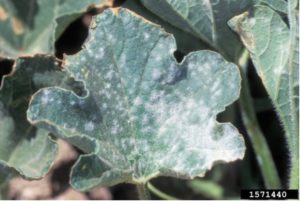 Figure 1. Powdery mildew growth on a leaf. Gerald Holmes, California Polytechnic State University at San Luis Obispo, Bugwood.org
Crop rotation is not usually effective for controlling powdery mildew on melons.1 However, some production guides indicate that crop rotation and fall tillage can help delay the onset of epidemics in some areas.2,3,4 Host resistance to both powdery mildew species is available in melon varieties.1 Seminis® uses the designation Px to indicate resistance to Podosphaera xanthii and Gc to indicate resistance to Golovinomyces cichoracearum. Px resistance can be race- specific, and a designation of Px-1 indicates a variety with resistance to P. xanthii race 1.
Fungicides may be needed even with varieties that have some resistance to powdery mildew. Initiate treatments when the disease is first detected in the region. Fungicides need to reach the undersides of leaves and leaves in the lower canopy. Adjust sprayers to provide maximum coverage and use mobile (systemic, translaminar, or volatile) fungicides.1,4 A number of protectant and mobile fungicides are available for powdery mildew on melons. However, resistance has developed to some fungicide groups. When using a fungicide that has a higher risk for resistance to develop, apply the fungicide with a protectant fungicide and alternate applications of fungicides in different MOA groups.1,2,4
MONOSPORASCUS ROOT ROT
Monosporascus root rot is also called vine decline and sudden wilt. Plants can be infected early in the season, but symptoms usually develop late in the season, 1 to 3 weeks before harvest.1,2 Symptoms appear first on older crown leaves, which become chlorotic and then rapidly collapse and die. The symptoms progress toward the tips of vines, and total plant collapse can occur within 5 to 10 days. Lesions develop on the primary and secondary roots of affected plants. The lesions are distinct, reddish- brown, and often dry. Black, spherical fungal fruiting bodies may develop on infected roots very late in the season, sometimes after harvest (Figure 2).1,2
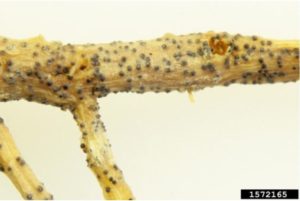 Figure 2. Fruiting structures of Monosporascus on roots. Gerald Holmes, California Polytechnic State University at San Luis Obispo, Bugwood.org
Avoid planting in areas known to be infested with the pathogen and avoid excessive irrigation. Direct-seeded plants often develop root systems that can better tolerate the disease. Preplant soil fumigation is sometimes used on fields with a history of vine decline, but this may only be minimally effective.1,2 The application of fungicides (such as fludioxonil) through a drip irrigation system early in the season has been shown to provide some control.1 To prevent the buildup of inoculum for future plantings, cultivate the field after harvest to destroy and dry the infected roots.1
ROOT-KNOT NEMATODES
Several species of root-knot nematodes can infect and damage melon roots. Patches of stunted, chlorotic plants develop in the field. Infected plants can wilt during the heat of the day.1 Root symptoms include the formation of wart-like galls, singly or in clumps, giving the roots a knobby appearance with few feeder roots (Figure 3).
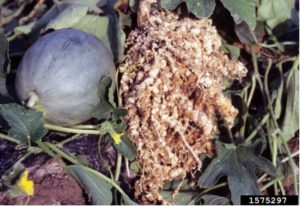 Figure 3. Root-knot symptoms on melon roots. Gerald Holmes, California Polytechnic State University at San Luis Obispo, Bugwood.org
Root-knot nematodes have a wide host range (infecting over 2,000 different plants). Therefore, crop rotation is not an effective management strategy.1 Pre-plant soil fumigation with nematicidal fumigants, such as 1,3-dichloropropene (Telone® II) and metam sodium (Vapam® HLTM Soil Fumigant), can effectively reduce populations of root-knot nematodes and control the disease. Applications of oxamyl (DuPontTM Vydate® L Insecticide/Nematicide) at planting followed by foliar application during the season can also effectively manage the disease.3
CUCURBIT YELLOW STUNTING DISORDER
Cucurbit yellow stunting disorder (CYSD), caused by the Cucurbit yellow stunting disorder virus (CYSDV), is transmitted primarily by the silverleaf whitefly.1 Following infection, it can take up to three weeks for symptoms to develop. Initial symptoms include mottling of leaves followed by interveinal chlorosis and foliar yellowing (Figure 4). These symptoms are most prominent on older leaves.1 With time, the leaves may start to roll upward and become brittle. Infected plants show reduced vigor, and the fruit on these plants have reduced sugar content making them unmarketable.
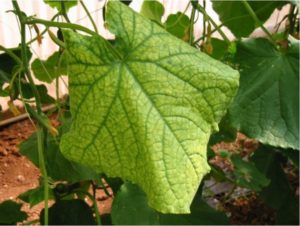 Figure 4. Foliar symptoms of Cucurbit yellow stunting disorder.
Management of CYSD is focused mostly on controlling the whitefly vector. If possible, time plantings to avoid periods with large whitefly populations. Whiteflies can be excluded in protected culture systems with the use of 50-52 mesh (297 micron) screens and in field planting with the use of early- season mesh tunnels. The tunnels need to be removed prior to flowering. Preventative applications of insecticides during transplant production can reduce the incidence of CYSD, but field applications of insecticides are usually not effective for managing virus spread.1
CUCUMBER GREEN MOTTLE MOSAIC
(CGMM) is caused by the Cucumber green mottle mosaic virus (CGMMV). This virus is very stable and can survive in infested crop debris. It is easily transmitted by workers and on equipment. It has also been shown to be transmitted by honey bees in net-house culture systems, and this virus can be seedborne.1,5
The symptoms of CGMM are similar to those of other mosaic virus diseases of melons.6 Initial symptoms appear on leaves one to two weeks after infection. A dark- green mottling develops on leaves, and young leaves may show vein clearing and crumpling deformation (Figure 5). Infected plants are stunted.1,6 Fruit on infected plants may show some spotting or streaking and be distorted, especially at high temperatures.
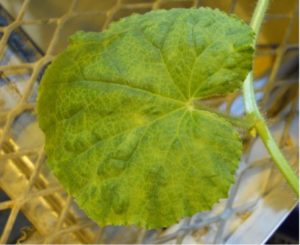 Figure 5. Foliar symptoms of Cucumber green mottle mosaic. Tera Pitman, UC Davis.
Plant only seed or transplants obtained from reputable sources. During transplant production, inspect seedlings regularly for disease symptoms. Verify suspected infections with lab tests or test kits. Remove and destroy all seedlings within 3 to 5 feet of infected plants. Sanitize trays, benches, and tools with 10% bleach or other disinfectants. In field and greenhouse systems, workers should wash their hands before and after working with plants. Minimize the handling of seedlings for the first few weeks after transplanting.1,6
SOURCES
1 Keinath, A., Wintermantel, W., and Zitter, T. 2017. Compendium of cucurbit diseases and Pests. American Phytopathological Society. St. Paul, MN.
2 Davis, R., Turini, T., Aegerter, B., and Stapleton, J. 2012. UC IPM pest management guidelines: Cucurbits. UC ANR Publication 3445.
3 Egel, D., Foster, R., Maynard, E., Weller, S., Babadoost, M., Nair, A., Rivard, C., Kennelly, M., Hausbedk, M., Hutchinson, B., Eaton, T., Welty, C., and Miller, S. 2017. Midwest vegetable production guide for commercial growers 2017.
4 Reiners, S., Bellinder, R., Curtis, P., Helms, M., Landers, A., McGrath, M., Nault, B., and Seaman, A. 2017. Cornell integrated crop and pest management guidelines for commercial vegetable production.
5 Darziab, E., Smitha, E., Shargila, D., Lachmana, O., Ganotc, L., and Dombrovskya, A. 2017. The honeybee Apis mellifera contributes to Cucumber green mottle mosaic virus spread via pollination. Plant Pathology Doi: 10.1111/ppa.12702.
6 American Seed Trade Association. 2014. Cucumber green mottle mosaic virus: A seed production and commercial growers guide.
ADDITIONAL INFORMATION
For additional agronomic information, please contact your local seed representative. Developed in partnership with Technology Development & Agronomy by Monsanto.
Individual results may vary, and performance may vary from location to location and from year to year. The information provided in this communication may not be an indicator of results you may obtain as local growing, soil and weather conditions may vary. Growers should evaluate data from multiple locations and years whenever possible. ALWAYS READ AND FOLLOW PESTICIDE LABEL DIRECTIONS. The recommendations in this article are based upon information obtained from the cited sources and should be used as a quick reference for information about melon diseases. The content of this article should not be substituted for the professional opinion of a producer, grower, agronomist, pathologist and similar professional dealing with this specific crop.
SEMINIS DOES NOT WARRANT THE ACCURACY OF ANY INFORMATION OR TECHNICAL ADVICE PROVIDED HEREIN AND DISCLAIMS ALL LIABILITY FOR ANY CLAIM INVOLVING SUCH INFORMATION OR ADVICE. 170826153020 120117DME
Seminis® is a registered trademark of Seminis Vegetable Seeds, Inc. All other trademarks are property of their respective owners. © 2017 Seminis Vegetable Seeds, Inc. All rights reserved.