- West / East Africa
- expand_more

-
Products
-
Knowledge Center

Are you ready to take your farming game to the next level? Learn why crop rotation is more than just a farming practice—it's a game-changer for sustainable farming!
-
About

Learn more about us
-
Innovation

Learn about our approach to innovation.
Causal Agent
Fulvia fulva
(syn: Cladosporium fulvum)
Many physiological races have been reported.
Distribution
Worldwide
Symptoms
The first symptoms appear as light green to yellowish areas on the upper surface of the older leaves. This coincides with the development of masses of olive green fungal conidia on the lower leaf surface. As the disease progresses, the lower leaves turn yellow and drop off. The fungus typically occurs on leaves, but the stems, blossoms and fruit may also become infected. Infected fruit develop a black leathery rot on the calyx end. Although this disease occurs in the field, it is mainly a problem in greenhouses where it can spread rapidly under favorable conditions.
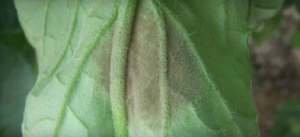 Sporulating lesion.
Conditions for Development
This fungus is an efficient saprophyte and can survive as conidia and sclerotia in the soil and plant debris for at least one year. The conidia are readily dispersed by wind and rain. Dissemination can also occur on workers’ clothing and equipment. High (90%) relative humidity and warm (24°C, 75°F) temperatures are optimal for disease development. However, disease can occur between 10-32°C (50-90°F). Leaf mold will not develop if the relative humidity is less than 85%.
Control
A good fungicide spray program, as well as providing adequate air movement and heating to reduce the relative humidity to less than 85%, can be effective in reducing losses from this disease. Resistant varieties should be used when possible, however, the extreme diversity of the fungus often makes this difficult.