- West / East Africa
- expand_more

-
Products
-
Knowledge Center

Are you ready to take your farming game to the next level? Learn why crop rotation is more than just a farming practice—it's a game-changer for sustainable farming!
-
About

Learn more about us
-
Innovation

Learn about our approach to innovation.
Causal Agent
Phytophthora porri
Distribution
Worldwide
Symptoms
Initial infection mainly occurs at the leaf tip and less frequently between the leaf tip and mid-leaf. Disease first appears as water-soaked spots that expand into lesions. Lesion margins remain watersoaked as affected tissue wilts and dries to the bleached white appearance for which this disease is named. When environmental conditions favor disease development, secondary lesions elongate to the base of the leaf. Crop losses are generally due to reduced plant weight in leek and storage rot of onion bulbs. Total crop loss may occur under severe disease pressure.
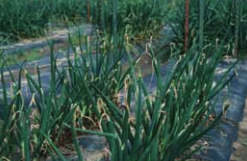 Advanced leaf tip dieback.
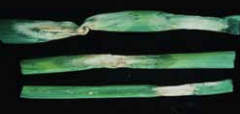 Leaf lesions showing tissue collapse.
Conditions for Development
Phytophthora porri oospores can survive for years in soil. High humidity and rainfall combined with low temperatures [15°C (59°F)] favor disease development. This disease tends to be more severe in fields with poor drainage. Once the disease is established, wind-borne and water-splashed sporangia and zoospores are easily spread.
Control
Avoid sprinkler irrigation. Rotation to nonhost crops helps to reduce soil inoculum levels and losses from this disease. Some fungicides may be efficacious during early stages of infection.