



Causal Agent
Xanthomonas axonopodis pv. allii
Distribution
Brazil, the Caribbean, Japan, Reunion Island (France), South Africa, USA and Venezuela
Symptoms
Symptoms first appear as white to tan flecks, light-colored spots and/or lenticular lesions surrounded by water-soaking. Lesions rapidly enlarge, turning tan to brown with extensive water-soaking. As the disease progresses, lesions coalesce into dry necrotic areas of tip dieback. Typically, blighting of outer, older leaves leads to plant stunting and undersized bulbs. When conditions are favorable for disease, all leaves may become completely blighted and plant death may follow. Symptoms in leek, shallot, chives, and garlic are similar to those in onion but are less severe. Short-day onion varieties may develop symptoms at any stage of crop development, and long-day onion varieties usually develop symptoms during or after bulb-initiation.
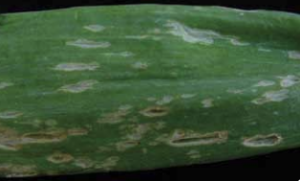 Lenticular lesions on an onion leaf.
Conditions for Development
Disease is favored by temperatures above 26°C (80°F). Frequent rains and high humidity promote disease development. Severe outbreaks are often associated with heavy rain, hail and wind-blown sand that damages foliage. Symptoms usually appear 7-10 days later. Spread of the pathogen within and between fields occurs with both overhead and furrow irrigation and movement of residual onion debris by field equipment. Xanthomonas axonopodis pv. allii is also seed-transmitted. Frequent rains and overhead irrigation can initiate an epidemic from contaminated seed in semi-arid environments. The bacterium survives on contaminated seed, in infested crop debris and as an epiphyte or pathogen on volunteer onions, legumes and weeds.
Control
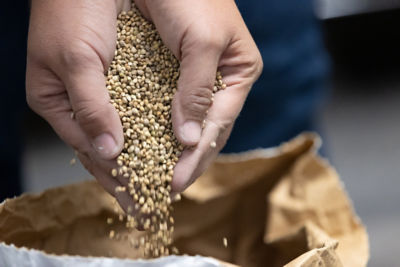
Use only clean seed or transplants. Rotate to non-hosts for at least two years. Do not plant onion or garlic after dry beans, soybeans or alfalfa which may harbor this pathogen. Control volunteer onions and weeds in and around fields. During the growing season avoid overhead irrigation and excessive nitrogen fertilization. Copper bactericides alone or in combination with recommended fungicides can be effective in semi-arid regions when applied prior to the onset of symptoms. Incorporate crop debris into soil promptly after harvest.