

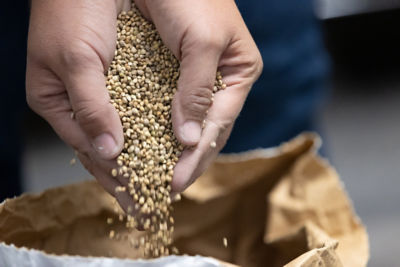


Causal Agent
Pseudomonas syringae pv. porri
Distribution
Canada, Europe, New Zealand and USA
Symptoms
The disease first appears as dark-green, longitudinal, water-soaked lesions that form at leaf tips and edges. As they elongate, lesions turn orange to brown with surrounding chlorosis and may extend as a narrow strip from leaf tip to the sheath. When a lesion extends into the sheath, the affected leaf turns light-green, curls, splits and eventually wilts and dies. Severely affected plants are misshapen, undersized and cannot be harvested.
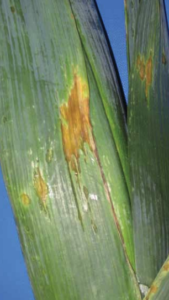 Elongate orange to brown lesions with surrounding chlorosis.
Conditions for Development
Infested seed and infected leek debris from a previous crop are both sources of primary inoculum. The bacterium may infect but remain latent in the plant until environmental conditions favor development of disease. Generally, warm temperatures and high humidity encourage symptom expression and disease spread.
Control
Sow only clean seed. During the growing season, limit overhead irrigation and avoid mowing the crop when plants are wet with dew or rain. Removing infected plants and plant debris throughout the season and rotating to a non-host help mitigate the risk of disease. Apply soil amendments as needed to increase soil pH to at least 5.5 to reduce the chance of infection.