
-
Szegmensek és fajták
-
Tudástár

Termesztési tippeket keres?
-
Rólunk

Tudjunk meg többet rólunk
-
Innováció

Innovatív megoldásainkról
Biocontrol of Pests of Greenhouse Grown Peppers
Click here to download a PDF version of this spotlight.
» Natural enemies can be released in pepper greenhouses to help manage aphids, mites, and thrips.
» Predatory mites and parasitoid wasps can be purchased from commercial sources.
» The life cycles and developmental stages of the plants, pests, and natural enemies need to be considered to set up an
effective management system.
METHODS OF BIOCONTROL
The use of natural enemies, including insect and mite species, to reduce populations of pests on peppers has been shown to be an effective management strategy in greenhouse pepper production. Natural enemies include predators that prey on insect and mite pests and parasitoids that lay their eggs in insect hosts. Some predators are generalists, eating a wide variety of prey species, while others are specialists, eating only certain types of prey. An individual predator eats many prey and can quickly lower pest populations. Parasitoids usually lower pest populations more gradualy. The larvae that emerge from the eggs eventually kill their hosts, and each larva kills only one host in its lifetime.1
In protected culture systems, commercially produced natural enemies (predators and parasitoids) are usually released into the greenhouse, a process called augmentation. Greenhouses are well suited for using augmentation because the enclosed nature of the houses helps keep the released natural enemies in the vicinity of the crop plants. Greenhouses and high tunnels that have insect-proof screens covering vents and windows are better able to prevent the released natural enemies from leaving the enclosure. The choice of which natural enemies to use and when to release them should be based on the lifecycle and developmental stages of the crop plants, the pests, and the natural enemies. Some predators and parasitoids can feed on plant nectar and pollen, so they can survive even when the populations of their target pests are low if the plants are flowering.2
Others require moderate to high pest populations to survive. Environmental conditions should also be considered, as natural enemy species differ in the ranges of temperature and humidity that they can tolerate and in which they are most active.
APHID MANAGEMENT
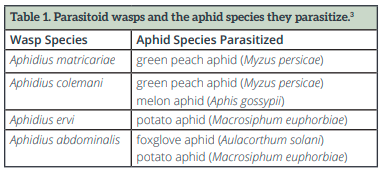
The green peach aphid is the most common aphid pest of greenhouse-grown peppers. Other species that affect peppers include potato aphids, melon aphids, and foxglove aphids.3 Unfortunately, individual biocontrol agents are not equally effective against all of these aphid species. Therefore, the correct identification of the aphids that are present is important. A program of biological control may involve a combination of parasitoid and predator releases, based on the size of the aphid populations. Parasitic wasps in the genus Aphidius can be released weekly, starting early in the crop cycle to help keep aphid populations in check. The wasp species to use will depend on the aphid species present (Table 1). A recommended rate of application for Aphidius colemani is 0.25 wasps/m2 of greenhouse space for preventative control. For management of small, established populations, a rate of 1 wasp/m2 of space applied in three weekly releases is recommended. For managing high aphid populations, 2 wasps/m2 applied in six weekly releases may be necessary.
When aphid populations start to build, green lacewings (members of the insect family Chysopidae) can be released. The green lacewing larvae are predators of small, soft-bodied arthropods, including aphids, scale insects, whiteflies, thrips, and insect eggs (Figure 1). The adults of some green lacewing species are also predators, while others feed on pollen. Green lacewings should be used as spot treatments in areas of aphid infestation. Green lacewings are sold commercially as eggs, larvae, pupae, and adults, but the larval stage is R recommended for greenhouse settings.4,5 Weekly applications of 5 to 10 larvae/m2 are recommended for managing small aphid infestations. For larger infestations releases of 10 to 20 larvae/m2 may be needed.
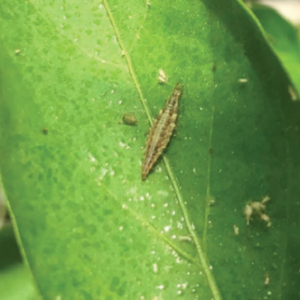 Figure 1. A green lacewing larva.
If aphid populations start to get very high, then lady beetles (ladybird beetles or ladybugs) can be released in hot spots to manage rapid population increases. Several species of lady beetles are available, including the Asian lady beetle (Harmonia axyridis), the convergent lady beetle (H. convergens), and the two-spotted lady beetle (Adalia bipunctata). Repeated introductions of lady beetles throughout the season may be necessary to adequately manage aphid outbreaks.3
MITE MANAGEMENT
Both spider mites and broad mites can be damaging to greenhouse-grown peppers, with the two-spotted spider mite being the most common mite pest on peppers in the greenhouse. These mites can usually be managed by releases of predatory mites. There are several genera and species of predatory mites, and they vary in their specificity for prey and the temperature ranges that they can tolerate. The swirski mite (Amblyseius swirskii) is a generalist predator that feeds on mites, whitefly and thrips larvae.
The swirski mite tolerates temperatures in the range of 64° to 96°F. Swirski mites can be applied as adults or as a combination of adults and eggs, which will providing protection over a longer period of time. For preventative control, a release rate of 25 mites/m2 is recommended. To manage small, established infestations a rate of 50 mites/m2 is recommended, and a rate of 100 to 300 mites/m2 may be needed to manage larger infestations.
Phytoseiulus persimilis is another predacious mite that feeds specifically on spider mites, including the two-spotted spider mite. Phytoseiulus persimilis should be introduced to the greenhouse as soon as mites are detected. Once established, P. persimilis can control spider mites for the remainder of the season in some situations. However, they will disperse or starve if they do not have spider mites to feed on. Repeated releases every 7 to 14 days may be necessary to maintain effectiveness. They tolerate temperatures from 68° to 90°F.3
If spider mite populations are low, the release of other predatory mites, such as Neoseiulus californicus (also called Amblyseius californicus), can help with spider mite management. This predacious mite prefers to feed on spider mites; however, it will also feed on other types of mites, small insects, thrips, and pollen when necessary. They are slow feeders, effective against low mite populations. Neoseiulus californicus can tolerate a wide range of temperatures (50° to 105°F), so they remain active at higher temperatures when other predator mites are no longer effective.3,6
THRIPS MANAGEMENT
Western flower thrips (Fankliniella occidentalis) and onion thrips (Thrips tabaci) can infest greenhouse-grown peppers. These thrips feed on the pepper fruit, and the resulting damage can make the fruit unmarketable. In addition, these thrips are vectors of Tomato spotted wilt virus (TSWV), which can be devastating to pepper production. Swirski mites (Amblyseius swirskii) can be used to feed on the larval stages of thrips. They can also feed on pollen and plant nectar, which allows them to survive when pest populations are low. Swirski mites are adapted to warmer temperatures (64° to 96°F), and they do best in humid conditions.3,7 One strategy is to apply adult swirski mites repeatedly (weekly) from transplanting to bloom. Once the plants start to bloom, a final application of a formulation that includes both adults and eggs can be used as a slow release product. This application is intended to establish a population that will last for the rest of the season. Some growers may choose to only use a single application of the the slow release product (adults + eggs) to lower costs, but additional applications may be needed if populations do not become established.
Other predatory mites that feed on thrips include Amblyseius degenerans, Amblyseius cucumeris, Hypoaspis miles, and Hypoaspis aculeifer. Predatory bugs in the genus Orius, including O. insidiosus, O.laevigatus, and O. albidipennis, are also useful for managing thrips in peppers (Figure 2).8
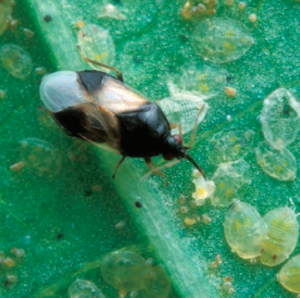 Figure 2. A tiny pirate bug, Orius insidiosus, feeding on whitefly nymphs. Jack Dykinga, USDA-ARS.
IPM
The use of natual enemies to manage insect and mite pests of peppers should be used as part of an integrated pest management (IPM) system. Pest populations should be monitored through the use of scouting and monitoring traps, such as sticky traps. Some management practices are implemented prior to pests showing up, while others are put into place once the pest levels have reached an action threshold. Treatment with insecticides that are compatible with the use of natural enemies may be necessary in some situations.
SOURCES
1 Lee, J. and Landis, D. 2000. Natural enemies in your garden: A homeowner’s guide to biological control. Michigan State University. Extension Bulletin 2719.
2 Barbercheck, M. Biological control of insect pests. eOrganic. https://eorganic.org/node/919.
3 Pests of greenhouse sweet bell peppers and their biological control. https://www.alberta.ca/pests-of-greenhouse-sweet-bell-peppers and-their-biological-control.aspx.
4 Strange, L. 2015. Featured creatures: Green lacewings (of Florida). UFIFAS Entomology and Nematology. Publication Number: EENY-534.
http://entnemdept.ufl.edu/creatures/BENEFICIAL/green_lace ings.htm.
5 Vegetable pest and beneficial insect profiles. VegEdge. University of Minnesota. https://www.vegedge.umn.edu/pest-profiles/pests.
6 Rhodes, E., and Liburd, O. 2015. Featured creatures: Neoseiulus californicus. UFIFAS Entomology and Nematology. Publication Number: EENY-359. http://entnemdept.ufl.edu/creatures/beneficial/Neoseiulus_californicus.htm.
7 Dogramaci, M., Kakkar, G., and Kumar, V. 2016. Featured creatures: Swirski mite. UFIFAS Entomology and Nematology. Publication Number: EENY 565. http://entnemdept.ufl.edu/creatures/BENEFICIAL/swirksi_mite.htm.
8 Silveira, L., Bueno, V., van Lenteren, J. 2004. Orius insidiosus as biological control agent of thrips in greenhouse chrysanthemums in the tropics. Bulletin of Insectology 57: 1-6.
Websites verified 9/30/2020
ADDITIONAL INFORMATION
For additional agronomic information, please contact your local seed representative.
Performance may vary from location to location and from year to year, as local growing, soil and weather conditions may vary. Growers should evaluate data from multiple locations and years whenever possible and should consider the impacts of these conditions on the grower’s fields. The recommendations in this article are based upon information obtained from the cited sources and should be used as a quick reference for information about pepper production.
The content of this article should not be substituted for the professional opinion of a producer, grower, agronomist, pathologist and similar professional dealing with this specific crop.
BAYER GROUP DOES NOT WARRANT THE ACCURACY OF ANY INFORMATION OR TECHNICAL ADVICE PROVIDED HEREIN AND DISCLAIMS ALL LIABILITY FOR ANY CLAIM INVOLVING SUCH INFORMATION OR ADVICE.
9064_SE_S3 Published 11-03-2020